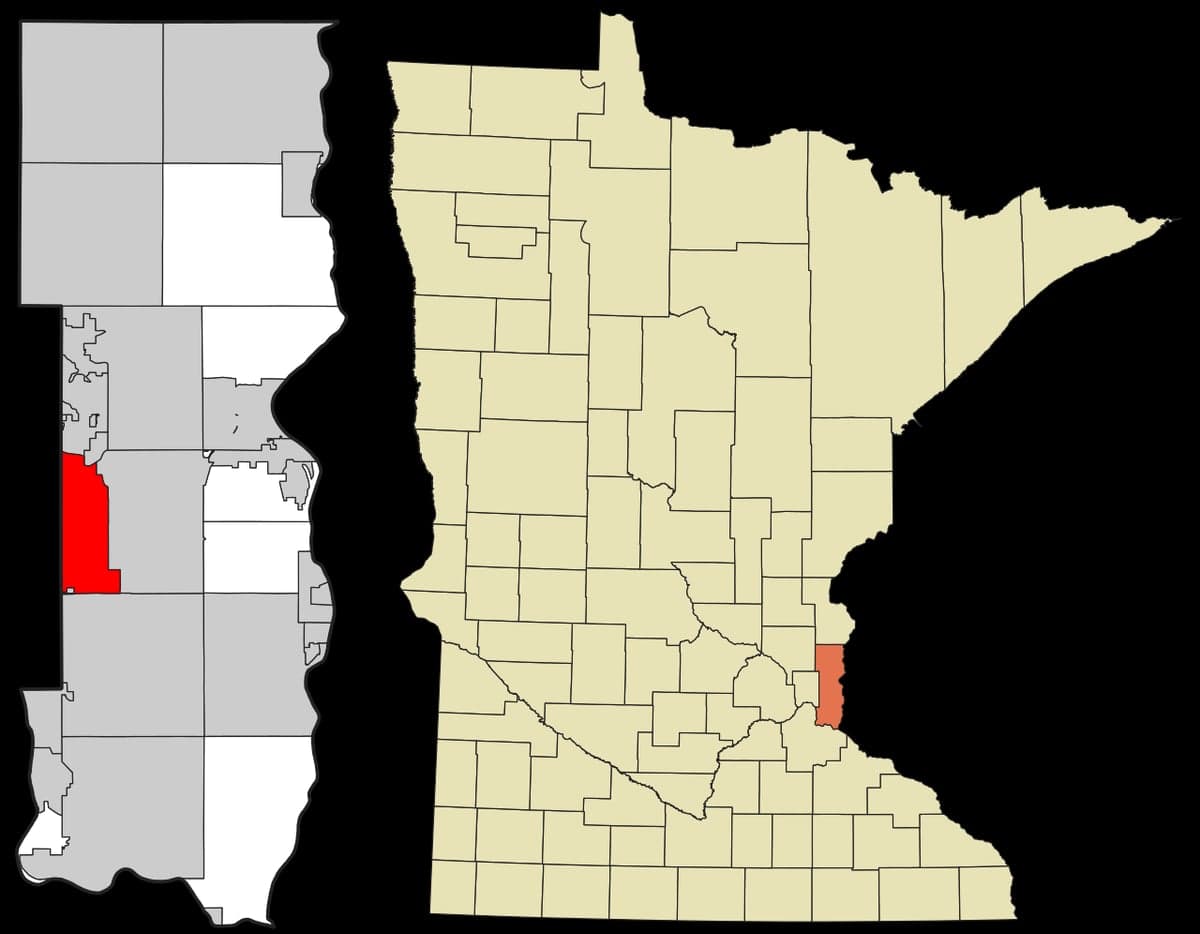
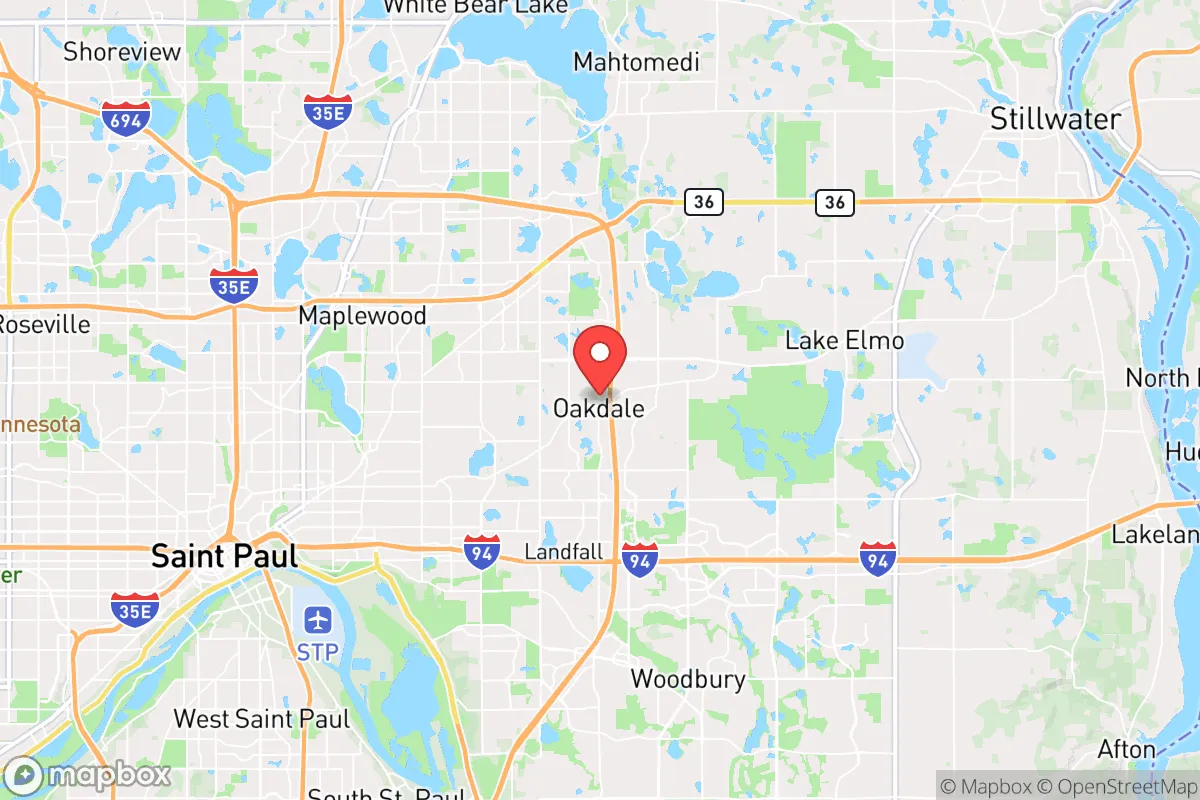
Photo: Wikipedia
Demographics of Oakdale, MN
Affluence Level in Oakdale, MN
A middle-class area roughly in line with national averages across income, home values, education, and employment.
People of Oakdale, MN
The people of Oakdale, Minnesota, today form a predominantly white (67.4%) but increasingly diverse suburban community of 28,109 residents, characterized by a strong East and Southeast Asian presence (12.6%) and a notable Black population (8.6%). The city is a middle-class, family-oriented suburb with a college-educated rate of 33.6% and a very low foreign-born share of just 2.3%, indicating that most diversity comes from second-generation and longer-established families rather than recent immigration. Oakdale’s identity is shaped by its post-war suburban growth, a stable housing stock, and a population that is quietly diversifying without the rapid churn seen in some Twin Cities suburbs.
How the city was settled and grew
Oakdale’s human history begins not with a founding village but with the forced displacement of the Dakota people following the U.S.-Dakota War of 1862, after which European-American settlers—primarily German, Irish, and Swedish farmers—claimed the land under the Homestead Act. The area remained sparsely populated agricultural land until the mid-20th century, with no real town center. The first significant residential wave came in the 1950s and 1960s, when returning WWII veterans and their families moved into newly built subdivisions like Oakdale Heights and Glendale, drawn by affordable land and proximity to emerging industrial jobs in St. Paul and the 3M headquarters in nearby Maplewood. These early subdivisions were almost entirely white, with a mix of working-class and middle-class families, and they established Oakdale’s character as a quiet, car-dependent bedroom community.
Modern era (post-1965)
The post-1965 immigration reforms had a delayed but noticeable effect on Oakdale. Unlike inner-ring suburbs that absorbed waves of Hmong and Somali refugees in the 1980s and 1990s, Oakdale’s diversification came later and more gradually, driven by domestic migration from Minneapolis and St. Paul rather than direct foreign settlement. The Oakdale Village and Tamarack Hills neighborhoods saw an influx of Black and East/Southeast Asian families—many of Hmong and Vietnamese heritage—who moved from the core cities seeking better schools and larger lots. The Asian population, now 12.6%, is concentrated in these areas, while the Black population (8.6%) is more evenly spread across the city’s post-1970s subdivisions. The Hispanic share (4.9%) is smaller and more scattered, with no single ethnic enclave. The Indian subcontinent population remains negligible at 0.4%, reflecting Oakdale’s lack of the tech-sector pull that draws South Asians to suburbs like Eden Prairie or Eagan. Notably, the foreign-born share is only 2.3%, meaning nearly all of Oakdale’s diversity is native-born—a sign of stable, multigenerational communities rather than a revolving door of new arrivals.
The future
Oakdale’s population is heading toward slow, steady diversification rather than rapid transformation. The white share, while still a majority, is declining gradually as older residents age in place and younger, more diverse families move into neighborhoods like Oakwood Estates and Sunrise Ridge. The East and Southeast Asian communities are likely to grow modestly through natural increase and some secondary migration from the Twin Cities, but the city lacks the job base or ethnic infrastructure to become a major destination for new immigrants. The Black population is also expected to rise incrementally, driven by domestic moves from Minneapolis and St. Paul. The Hispanic share may increase slightly but will likely remain a small minority. Oakdale is not tribalizing into distinct ethnic enclaves; instead, it is homogenizing into a broadly middle-class, multiethnic suburb where no single minority group dominates any neighborhood. The next 10–20 years will likely see Oakdale become slightly less white, slightly more Asian and Black, and remain a stable, family-oriented community with low turnover.
For someone moving in now, Oakdale is becoming a quietly diverse, middle-class suburb where demographic change is gradual and integration is the norm. It offers a stable, safe environment with good schools and a population that is slowly reflecting the broader Twin Cities’ diversity, but without the rapid churn or ethnic clustering seen in some neighboring communities. The city’s future is one of incremental change, not transformation—a place where newcomers will find a settled, family-focused population that is neither homogenously white nor sharply divided by ethnicity.

* Values derived from national, state, county, city and local statistics and may differ in a specific area. Last updated: 2026-04-24T15:57:05.000Z
Narrative content on this page is AI-generated and may contain mistakes. Verify any details that matter before acting on them.
ReloMaps may earn a commission from affiliate links at no extra cost to you.

