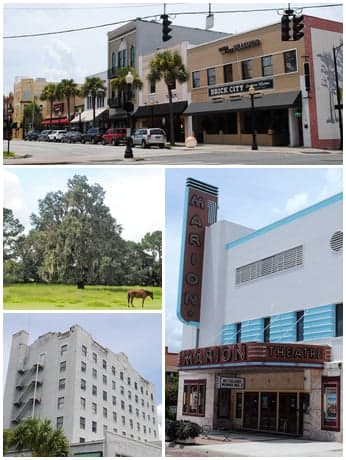
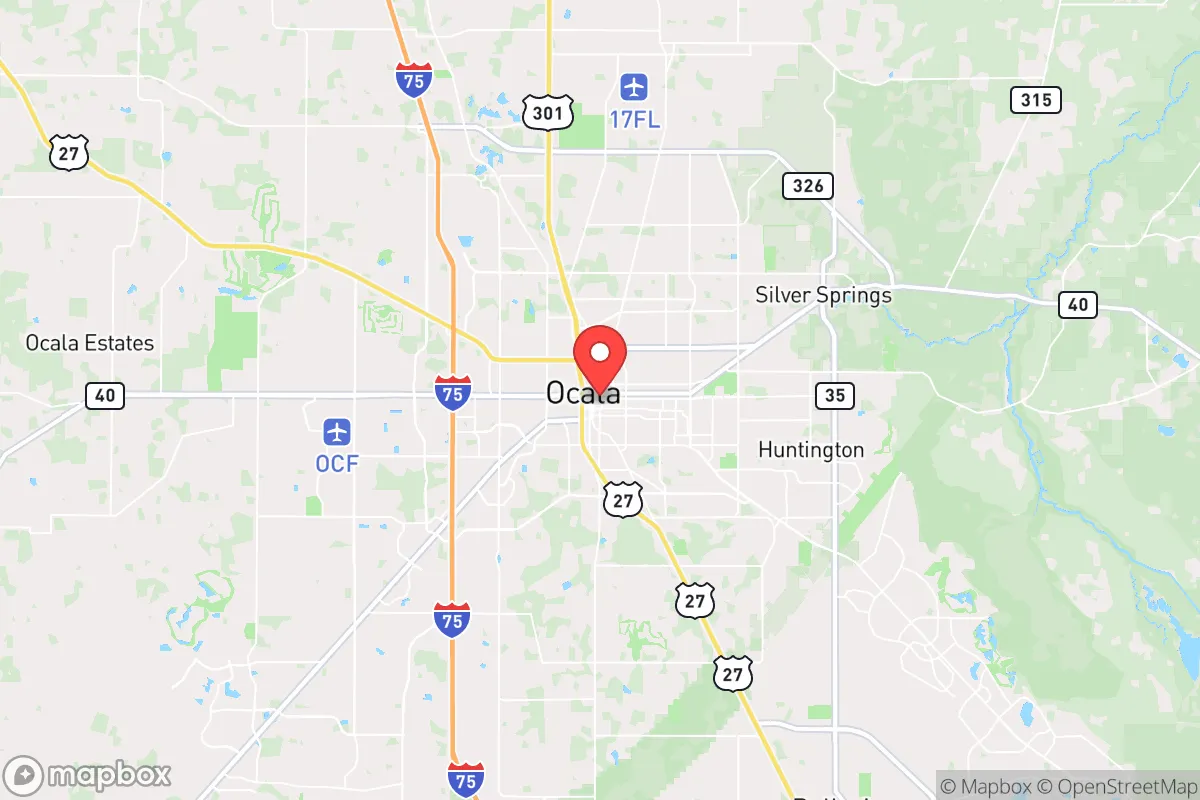
Photo: Wikipedia
Demographics of Ocala, FL
Affluence Level in Ocala, FL
A below-average socioeconomic profile. Incomes, home values, and educational attainment trail the U.S., with higher poverty and unemployment.
People of Ocala, FL
Ocala, Florida, is a city of roughly 65,000 residents that retains a distinctly Southern, small-town character even as it absorbs rapid growth from retirees and remote workers. Its population is majority-white (57.8%) with a significant Black minority (18.7%) and a fast-growing Hispanic community (16.3%), creating a demographic mix that is more diverse than the surrounding rural counties but less so than Florida’s coastal metros. The city’s identity is rooted in its historic role as a horse-farming and citrus center, and today it balances a conservative, family-oriented culture with an influx of newcomers seeking affordable land and a slower pace of life.
How the city was settled and grew
Ocala was founded in 1846 as a trading post for cotton and citrus farmers, drawing its first permanent settlers from Georgia and the Carolinas. These early arrivals were largely white yeoman farmers who claimed land under the Armed Occupation Act of 1842, which granted 160 acres to settlers willing to improve and defend the frontier. The city’s historic Fort King Street corridor and the Downtown Ocala district were built by these families, who established the area’s agricultural economy. After the Civil War, freed Black families formed their own communities, most notably in the West Ocala neighborhood, which became a hub for African American businesses, churches, and schools during Reconstruction and Jim Crow. By 1900, Ocala’s population was roughly 40% Black, a share that persisted until the Great Migration drew many Black residents northward. The arrival of the railroad in the 1880s brought a small wave of European immigrants—primarily Irish and Italian laborers—who settled in the Silver Springs Shores area, then a separate rural settlement. The city remained a sleepy agricultural town through the mid-20th century, with its population barely topping 10,000 by 1950.
Modern era (post-1965)
The post-1965 period reshaped Ocala’s population through two main forces: domestic in-migration from the Northeast and Midwest, and a gradual diversification driven by immigration reform. The opening of Interstate 75 in the 1970s made Ocala a viable bedroom community for Gainesville and Orlando, attracting white retirees and working-class families to new subdivisions like On Top of the World (a 55+ community) and Marion Oaks, a sprawling master-planned development. These areas remain overwhelmingly white and politically conservative. Meanwhile, the Hispanic population began growing in the 1990s, driven by Puerto Rican families moving from the Northeast and Mexican immigrants recruited for construction and landscaping work. Today, the Pine Run Estates area and parts of South Ocala have visible Hispanic concentrations, with bodegas and Spanish-language churches. The Black population, which had declined to about 15% by 1980, rebounded to 18.7% as younger Black families moved from nearby cities like Jacksonville and Orlando for lower housing costs. The Asian population remains small (1.2% East/Southeast Asian, 2.4% Indian), concentrated among professionals in the healthcare and veterinary sectors, with no single ethnic enclave. The Indian community, notably, is dispersed across newer subdivisions like Stone Creek rather than clustering in a historic neighborhood.
The future
Ocala’s population is projected to grow by roughly 20% over the next decade, driven by continued domestic migration from high-cost states like California and New York. This influx is likely to make the city more white and more affluent, as newcomers tend to be retirees and remote workers with above-average incomes. The Hispanic share is expected to rise slowly, possibly reaching 20% by 2035, as second-generation Puerto Rican families remain and new arrivals from Central America settle in the service economy. The Black share appears stable, with growth from natural increase offset by out-migration of younger Black residents to larger metros. The Indian and East/Southeast Asian communities are likely to remain small but grow modestly as the University of Florida’s Health system expands its Ocala campus, drawing medical professionals. The city is not tribalizing into distinct ethnic enclaves; rather, it is homogenizing into a predominantly white, conservative-leaning suburb with a sizable Black and Hispanic minority that is residentially integrated at the block level. New construction in NW Ocala and the 441 corridor is attracting a mix of white and Hispanic families, while the historic West Ocala neighborhood remains predominantly Black but is gentrifying slowly as downtown redevelopment pushes outward.
For someone moving to Ocala now, the city offers a stable, family-oriented environment with a clear conservative majority and a growing but still small immigrant presence. The population is becoming whiter and wealthier at the margins, but the core demographic—white, native-born, and politically conservative—remains firmly in control. Newcomers should expect a community that values tradition, low taxes, and outdoor recreation, with a demographic trajectory that reinforces rather than disrupts those priorities.

* Values derived from national, state, county, city and local statistics and may differ in a specific area. Last updated: 2026-04-19T06:59:22.000Z
Narrative content on this page is AI-generated and may contain mistakes. Verify any details that matter before acting on them.
ReloMaps may earn a commission from affiliate links at no extra cost to you.

