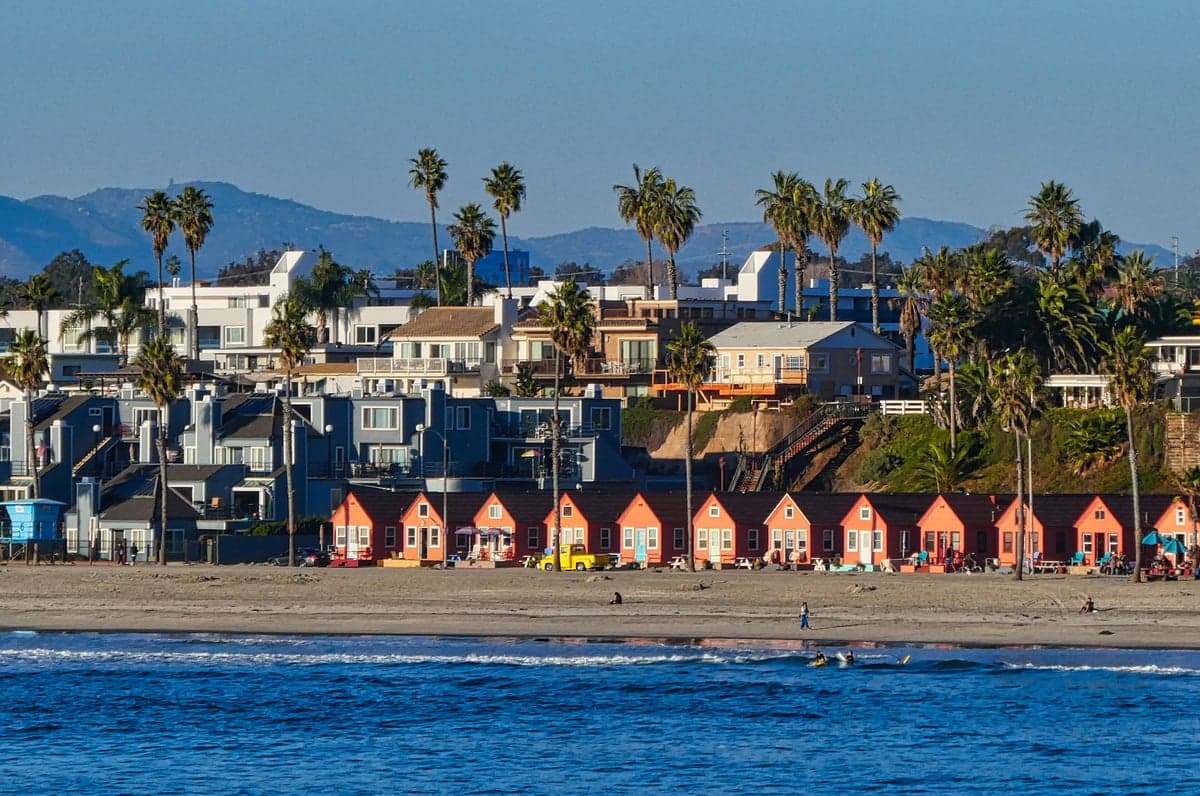
Photo: Wikipedia
Personal Sovereignty in Oceanside, CA
Moderate friction. Expect trade-offs in some aspect of personal liberty and independence.
What does Personal Sovereignty tell us?
Personal Sovereignty measures your capacity for self-reliance and independence with minimal government friction. Higher scores mean fewer barriers between you and the way you want to live... but it assumes you have the space you need and good neighbors.
What does this tell us?
Personal Sovereignty measures your capacity for self-reliance and independence with minimal government friction. Higher scores mean fewer barriers between you and the way you want to live... but it assumes you have the space you need and good neighbors.
State Policy
Energy independence: Importer (33% of energy produced in-state)
Personal Liberty
Homesteading

Personal Liberty Analysis
Oceanside, California, presents a complex and often contradictory environment for personal sovereignty, where the promise of coastal living and a strong military community clashes with one of the nation's most aggressive state-level regulatory apparatuses. For the survivalist or prepper evaluating this city, the calculus is stark: you gain proximity to a resilient, defense-oriented population and a temperate climate that supports year-round subsistence, but you do so under the thumb of California’s expansive government, which consistently ranks among the worst in the nation for personal autonomy. The city itself, with its large Marine Corps base at Camp Pendleton, fosters a culture of self-reliance and preparedness, yet the legal and tax framework in which it sits systematically erodes the very independence that mindset requires. This analysis breaks down the key sovereignty factors—tax burden, self-defense law, homesteading feasibility, and personal liberties—to give you a clear-eyed picture of what autonomy actually looks like on the ground in Oceanside.
Tax burden and regulatory posture: what you pay for limited freedom
California’s tax and regulatory climate is a primary drag on personal sovereignty in Oceanside. The state’s top marginal income tax rate of 13.3% is the highest in the nation, and when combined with a state sales tax rate of 7.25% (which can climb to over 8% in Oceanside proper after local add-ons), the effective tax burden on a middle-class household is punishing. Property taxes, while capped at 1% of assessed value under Proposition 13, are still significant on Oceanside’s median home price of roughly $850,000, meaning an annual bill around $8,500 before any Mello-Roos district assessments. For the prepper, this tax structure directly reduces capital available for land, supplies, and training. The regulatory posture is equally hostile: California’s California Environmental Quality Act (CEQA) can be weaponized to block any significant property modification, from building a rainwater catchment system to constructing a root cellar. The state’s energy regulations also mandate strict building codes that make off-grid solar setups legally complex, requiring permits and grid-tie agreements that undermine true independence. In short, every dollar you earn and every structure you build is subject to layers of state oversight that a sovereign-minded individual would find suffocating.
Self-defense and gun law specifics: navigating California’s restrictions
For the survivalist, gun rights in Oceanside are severely constrained by state law, despite the city’s proximity to a major military installation. California operates a may-issue concealed carry regime that, in practice, is nearly impossible for ordinary civilians in San Diego County to navigate; the sheriff’s office requires a "good cause" showing beyond general self-defense, and issuance is rare. This means that even if you live in a high-crime area of Oceanside, carrying a firearm for personal protection is legally precarious. The state also bans so-called "assault weapons" by feature, including pistol grips and flash hiders on semi-automatic rifles, and mandates a 10-day waiting period and a background check for all purchases. Magazine capacity is capped at 10 rounds. For the prepper, this means your defensive capabilities are limited to handguns and featureless rifles, and you cannot legally carry them outside your home without significant bureaucratic hurdles. The one bright spot is that California does not have a statewide red flag law that allows confiscation without a hearing, though local ordinances in some cities have attempted to impose additional storage requirements. Overall, Oceanside’s gun laws are a major liability for anyone prioritizing self-defense sovereignty.
Self-reliance and homesteading viability: lot sizes, zoning, and off-grid feasibility
Oceanside’s urban density and zoning codes make traditional homesteading nearly impossible within city limits. The typical residential lot is a quarter-acre or less, and the city’s municipal code strictly limits livestock—chickens are allowed only with a permit and no roosters, and larger animals like goats or pigs are prohibited on standard residential parcels. Off-grid living is legally unfeasible: California law requires all habitable dwellings to be connected to the electrical grid, and Oceanside’s building department enforces this rigorously. Rainwater harvesting is permitted but limited to 5,000 gallons of storage without a permit, and any system must comply with state health codes that discourage simple, low-cost setups. The city’s climate is a double-edged sword: the mild, coastal weather (average highs in the 70s year-round) reduces heating and cooling costs, but the lack of meaningful rainfall (about 13 inches annually) means you’ll rely on municipal water, which is subject to drought restrictions and rate hikes. For the prepper seeking true self-reliance, the best option is to look east of the city into unincorporated San Diego County, where lot sizes increase to 1-5 acres and zoning is more permissive for small-scale agriculture and alternative energy. Within Oceanside proper, you’re limited to urban gardening and small-scale food preservation, not genuine homesteading.
Personal liberties: parental rights, medical autonomy, speech, and property
On personal liberties, Oceanside reflects California’s broader erosion of individual decision-making. Parental rights are under consistent assault: the state’s education code allows schools to withhold information about a child’s gender identity from parents, and the 2024 passage of AB 1955 prohibits school districts from requiring parental notification policies. For conservative parents, this means your child’s school can actively work against your authority without your knowledge. Medical autonomy is similarly constrained—California mandates COVID-19 and other vaccines for school attendance, and the state’s public health officer has broad emergency powers to impose lockdowns and mandates without legislative approval. Free speech is legally protected, but the state’s "political deepfake" laws and hate speech statutes create chilling effects, and local city council meetings in Oceanside have seen increased security and restrictions on public comment in recent years. Property rights are the weakest link: California’s rent control laws (the Costa-Hawkins Rental Housing Act) limit what landlords can charge, and the state’s "builder’s remedy" allows developers to bypass local zoning if a city fails to meet housing element targets, meaning your neighborhood’s character can be altered without your input. The cumulative effect is a jurisdiction where the state routinely overrides local and individual decisions, leaving the sovereign-minded individual constantly on the defensive.
In the broader context of Southern California, Oceanside offers a marginally better sovereignty profile than deep-blue cities like Los Angeles or San Francisco, primarily due to its military culture and slightly lower cost of living. But compared to states like Texas, Arizona, or Idaho, it is a deeply compromised environment for anyone prioritizing personal autonomy. The prepper or survivalist will find a community that understands preparedness, but a legal and tax system that actively works against it. If you must be in California for family or career reasons, Oceanside is a reasonable compromise—but it is a compromise, not a stronghold. For those who can relocate, the sovereignty math points decisively eastward.

* Values derived from national, state, county, city and local statistics and may differ in a specific area. Last updated: 2026-04-24T14:29:58.000Z
Narrative content on this page is AI-generated and may contain mistakes. Verify any details that matter before acting on them.
ReloMaps may earn a commission from affiliate links at no extra cost to you.

