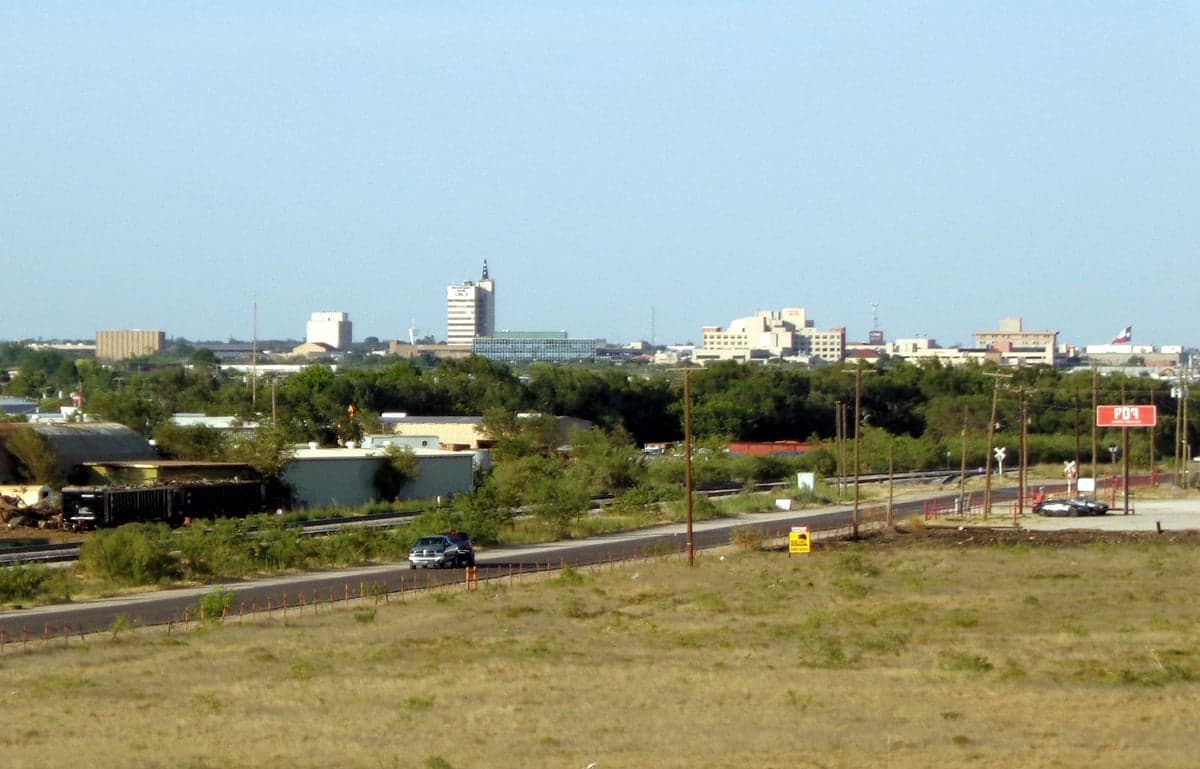
Photo: Wikipedia
Personal Sovereignty in Odessa, TX
Viable for self-reliance. Generally workable, though some barriers may limit total independence.
What does Personal Sovereignty tell us?
Personal Sovereignty measures your capacity for self-reliance and independence with minimal government friction. Higher scores mean fewer barriers between you and the way you want to live... but it assumes you have the space you need and good neighbors.
What does this tell us?
Personal Sovereignty measures your capacity for self-reliance and independence with minimal government friction. Higher scores mean fewer barriers between you and the way you want to live... but it assumes you have the space you need and good neighbors.
State Policy
Energy independence: Net exporter (220% of energy produced in-state)
Personal Liberty
Homesteading

Personal Liberty Analysis
Odessa, Texas, offers one of the strongest environments for personal sovereignty in the United States, particularly for those who view government overreach as a primary threat to individual liberty. The city sits in a state that has deliberately structured its laws to minimize interference in daily life, from taxation to self-defense, and the local culture reinforces a live-and-let-live ethos that is increasingly rare. For a single individual or parent operating from a survivalist or prepper mindset, Odessa represents a place where the state is more of a background presence than an active manager of your choices. The key question is whether the trade-offs—extreme heat, water scarcity, and geographic isolation—are worth the autonomy you gain.
Tax burden and regulatory posture: How Texas law keeps government off your back
Texas has no state income tax, which is the single most important structural advantage for anyone seeking to keep more of their earnings and reduce government leverage over their finances. In Odessa, this means your paycheck is not automatically skimmed by Austin, and the total state and local tax burden is among the lowest in the nation. Property taxes are the main trade-off, with effective rates around 2.5% to 3% of assessed value, but the state's homestead exemption and property tax caps for school districts (Proposition 4, 2023) provide some predictability. The regulatory posture in Odessa is notably light: there are no city-level zoning codes that restrict what you can do on your own land in many areas, no state-level building codes in unincorporated parts of Ector County, and no permit requirements for most small-scale construction. Business licensing is minimal, and there is no state-level occupational licensing for dozens of trades that require it in California or New York. For a prepper, this means you can build a shed, install a rainwater catchment system, or start a side business without filing a stack of forms. The city government is small and generally non-intrusive, though it does enforce basic health and safety codes in the urban core.
Self-defense and gun law specifics: What you can carry, where, and how to store it
Texas is a constitutional carry state, meaning you can carry a handgun openly or concealed without a permit as long as you are 21 and not a prohibited person. Odessa's local culture is heavily pro-gun, and you will see firearms openly carried in grocery stores, gas stations, and churches without anyone batting an eye. There are no city-level restrictions on magazine capacity, firearm types, or ammunition purchases. The state's Castle Doctrine and Stand Your Ground laws are among the strongest in the country: you have no duty to retreat in any place you are lawfully present, and the presumption is that a forcible entry into your home or vehicle is a deadly threat. For parents, this extends to protecting children in your vehicle or on your property. The state also has a preemption law that prevents cities like Odessa from passing their own gun ordinances, so you don't have to worry about local bans on certain firearms or storage requirements. Storage is entirely your choice: there is no state mandate for gun safes, trigger locks, or separate ammunition storage. If you want to keep a loaded AR-15 in your closet, that is your business. The only real restriction is that you cannot carry in schools, polling places, or government meetings, but even those have exceptions for licensed carriers in some cases.
Self-reliance and homesteading viability: Lot sizes, zoning, and off-grid feasibility
Odessa's geography and local regulations make it one of the most viable places in Texas for a serious homesteading or off-grid lifestyle. Within the city limits, lot sizes vary widely, but you can find residential lots of half an acre to one acre in older neighborhoods, and larger parcels are available on the outskirts. The city does not have restrictive zoning that prohibits keeping chickens, goats, or even a small number of livestock on residential property, though you should check the specific subdivision covenants. In unincorporated Ector County, there are essentially no zoning restrictions: you can build a house, a barn, a workshop, or a greenhouse without permits, and you can keep as many animals as your land can support. Water is the critical constraint: the Ogallala Aquifer is deep and declining, and municipal water is expensive for large-scale gardening. However, rainwater harvesting is legal and encouraged, with no state-level restrictions on collection, and the city does not tax or regulate rainwater systems. Solar is a no-brainer: Odessa averages over 260 sunny days per year, and net metering is available through Oncor, though the rates are not generous. For a prepper, the ability to install a solar array, dig a well (with a permit), and set up a septic system without bureaucratic hassle is a major advantage. The trade-off is that the soil is sandy and alkaline, so raised beds and imported topsoil are almost mandatory for serious food production.
Personal liberties: Parental rights, medical autonomy, speech, and property
Texas has been at the forefront of protecting parental rights, and Odessa reflects that. The state's Parental Bill of Rights (HB 900, 2023) gives parents explicit authority over their children's education, medical decisions, and exposure to library materials. In practice, this means you can opt your child out of any curriculum you find objectionable, and the school district cannot provide medical care or mental health services without your written consent. Medical autonomy is strong: there is no state-level vaccine mandate for adults or children, and the state has banned vaccine passports. For parents, this means you can choose not to vaccinate your child without losing access to public school, though some private schools may have their own requirements. Speech is broadly protected: Texas has no hate speech laws, no social media censorship mandates, and no restrictions on political speech in public spaces. Property rights are reinforced by the state's private property rights protection act, which limits eminent domain to truly public uses and requires full compensation. Odessa's local government is generally deferential to property owners, and there are no rent control laws, no short-term rental bans, and no restrictive historic preservation districts. The only notable limitation is that the city does enforce noise ordinances and some nuisance codes, but these are rarely applied to rural or semi-rural properties.
Overall, Odessa ranks among the top-tier locations in the United States for personal sovereignty, especially when compared to the regulatory-heavy environments of the West Coast, Northeast, or even parts of the Front Range. The combination of no state income tax, constitutional carry, minimal zoning, strong parental rights, and a culture that values self-reliance creates a legal and social environment where the government is a partner rather than a manager. The main vulnerabilities are water scarcity and the extreme climate, which require serious planning for anyone attempting true off-grid living. But for a single individual or parent who prioritizes freedom over convenience, Odessa offers a rare opportunity to live largely on your own terms, with the state acting as a distant referee rather than an active participant in your daily decisions. If you are willing to adapt to the heat and the dust, the sovereignty here is real and durable.

* Values derived from national, state, county, city and local statistics and may differ in a specific area. Last updated: 2026-10-10T16:28:34.000Z
Narrative content on this page is AI-generated and may contain mistakes. Verify any details that matter before acting on them.
ReloMaps may earn a commission from affiliate links at no extra cost to you.

