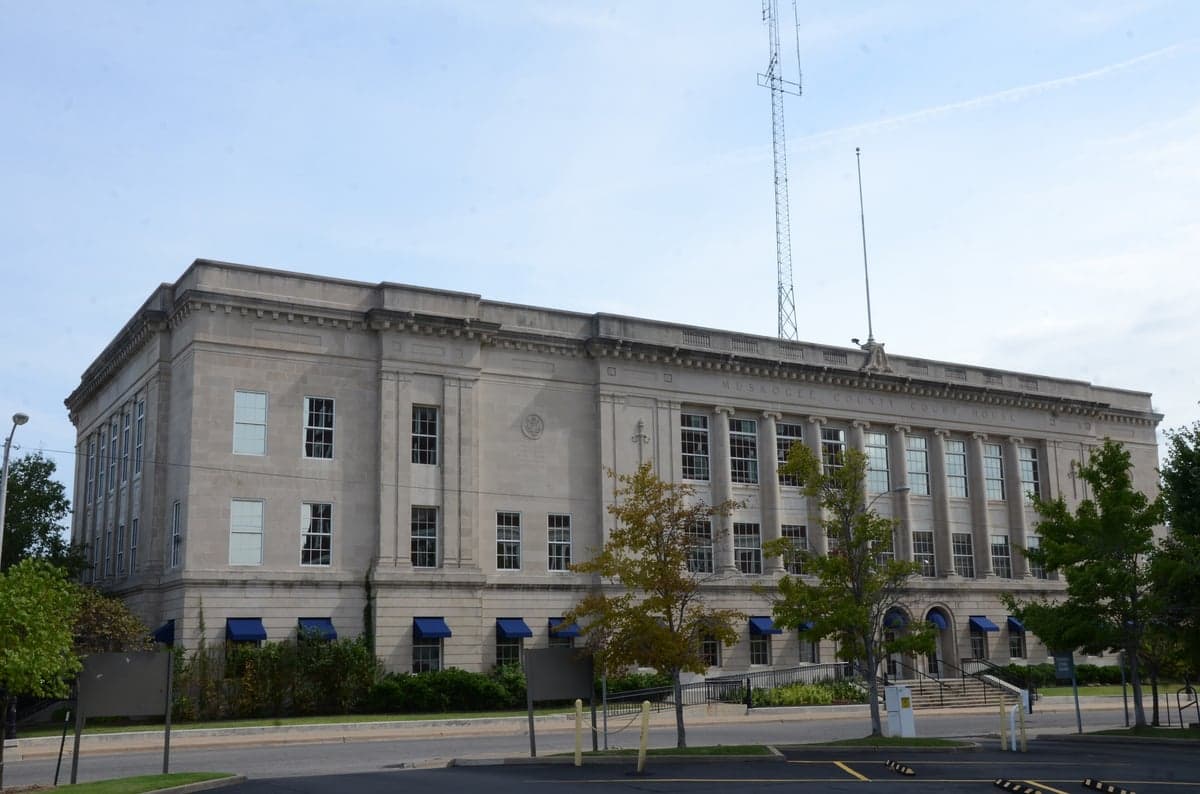
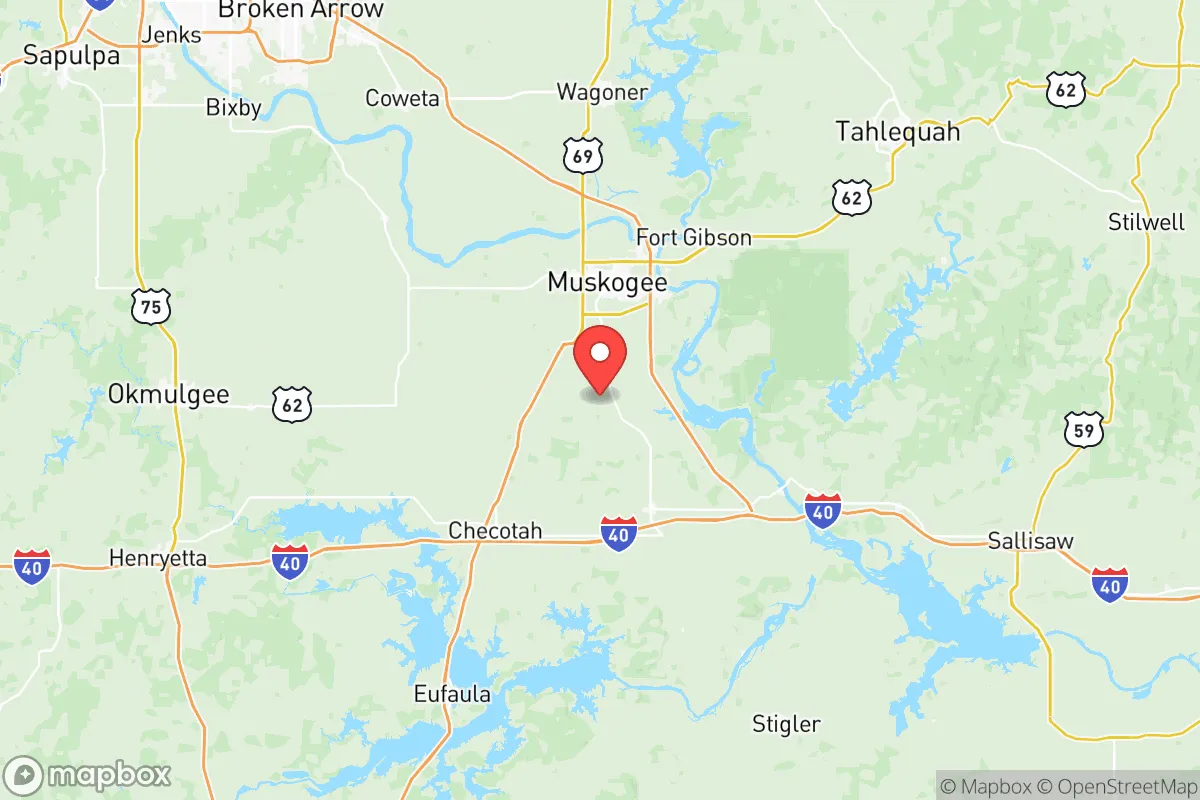
Photo: Wikipedia
Demographics of Muskogee County
Affluence Level in Muskogee County
A below-average socioeconomic profile. Incomes, home values, and educational attainment trail the U.S., with higher poverty and unemployment.
People of Muskogee County
Today, Muskogee County is home to roughly 66,500 residents, a population shaped by its deep Native American roots, a wave of European settlement in the late 19th and early 20th centuries, and a modern stability that sets it apart from faster-growing parts of Oklahoma. The county’s population is 54% white, 9.8% Black, 7.2% Hispanic, and 0.6% East/Southeast Asian, with a foreign-born share of just 1.4% — one of the lowest in the state. The most distinctive identity marker is the county’s role as the seat of the Muscogee (Creek) Nation, with the city of Muskogee serving as a cultural and governmental hub for the tribe. This is a place where the legacy of the Five Tribes, the Land Run, and the railroad era remains visible in the built environment and the demographics of its towns.
Settlement & growth (pre-1960)
The human history of Muskogee County begins long before statehood. The area was originally part of the homelands of the Osage and Quapaw nations, but the defining pre-American chapter is the forced removal of the Muscogee (Creek) people from the Southeastern United States along the Trail of Tears in the 1830s. The Muscogee Nation established its capital at Okmulgee, but the county’s namesake city, Muskogee, was founded in 1872 as a railroad town and quickly became the tribe’s primary commercial and governmental center. The Muscogee (Creek) Nation’s presence remains the single most important cultural and political fact about the county today, with tribal headquarters and the Creek Council House located in downtown Muskogee.
The first major non-Native wave arrived with the railroads. The Missouri-Kansas-Texas Railroad (the “Katy”) reached Muskogee in 1872, and the town was incorporated in 1873. This brought a mix of white settlers from the Midwest and Upper South, many of them merchants, railroad workers, and farmers drawn by the promise of commerce in Indian Territory. The town of Fort Gibson, established as a U.S. Army post in 1824, became a magnet for early traders and settlers, while Warner and Haskell grew as agricultural service centers for the surrounding cotton and pecan farms. By 1900, Muskogee had become the largest city in Indian Territory, with a population of over 4,000, and was known as the “Queen City of the Southwest.”
The second major wave was the arrival of freedmen and Black settlers after the Civil War. Many formerly enslaved people from the Muscogee Nation and other tribes settled in Muskogee, creating a vibrant Black community centered around the West Muskogee neighborhood and the town of Rentiesville. By the early 20th century, Muskogee had a thriving Black business district, including the historic Muskogee Civic Center and the Manual Training High School, one of the first Black high schools in Oklahoma. The Black population peaked at around 15% of the county total in the 1920s and has since declined to 9.8% today, largely due to outmigration to larger cities.
The third wave was the oil boom of the 1910s and 1920s. The discovery of the Glenn Pool and Cushing oil fields drew thousands of workers to the region, and Muskogee became a refining and distribution hub. The town of Webbers Falls, located on the Arkansas River, grew as a river port and oil supply point. This boom brought a transient population of white and Black laborers, as well as a small number of European immigrants, though the foreign-born share never exceeded 3% even at its peak. The oil economy collapsed in the 1930s, and the county’s population stagnated during the Dust Bowl and Great Depression, with many residents leaving for California and Texas.
Modern era (post-1965)
The 1965 Hart-Cellar Act had a minimal direct impact on Muskogee County. The foreign-born population today is just 1.4%, compared to 13.7% nationally, and the county has not seen the large-scale immigration from Latin America or Asia that reshaped much of the Sun Belt. The small Hispanic population (7.2%) is concentrated in Muskogee city and in Fort Gibson, with many families tracing their roots to Mexican migrant farmworkers who arrived in the 1970s and 1980s to work in the pecan and vegetable harvests. The East/Southeast Asian population (0.6%) is almost entirely Vietnamese and Filipino, with a small enclave in Muskogee city, many of whom arrived as refugees after the Vietnam War and later as professionals in healthcare and manufacturing.
The most significant demographic shift since 1965 has been domestic: the decline of the Black population and the stabilization of the white population. The Black share fell from 15% in 1960 to 9.8% today, driven by the loss of manufacturing jobs at the Muskogee Regional Medical Center and the closure of the Muskogee Stockyards in the 1980s, which pushed younger Black families to Tulsa and Dallas. At the same time, the white population has remained stable at around 54%, with many families rooted in the county for three or four generations. The county has also seen a modest influx of retirees from the Midwest and Texas, drawn by low housing costs and the proximity to the Arkansas River and Greenleaf Lake recreation areas.
Suburbanization has been limited. The city of Muskogee has lost population since its 1960 peak of 37,000, falling to roughly 36,000 today, while the unincorporated areas and smaller towns like Haskell and Warner have held steady. The county has not experienced the exurban sprawl seen in the Oklahoma City and Tulsa metro areas, largely because it lacks a major interstate highway connection and is 50 miles from Tulsa, too far for daily commuting for most workers.
The future
Muskogee County is likely to remain one of Oklahoma’s most demographically stable regions over the next 10–20 years. The population is projected to decline slightly, to around 65,000 by 2040, as the white population ages and younger residents continue to leave for Tulsa, Dallas, and other job centers. The Hispanic share is expected to grow slowly, perhaps reaching 10–12% by 2040, driven by natural increase and continued migration for agricultural and service work. The Black population will likely continue its slow decline, while the East/Southeast Asian population will remain small but stable, anchored by healthcare professionals at the Jack C. Montgomery VA Medical Center in Muskogee.
The county’s cultural identity is becoming more explicitly tied to its Native American heritage. The Muscogee (Creek) Nation has invested heavily in economic development, including the River Spirit Casino Resort in Muskogee and the College of the Muscogee Nation in Okmulgee, which has drawn younger tribal members back to the area. This has created a modest reverse migration of Native Americans from urban areas, particularly from Tulsa and Oklahoma City, who are returning for tribal jobs and cultural reconnection. The county is also seeing a small but growing number of white and Hispanic residents who identify as multiracial, reflecting the long history of intermarriage between Native and non-Native communities.
For someone moving in now, Muskogee County offers a low-cost, low-density lifestyle with a strong sense of place rooted in its Native and railroad history. The population is aging and slowly shrinking, but the county remains a stable, family-oriented community with affordable housing, good schools in Fort Gibson and Haskell, and easy access to outdoor recreation. The lack of diversity and the limited job market outside of healthcare, education, and tribal government are the main trade-offs. This is not a place of rapid change or growth, but of continuity — a place where the past is still very much present in the people who live there.

* Values derived from national, state, county, city and local statistics and may differ in a specific area. Last updated: 2026-08-04T04:41:29.000Z
Narrative content on this page is AI-generated and may contain mistakes. Verify any details that matter before acting on them.
ReloMaps may earn a commission from affiliate links at no extra cost to you.

