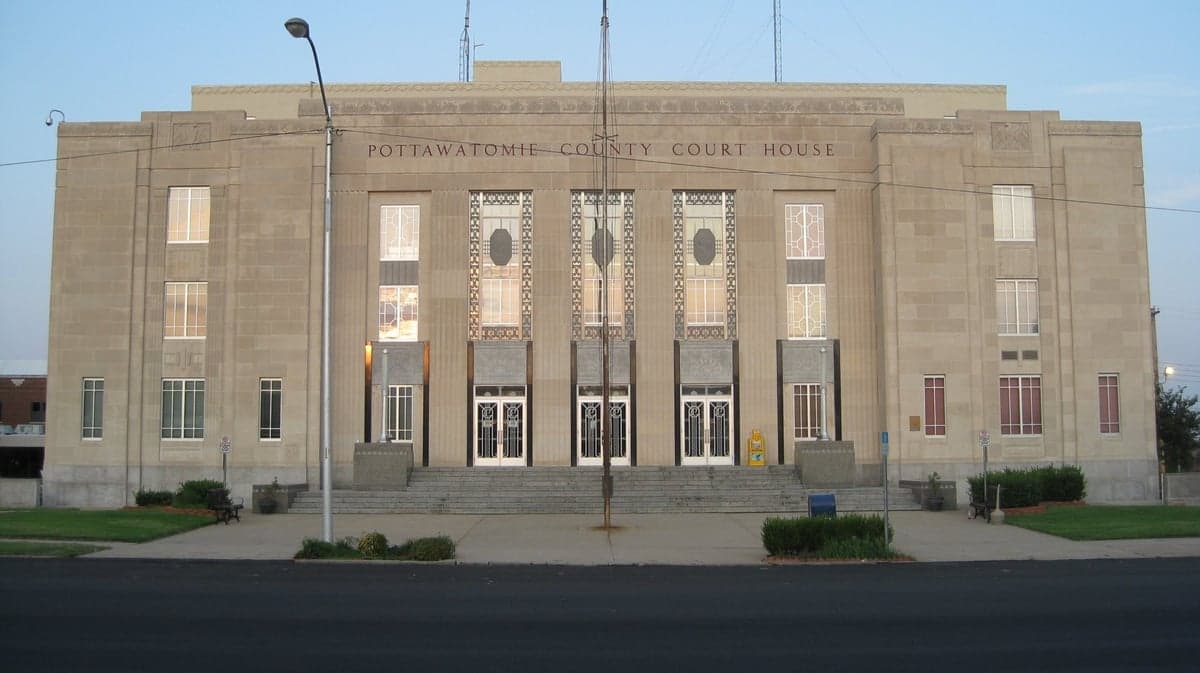
Photo: Wikipedia
Demographics of Pottawatomie County
Affluence Level in Pottawatomie County
A below-average socioeconomic profile. Incomes, home values, and educational attainment trail the U.S., with higher poverty and unemployment.
People of Pottawatomie County
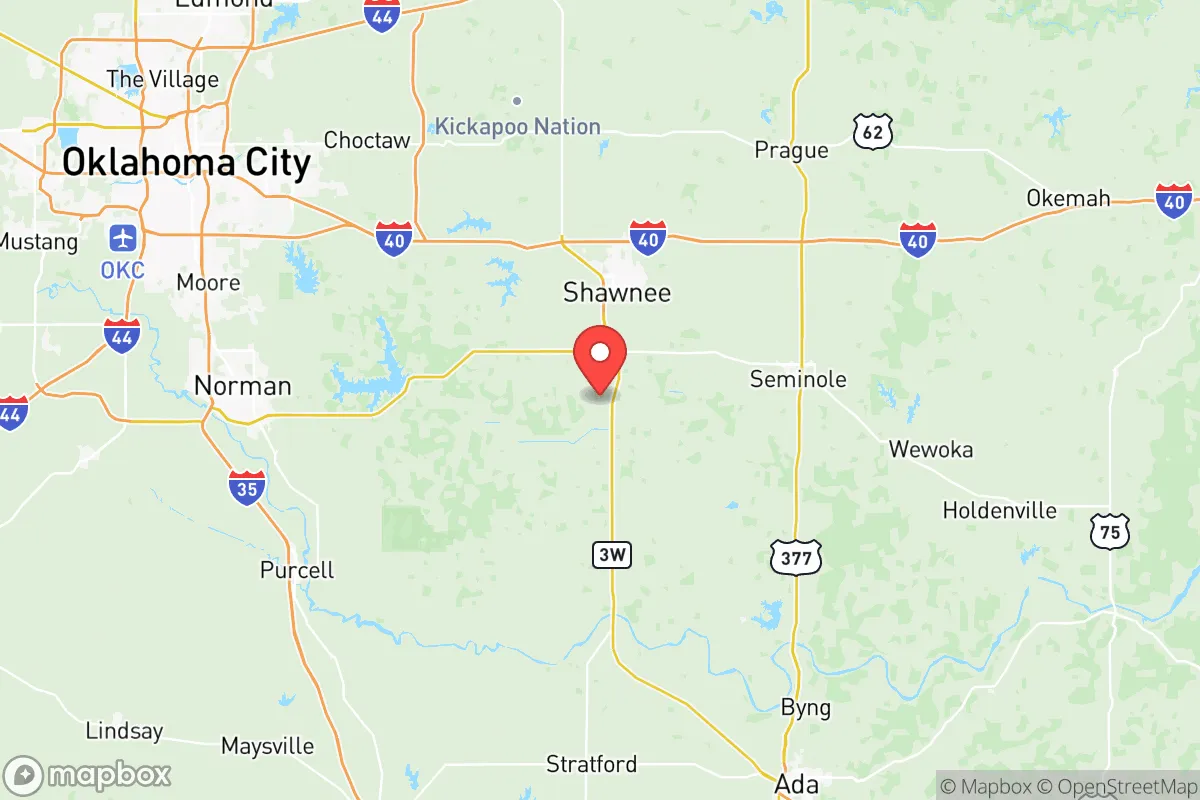
Today, Pottawatomie County, Oklahoma, is home to roughly 73,000 residents, a population that remains predominantly white (70.1%) with a notably small foreign-born share of just 1.0%. The county’s character is shaped by its deep Native American roots—it lies within the historic boundaries of the Citizen Potawatomi Nation—and a steady, slow-growth pattern that has preserved a rural, conservative, and family-oriented identity. With only 21.0% of adults holding a college degree, the workforce leans heavily toward agriculture, energy, and manufacturing, and the population density is low, concentrated in the county seat of Shawnee and smaller towns like Tecumseh, McLoud, and Prague.
Settlement & growth (pre-1960)
Long before European settlement, the land that is now Pottawatomie County was home to the Wichita and Caddo peoples, who lived in semi-permanent villages along the Canadian River. The region was part of the Louisiana Purchase and, after 1830, became a designated area for the forced relocation of eastern tribes under the Indian Removal Act. The Citizen Potawatomi Nation, originally from the Great Lakes region, were removed to Kansas in the 1830s and later, after the Civil War, were allotted land in what became Pottawatomie County. The Kickapoo, Shawnee, and Absentee Shawnee tribes also received reservations here, and their descendants remain a visible part of the county’s cultural fabric today, with tribal headquarters and communities in Shawnee and Tecumseh.
The first major wave of non-Native settlers arrived after the Land Run of 1889, which opened unassigned lands in central Oklahoma to white homesteaders. The following year, the Sac and Fox, Iowa, and Potawatomi lands were opened through a series of lotteries and runs, drawing thousands of settlers from the Midwest and Upper South—primarily farmers of English, Scots-Irish, and German descent. These families established the county’s foundational towns: Shawnee (founded 1895) grew as a railroad and agricultural hub; Tecumseh (1891) became the first county seat; and Prague (1902) was settled largely by Czech immigrants who brought their farming traditions and built a distinctive community that still celebrates its heritage with an annual Kolache Festival. Smaller settlements like Earlsboro, Maud, and Macomb sprang up along rail lines, serving as grain and cotton shipping points.
The discovery of oil in the 1920s transformed the county’s economy and population. The Greater Seminole Oil Field, which extended into eastern Pottawatomie County, triggered a boom that drew workers from Texas, Arkansas, and the Deep South. Towns like Earlsboro and Bowlegs saw their populations swell with roughnecks and speculators, though many left after production peaked in the 1930s. The Dust Bowl and Great Depression of the 1930s slowed growth, but the county’s agricultural base—cotton, cattle, and later wheat—kept the population relatively stable. By 1950, Pottawatomie County had roughly 43,000 residents, a number that would grow only modestly over the next three decades as the oil industry declined and young people left for urban centers like Oklahoma City, just 35 miles west.
Modern era (post-1965)
The 1965 Hart-Cellar Act had little direct impact on Pottawatomie County, as the region attracted almost no international immigration. The foreign-born population today stands at just 1.0%, far below the national average, and the county’s racial composition has shifted only slightly since 1970. The most notable change has been the growth of the Hispanic population, which now accounts for 6.2% of residents, up from less than 2% in 1990. These families—largely of Mexican origin—have settled primarily in Shawnee and Tecumseh, drawn by work in poultry processing plants, construction, and agriculture. They have established small but growing enclaves, with Spanish-language churches and tiendas appearing along the main commercial corridors.
Domestic migration has been the dominant demographic force since 1970. The county has experienced a slow but steady outflow of young adults seeking education and jobs in Oklahoma City, Norman, and beyond, offset by an inflow of retirees and families from more expensive parts of the state and country. The population has grown from roughly 58,000 in 1980 to 73,000 today, a pace of about 0.5% per year. Suburbanization has been modest compared to the explosive growth of the Oklahoma City metro’s western suburbs; instead, Shawnee has absorbed most new development, with subdivisions spreading south and east of the city center. The towns of McLoud and Bethel Acres have seen some commuter-driven growth, as workers trade longer drives for lower home prices.
The Black population, at 3.1%, is concentrated in Shawnee and Tecumseh, with roots in the post-Reconstruction migration of freedmen who worked as sharecroppers and later as railroad laborers. East/Southeast Asian communities (0.6%) and Indian-subcontinent residents (0.2%) are very small, mostly professionals associated with the University of Oklahoma’s satellite presence or with regional healthcare facilities. The county’s Native American population—roughly 15% of residents, including many who identify as multiracial—remains the most distinctive minority group, with strong ties to the Citizen Potawatomi Nation, the Absentee Shawnee Tribe, and the Kickapoo Tribe, all of which operate gaming facilities, health clinics, and cultural centers in the area.
The future
Pottawatomie County is likely to remain one of Oklahoma’s least diverse and slowest-growing counties over the next two decades. Projections from the Oklahoma State Data Center suggest the population could reach 80,000 by 2040, driven primarily by natural increase and modest domestic in-migration of retirees and remote workers seeking affordable land. The Hispanic share is expected to continue rising slowly, possibly reaching 10-12% by 2040, as younger families settle in Shawnee and Tecumseh for jobs in food processing and construction. The white population will likely decline slightly as a share, but will remain the overwhelming majority.
New residential development will concentrate in the Shawnee area, particularly along the Interstate 40 corridor and near the expanding Gordon Cooper Technology Center. The towns of Prague and McLoud may see modest growth as bedroom communities for Oklahoma City commuters, but the county’s rural character—open farmland, small-town main streets, and low taxes—will persist. The Native American tribes will continue to be major economic and cultural forces, with the Citizen Potawatomi Nation’s FireLake complex in Shawnee serving as a hub for employment, healthcare, and community events. The county’s cultural identity will remain rooted in its agricultural and oil heritage, with a conservative political tilt and a strong sense of local tradition.
For someone moving in now, Pottawatomie County offers a stable, affordable, and safe environment with a deeply rooted sense of place. It is not a place of rapid change or demographic upheaval, but rather a community where the past—Native American, pioneer, and oil-boom—remains visible in the landscape and the people. The county’s future is one of slow, steady continuity, with growth concentrated in Shawnee and its immediate surroundings, while the smaller towns hold steady as quiet anchors of rural Oklahoma life.

* Values derived from national, state, county, city and local statistics and may differ in a specific area. Last updated: 2026-07-29T20:48:03.000Z
Narrative content on this page is AI-generated and may contain mistakes. Verify any details that matter before acting on them.
ReloMaps may earn a commission from affiliate links at no extra cost to you.

