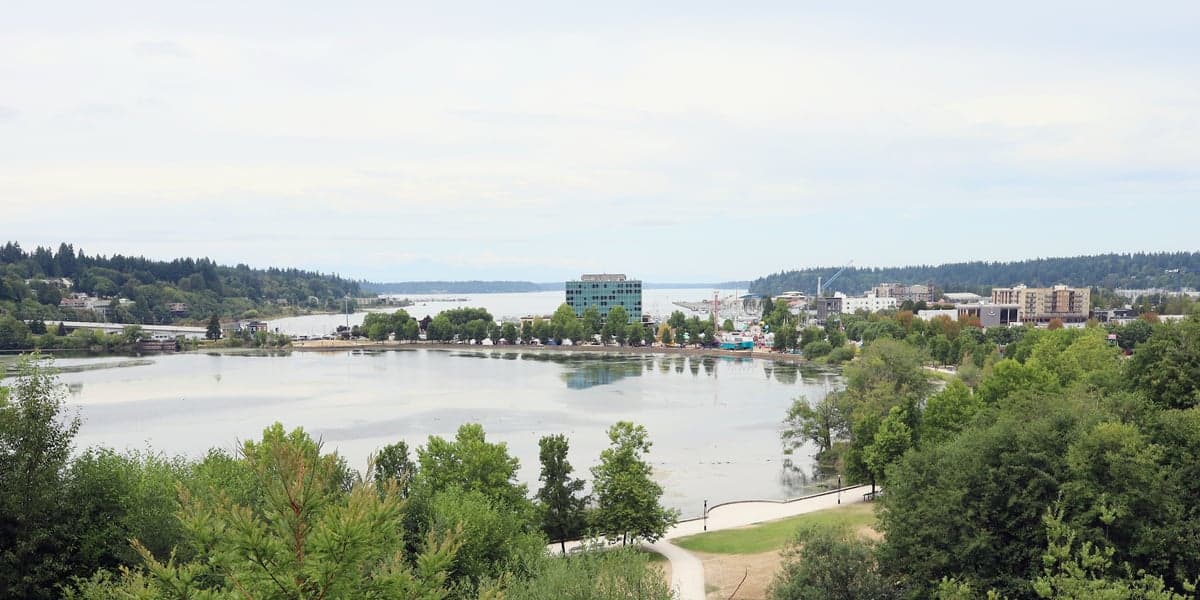
Photo: Wikipedia
Demographics of Olympia, WA
Affluence Level in Olympia, WA
A middle-class area roughly in line with national averages across income, home values, education, and employment.
People of Olympia, WA
The people of Olympia, Washington today number 55,583, forming a city that is notably more educated and less diverse than the national average. With 50% of adults holding a college degree, Olympia’s population skews heavily white (71.5%) and native-born, with a foreign-born share of just 3.0% — roughly one-third the U.S. average. The city’s character is defined by a mix of state government employees, Evergreen State College faculty and alumni, and long-standing working-class families, creating a politically progressive but demographically stable enclave where the largest minority group is Hispanic (10.3%), followed by East/Southeast Asian communities (6.0%).
How the city was settled and grew
Olympia’s original inhabitants were the Lushootseed-speaking Coast Salish peoples, particularly the Squaxin Island Tribe and Nisqually Tribe, who used the southern Puget Sound’s shellfish-rich inlets for thousands of years. American settlement began in earnest after the 1846 Oregon Treaty, when Edmund Sylvester and Levi Lathrop claimed the land that became downtown Olympia in 1850. The city was platted as the territorial capital in 1853, drawing a first wave of Yankee and Midwestern migrants — merchants, lawyers, and politicians — who built the South Capitol Historic District with its Victorian homes and the Bigelow Neighborhood, where many early government officials settled. A second wave arrived with the Northern Pacific Railroad’s completion in 1873, bringing Scandinavian loggers and millworkers who established Eastside (east of Capitol Way), a working-class area of modest bungalows that still retains a Nordic cultural imprint. By 1900, Olympia’s population was nearly entirely white, native-born, and Protestant, with a small Chinese enclave in the China Row area near the waterfront — a community that was largely expelled by anti-Chinese violence in the 1880s. The city grew slowly through the early 20th century, driven by state government expansion and timber mills, reaching 15,000 by 1940.
Modern era (post-1965)
The post-1965 period reshaped Olympia’s population less through immigration than through domestic in-migration and suburbanization. The 1967 founding of The Evergreen State College drew a wave of counterculture migrants — artists, activists, and academics — who settled in the Wilderwood and Westside neighborhoods, areas of mid-century ranch homes and wooded lots that became known for their liberal politics and alternative lifestyles. Meanwhile, the expansion of state government under Governors Dan Evans and Gary Locke brought a steady stream of middle-class professionals from other parts of Washington and the West Coast, filling subdivisions like Cooper Point and Lakeridge with families seeking good schools and proximity to the capitol campus. The foreign-born population remained low throughout this period, never exceeding 5%. The Hispanic population grew from under 2% in 1980 to 10.3% today, concentrated in the Southwest Olympia area near the Tumwater border, where Mexican and Central American immigrants found work in landscaping, construction, and the food-processing plants along the Deschutes River. The East/Southeast Asian population (6.0%) is largely composed of Vietnamese and Filipino families who arrived after 1975, many settling in the Northeast Olympia neighborhoods near the Capitol Campus, where they operate small businesses and work in healthcare. The Black population has remained small (2.5%), with no single neighborhood concentration, while the Indian-subcontinent population (0.5%) is a recent, highly educated cohort of tech and medical professionals living mostly in the Cooper Point area.
The future
Olympia’s population is heading toward modest diversification, but at a slower pace than the Seattle metro area. The Hispanic share is projected to reach 13-15% by 2040, driven by natural increase and continued labor migration, with the Southwest Olympia corridor likely becoming a more defined ethnic enclave. The East/Southeast Asian population is plateauing, as younger generations assimilate and move to suburban areas like Lacey and Tumwater for newer housing. The white population, while still dominant, is aging — the median age in the South Capitol and Bigelow neighborhoods exceeds 50 — and younger white residents are increasingly childless professionals or retirees, not families. The city is not tribalizing into distinct ethnic enclaves as much as it is sorting by income and lifestyle: Westside and Wilderwood remain liberal and countercultural, Cooper Point is professional and family-oriented, and Eastside is increasingly working-class and Hispanic. The foreign-born share is unlikely to rise above 5-6% in the next decade, as high housing costs and limited job growth outside government and education deter new immigrants.
For someone moving to Olympia now, the city offers a stable, highly educated, and politically progressive population that is slowly becoming more Hispanic but remains overwhelmingly white and native-born. The neighborhoods are distinct in character — from the historic homes of South Capitol to the liberal enclaves of Westside to the working-class Eastside — but the overall demographic trajectory is one of gradual diversification rather than rapid change. New residents should expect a community where government employment and Evergreen State College shape the culture, where racial diversity is modest, and where the population is aging in place rather than booming.

* Values derived from national, state, county, city and local statistics and may differ in a specific area. Last updated: 2026-04-19T09:14:56.000Z
Narrative content on this page is AI-generated and may contain mistakes. Verify any details that matter before acting on them.
ReloMaps may earn a commission from affiliate links at no extra cost to you.

