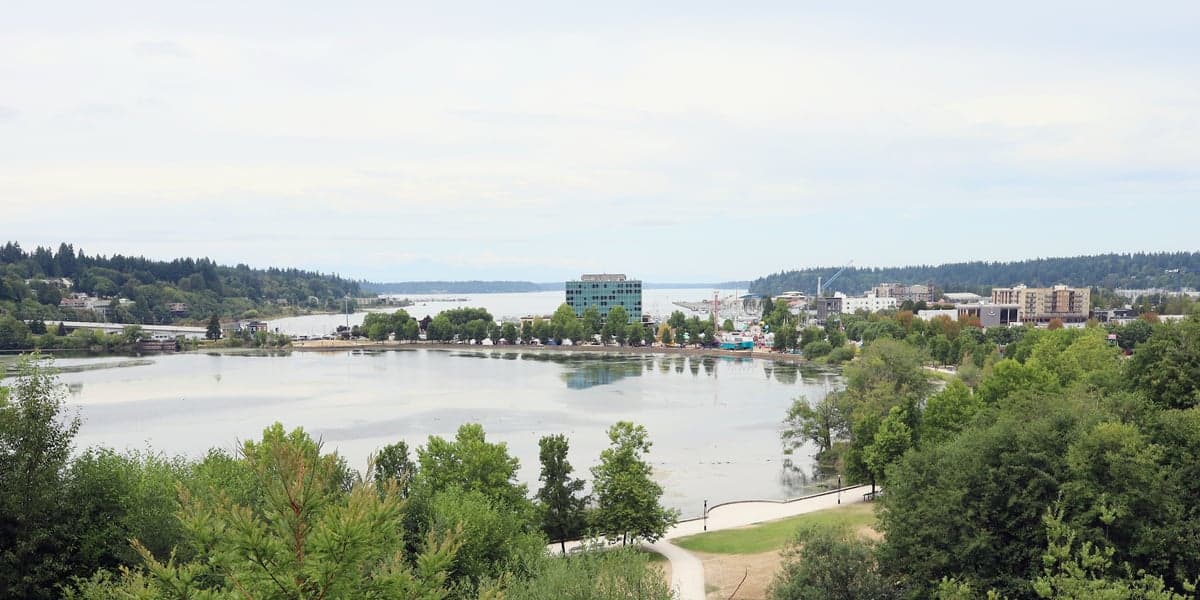
Photo: Wikipedia
Political ClimatePolitical Climate in Olympia, WA
District shown is the primary district for this city’s centroid. Cities may span multiple districts.
Local Political AnalysisPolitical Analysis of Olympia, WA
Olympia, Washington, has been a deep blue stronghold for decades, and that isn't changing anytime soon. The city itself, along with neighboring Tumwater and Lacey, votes overwhelmingly Democratic, with the Cook PVI clocking in at D+9. But if you’ve lived here as long as I have, you’ve watched it shift from a laid-back, live-and-let-live state capital into something far more ideologically rigid. The trajectory isn’t just blue—it’s a steady march toward progressive orthodoxy, where local politics increasingly prioritize symbolic gestures and top-down mandates over the kind of practical, hands-off governance that used to define the Pacific Northwest.
How it compares
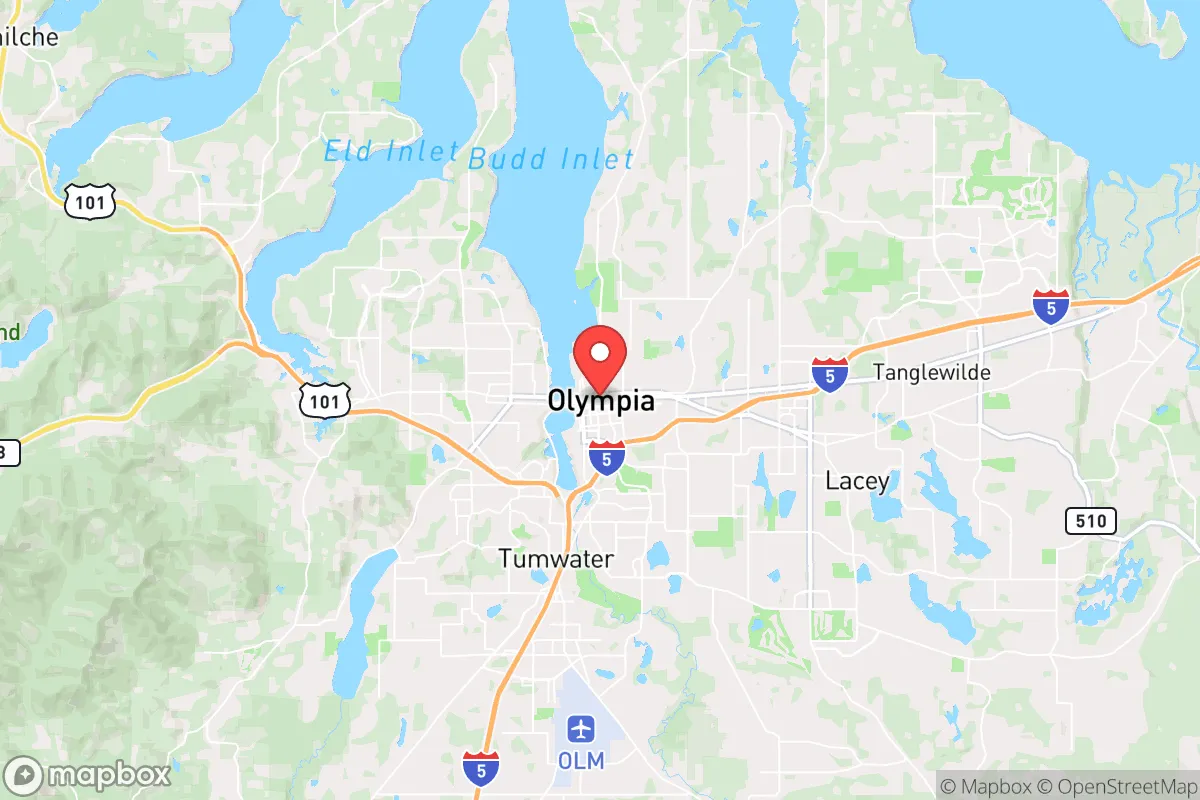
To really understand Olympia’s political isolation, you have to look at the ring of towns around it. Drive 20 minutes south to Tenino or Bucoda, and you’ll find a completely different world—folks who wave Trump flags from their pickup trucks and grumble about the latest state-level gun restrictions or property tax hikes. Head east toward Yelm, and you’re in a rural, libertarian-leaning area where people value their privacy and resent being told how to run their lives. Even Lacey, while still blue, has a more moderate, family-oriented vibe than Olympia proper. The contrast is stark: Olympia’s city council and Thurston County commissioners often push policies that feel like they’re designed for a coastal metro, not a mid-sized capital surrounded by farmland and forests. It’s a classic urban-rural divide, but the city’s political machine has the loudest megaphone.
What this means for residents
For the average person just trying to live their life, the political climate here means you’re constantly navigating new layers of regulation and social pressure. Want to start a small business? You’ll face some of the highest B&O taxes in the state, plus a local push for paid sick leave mandates and minimum wage hikes that go beyond state law. Own a firearm? Olympia was one of the first cities in Washington to pass a “safe storage” ordinance, and the city council has openly discussed banning guns in public parks and buildings—even though state law already covers most of that. The public schools, meanwhile, have embraced critical race theory and gender ideology curricula that many parents find intrusive. If you’re a conservative or even a moderate, you’ll quickly learn to keep your opinions to yourself at neighborhood gatherings or PTA meetings, because the social cost of dissent is real. The city’s homeless crisis, driven in part by permissive policies that prioritize harm reduction over accountability, has turned downtown into a no-go zone after dark for many families.
What really sets Olympia apart from other blue cities is its willingness to experiment with policy as a form of activism. The city council has declared itself a “sanctuary city” for transgender individuals and passed resolutions supporting the Boycott, Divestment and Sanctions movement against Israel—moves that have zero practical impact but signal a cultural allegiance that alienates a huge chunk of the population. The state capitol grounds are a constant hub for protests, from climate activists to anti-police rallies, and the local government rarely pushes back. If you value personal freedom, low taxes, and a government that stays out of your business, Olympia is a tough place to call home. The long-term trend is clear: more mandates, more social engineering, and less tolerance for anyone who doesn’t fall in line. It’s a beautiful area with great access to nature, but the political climate is suffocating for those who remember when Washington was known for its independent streak, not its progressive experiments.

State Political ClimatePolitical Climate in Washington
State Political AnalysisPolitical Environment in the State
Washington State has shifted from a historically moderate, pragmatic swing state into a solidly Democratic stronghold over the past two decades, driven overwhelmingly by the explosive growth of the Seattle metro area and its surrounding suburbs. While the state’s constitution and frontier roots once fostered a live-and-let-live ethos, the dominant coalition today is a progressive urban machine that has consolidated power through aggressive ballot initiatives and legislative supermajorities. For a conservative-leaning individual or family, the political landscape is increasingly defined by a stark urban-rural chasm, with the Puget Sound region dictating statewide policy while the rest of the state fights a rear-guard action to preserve local autonomy.
Urban vs. rural divide
The political map of Washington is a tale of two states. King County, home to Seattle, alone casts roughly 30% of the state’s vote and delivers margins of +40 to +50 points for Democrats. Neighboring Snohomish and Pierce counties have also trended blue, with Pierce County—once a swing area—now reliably Democratic thanks to the growth of Tacoma and its suburbs. The real story, however, is the suburban flip: places like Redmond, Bellevue, and Kirkland on the Eastside, once Republican-leaning tech hubs, have become solidly progressive as the tech workforce has aged leftward. Meanwhile, the rural eastern half of the state—counties like Spokane, Yakima, and Grant—vote Republican by wide margins, but their population is too small to counterbalance the Seattle metro. The Columbia River Gorge and the Olympic Peninsula also lean conservative, but they are increasingly outnumbered by new arrivals from California and Oregon settling in the I-5 corridor. The divide is not just geographic but cultural: rural residents feel ignored by Olympia, while urban voters see themselves as the state’s rightful engine.
Policy environment
Washington’s policy environment is a textbook case of progressive governance with a heavy hand. The state has no personal income tax, which sounds good on paper, but it has the most regressive tax system in the nation, relying heavily on high sales taxes (state rate of 6.5%, with local add-ons pushing it past 10% in Seattle) and high property taxes. In 2021, the state enacted a capital gains tax on high earners, which is currently being challenged as an unconstitutional income tax. The regulatory posture is among the most aggressive in the country: the state has a strict cap-and-trade program (the Climate Commitment Act) that drives up gas prices, a ban on new natural gas hookups in many cities, and a highly restrictive business climate that has driven companies like Boeing to move manufacturing to South Carolina. On education, the state has a “paramount duty” to fund schools, but outcomes are mixed—Seattle schools are well-funded but ideologically driven, while rural districts struggle with funding and teacher shortages. Healthcare is dominated by the state’s public option (Cascade Care) and strict insurance mandates. Election laws are among the most liberal: universal mail-in voting with no voter ID requirement, same-day registration, and automatic voter registration. This system has been praised for turnout but criticized for security concerns, especially after the 2020 election saw ballot harvesting and signature verification issues in some counties.
Trajectory & freedom
Washington is unequivocally becoming less free for conservatives, measured by any standard of personal liberty. The state has enacted some of the nation’s strictest gun control laws: a ban on “assault weapons” (HB 1240, 2023), a ban on high-capacity magazines (HB 1143, 2022), and a requirement for a 10-day waiting period and safety training for all firearm purchases. These laws were passed without a public vote and have been challenged in court. On parental rights, the state has moved aggressively to undermine parental authority: a 2023 law (SB 5599) allows minors to receive gender-affirming care without parental consent, and school districts in Seattle and Olympia have adopted policies that withhold information about a child’s gender identity from parents. Medical autonomy has been curtailed by vaccine mandates for healthcare workers and schoolchildren, and the state’s COVID-19 emergency orders were among the longest in the nation. Property rights are under constant threat from the Growth Management Act, which limits development and drives up housing costs, and from environmental regulations that restrict land use on private property. On speech, the state has considered “disinformation” laws that critics say could chill political speech. The only bright spot for liberty-minded residents is the state’s strong initiative process, which has been used to block some tax increases and preserve some local control, but the legislature has increasingly found ways to undermine or ignore initiative results.
Civil unrest & political movements
Washington has been a flashpoint for political unrest, particularly in Seattle. The 2020 CHOP/CHAZ occupation in the Capitol Hill neighborhood was a weeks-long, police-free zone that saw multiple shootings and became a national symbol of progressive governance gone awry. Since then, organized activist movements have become institutionalized: the Antifa-aligned network in Portland and Seattle remains active, and the state’s sanctuary policies (the 2019 “Keep Washington Working” Act) limit cooperation with federal immigration enforcement, making Washington a magnet for illegal immigration. On the right, the Three Percenters and other militia groups have a presence in rural areas, and there have been periodic standoffs over land use and gun rights. The state has seen a surge in election integrity concerns, particularly after the 2020 election when King County was found to have counted ballots with signature verification issues. The secession movement in eastern Washington—the “Liberty State” proposal—has gained traction, with several counties voting to explore splitting from the western part of the state. A new resident would notice the visible homelessness crisis in Seattle, Tacoma, and Spokane, which is directly tied to the state’s permissive drug laws (drug possession was effectively decriminalized until a 2023 law re-criminalized it) and lack of enforcement of public camping bans.
Projection
Over the next 5-10 years, Washington will likely become more progressive and more centralized. Demographic trends favor the urban core: the state is growing fastest in King, Snohomish, and Pierce counties, while rural counties are stagnant or losing population. In-migration from California and Oregon continues to bring voters who are comfortable with high taxes and heavy regulation. The state’s Democratic supermajority in the legislature is likely to hold, and may even expand, as the GOP becomes increasingly marginalized to the eastern half of the state. Expect more gun control, more environmental regulation (including a potential ban on gas-powered cars by 2035), and more erosion of parental rights. The capital gains tax will likely be upheld, paving the way for a full income tax. The only wild card is the state’s housing crisis: if the cost of living becomes unbearable, the urban growth machine could slow, but for now, the trajectory is clear. A conservative moving to Washington now should expect to live in a state where their vote is increasingly irrelevant at the state level, and where local control is the only remaining bulwark against progressive policy.
For a new resident, the bottom line is this: Washington offers stunning natural beauty and a strong economy, but it comes with a political price tag. If you value low taxes, gun rights, parental control, and local autonomy, you will find yourself fighting an uphill battle against a state government that is increasingly hostile to those values. The best strategy is to choose your county carefully—Spokane County and Yakima County offer more conservative communities, while Clark County (Vancouver) is a purple swing area with some hope. But be prepared: the state government in Olympia will continue to push policies that you likely oppose, and your vote will be a minority voice in a state that is moving further left every election cycle. If you’re willing to fight for your freedoms at the local level and accept that the state is a lost cause, Washington can still be a great place to live. If not, you may want to look elsewhere.
* Values derived from national, state, county, city and local statistics and may differ in a specific area. Last updated: 2026-04-19T09:14:56.000Z
Narrative content on this page is AI-generated and may contain mistakes. Verify any details that matter before acting on them.
ReloMaps may earn a commission from affiliate links at no extra cost to you.

