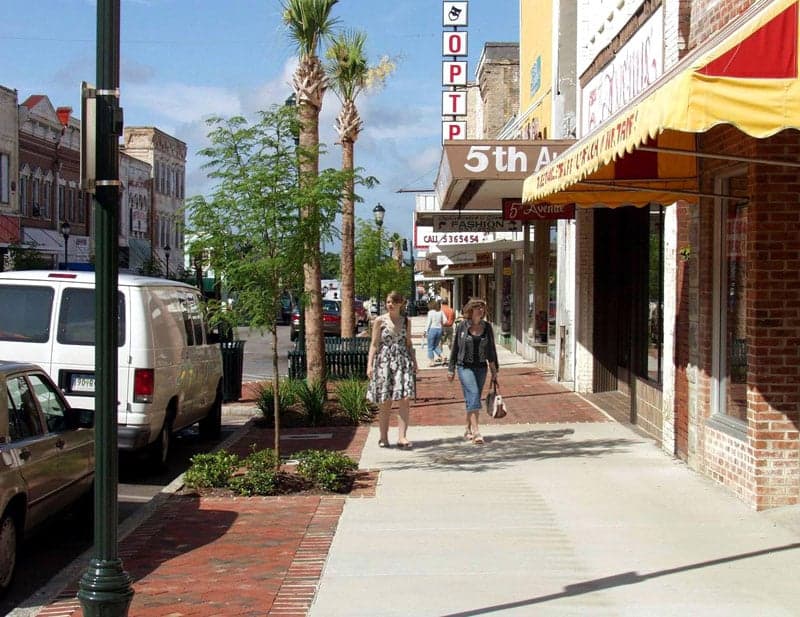
Photo: Wikipedia
Personal Sovereignty in Orangeburg, SC
Viable for self-reliance. Generally workable, though some barriers may limit total independence.
What does Personal Sovereignty tell us?
Personal Sovereignty measures your capacity for self-reliance and independence with minimal government friction. Higher scores mean fewer barriers between you and the way you want to live... but it assumes you have the space you need and good neighbors.
What does this tell us?
Personal Sovereignty measures your capacity for self-reliance and independence with minimal government friction. Higher scores mean fewer barriers between you and the way you want to live... but it assumes you have the space you need and good neighbors.
State Policy
Energy independence: Importer (25% of energy produced in-state)
Personal Liberty
Homesteading

Personal Liberty Analysis
For the individual or family who prioritizes personal sovereignty above all else, Orangeburg, South Carolina, presents a mixed but ultimately promising picture. While no location in the Lower 48 is a true libertarian utopia, Orangeburg offers a tangible buffer against the most aggressive forms of government overreach found in coastal blue states. The key is understanding that sovereignty here is less about what the local government grants and more about what it fails to restrict—a classic Southern approach that leaves significant room for self-reliance, provided you are willing to navigate the remaining bureaucratic hurdles. This analysis breaks down the specific levers of personal freedom in Orangeburg, from tax policy and gun rights to homesteading feasibility and medical autonomy, to help you determine if this area aligns with your strategic relocation goals.
Tax burden and regulatory posture: How much of your income and property stays yours
South Carolina’s state-level posture is generally favorable to personal sovereignty, and Orangeburg County benefits from this framework. There is no state income tax on Social Security benefits, and the state’s top marginal income tax rate has been cut to 6.2% as of 2026, with a path toward a flat 6% rate. For a prepper or self-reliant individual, this means more capital retained for land, supplies, and infrastructure rather than funding state programs. Property taxes are the real win: South Carolina’s owner-occupied property tax rate is among the lowest in the nation, averaging roughly 0.57% of market value. In Orangeburg County, the millage rate is competitive, and the state’s “Act 388” exempts the first $50,000 of a home’s value from school operating taxes. This is a direct sovereignty win—less of your land’s value is effectively owned by the school district. On the regulatory side, South Carolina is a “right-to-work” state, meaning you cannot be forced to join a union as a condition of employment. Occupational licensing is less burdensome than in the Northeast, but Orangeburg itself still has a municipal code that can be restrictive on things like vehicle storage and yard maintenance. The county’s regulatory posture is best described as “light touch for rural land, moderate for in-town lots.” If you buy acreage outside city limits, you will find far fewer zoning inspectors telling you what to do with your property.
Self-defense and gun law specifics: Stand your ground, permitless carry, and castle doctrine
For the survivalist-minded, South Carolina’s gun laws are a major draw. The state has had a “Stand Your Ground” law since 2006, meaning you have no duty to retreat from any place you are lawfully present before using deadly force in self-defense. This is codified in South Carolina Code § 16-11-440 and applies to both inside and outside the home. As of 2024, South Carolina is a permitless (constitutional) carry state for anyone 18 or older who can legally possess a firearm. This means no government permission slip is required to carry a concealed handgun. Orangeburg County’s sheriff’s office is generally pro-Second Amendment, and there are no local ordinances that preempt state law on firearms—meaning no local bans on magazine capacity or specific weapon types. The state also has a strong preemption law (SC Code § 23-31-510), which prohibits local governments from passing their own gun restrictions. This is critical: it prevents Orangeburg City Council from enacting the kind of magazine bans or “sensitive place” restrictions seen in states like Colorado or New York. For the prepper, this means you can legally stockpile ammunition, own suppressors (with a federal tax stamp), and keep a firearm in your vehicle without a permit. The only notable restriction is the 24-hour waiting period for handgun purchases, which was upheld in 2025. Overall, Orangeburg offers a high degree of armed sovereignty, with the state legislature actively blocking local encroachments.
Self-reliance and homesteading viability: Lot sizes, zoning, and off-grid feasibility
This is where Orangeburg truly shines for the self-reliant individual. The county is predominantly rural, with large tracts of agricultural and timber land available at prices far below the national average. As of early 2026, raw land in Orangeburg County can be found for $3,000 to $8,000 per acre, depending on proximity to I-26 and the city of Orangeburg. Zoning outside city limits is minimal; the county’s land-use regulations are primarily focused on commercial and industrial development, not on telling you how many chickens you can keep or whether you can build a root cellar. Many parcels are zoned “Agricultural-General,” which allows for livestock, farming, and the construction of outbuildings without a lengthy permitting process. Off-grid feasibility is high: South Carolina has no state-level ban on rainwater collection, and Orangeburg County does not prohibit composting toilets or solar panel installation. However, there is a catch: the county does enforce the International Residential Code (IRC) for new dwellings, which means a standard stick-built home must meet modern building codes. For the prepper wanting a truly off-grid cabin, the workaround is to build a “recreational” structure or a “farm building” under 600 square feet, which often falls into a less restrictive category. Well water is common, and the aquifer in the region is reliable, though you will need a permit for a new well (typically $200-$400). The county’s stance on “junk vehicles” or scrap storage is more relaxed than suburban areas, but neighbors can still file nuisance complaints if your property becomes an eyesore. For the serious homesteader, buying 10+ acres in the rural parts of the county (near Rowesville or Holly Hill) provides the most sovereignty with the least government interference.
Personal liberties: Parental rights, medical autonomy, speech, and property rights
South Carolina has been a battleground for parental rights, and the current legal climate is favorable to family sovereignty. The state passed the “Parents’ Bill of Rights” (H. 4755) in 2024, which codifies that parents have the fundamental right to direct the upbringing, education, and healthcare of their children. This means no school district in Orangeburg can hide a child’s medical or mental health records from parents, and parents can opt their children out of any curriculum they find objectionable. On medical autonomy, South Carolina is a mixed bag. The state has not mandated COVID-19 vaccines for children, and there is no state-level vaccine passport system. However, the state does require certain immunizations for school attendance (e.g., MMR, DTaP), with a religious exemption available but not a philosophical one. For the prepper concerned about medical freedom, the state’s stance on alternative medicine is permissive—you can see a naturopath or order certain lab tests without a doctor’s script. On speech, South Carolina has no state-level “hate speech” law that criminalizes political speech, and Orangeburg’s local government has not attempted to restrict public comment at meetings. Property rights are strong: South Carolina is a “Dillon’s Rule” state, meaning local governments only have powers explicitly granted by the state, but the state legislature has been aggressive in preempting local control over things like short-term rentals and tree removal. Eminent domain abuse is a concern near the I-26 corridor, but for rural land, the risk is low. The overall vibe is that the state government trusts families more than it trusts bureaucrats, which aligns well with a conservative, sovereignty-focused worldview.
In the broader context of the Southeast, Orangeburg offers a solid tier of personal sovereignty—better than the heavily regulated environments of North Carolina’s Research Triangle or Georgia’s Atlanta suburbs, but not quite as free as the truly unincorporated counties of the Deep South like those in Alabama’s Black Belt. The tax burden is low, gun laws are among the best in the nation, and the rural land market allows for genuine self-reliance. The trade-offs are real: the local economy is weaker, and the city of Orangeburg itself has a higher crime rate than the surrounding county, which pushes the sovereignty-minded toward rural acreage. For the strategic relocator who values keeping the government out of their home, their gun safe, and their children’s education, Orangeburg County is a viable, defensible choice that balances affordability with freedom. It is not a prepper paradise, but it is a place where a determined individual can build a sovereign life without constant bureaucratic friction.

* Values derived from national, state, county, city and local statistics and may differ in a specific area. Last updated: 2026-05-01T00:38:34.000Z
Narrative content on this page is AI-generated and may contain mistakes. Verify any details that matter before acting on them.
ReloMaps may earn a commission from affiliate links at no extra cost to you.

