Photo: Wikipedia
Political ClimatePolitical Climate in Orangeburg, SC
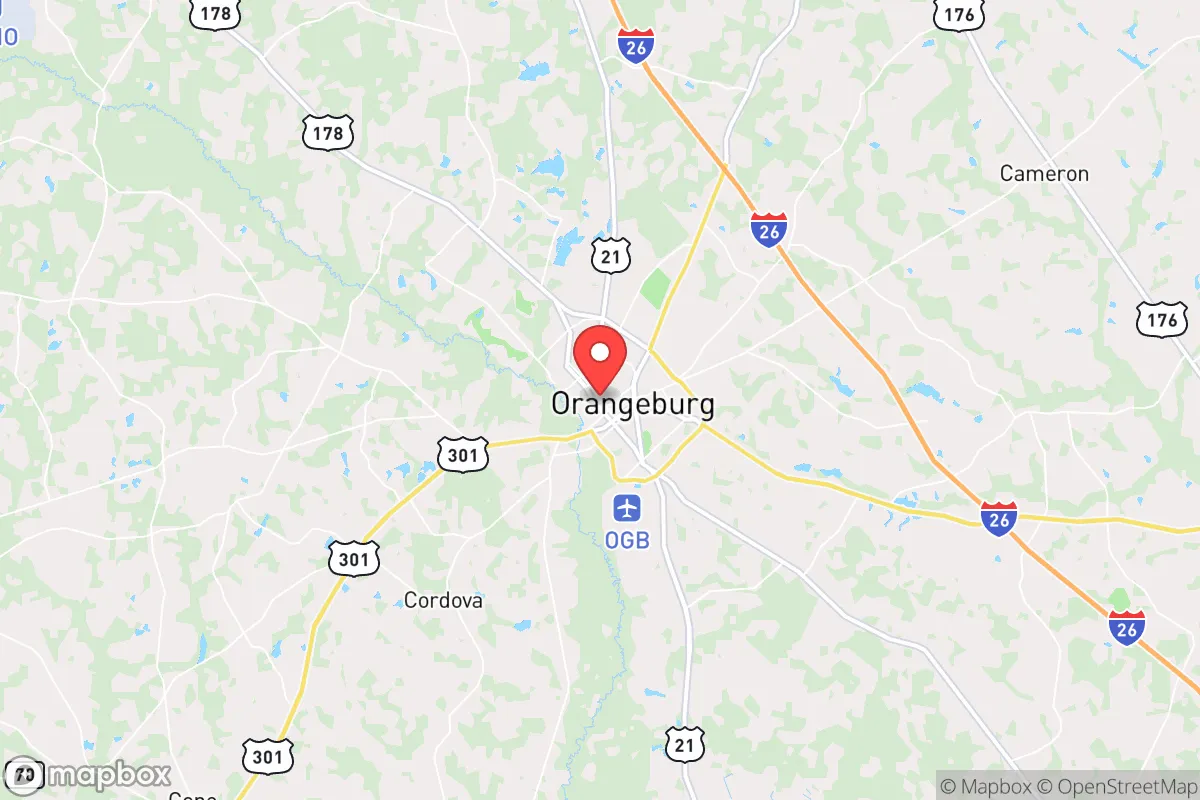
District shown is the primary district for this city’s centroid. Cities may span multiple districts.
Local Political AnalysisPolitical Analysis of Orangeburg, SC
Orangeburg’s political climate has long been a Democratic stronghold, with a Cook PVI of D+13 meaning the area votes about 13 points more Democratic than the national average. That’s a pretty deep blue shade for a small city in the Deep South, but it wasn’t always this way. I remember when folks here were more independent-minded, voting for the person rather than the party label. Over the last decade or so, though, the shift has been real—more progressive policies coming out of the county seat, more emphasis on government programs, and a growing sense that the local leadership is leaning into a one-size-fits-all approach that doesn’t always sit well with folks who value their personal freedoms.
How it compares
If you drive 30 miles west to Bamberg or 40 miles east to Sumter, you’ll find similar Democratic-leaning areas, but the contrast with nearby towns like St. Matthews (Calhoun County) or Barnwell is stark—those places still hold onto a more conservative, hands-off vibe. Even Columbia, just 45 minutes north, has a more mixed political scene, with suburban pockets that push back against the progressive tide. Orangeburg itself, though, has become a place where the county council and school board are dominated by Democrats, and that’s meant a steady stream of new regulations and spending initiatives. The PVI of D+13 isn’t just a number; it reflects a voting bloc that consistently supports candidates who favor expanding government’s role in daily life—from zoning rules to business licensing to school curriculum decisions.
What this means for residents
For the average person living here, the practical effect is that you’ve got less room to make your own choices. Property taxes have crept up to fund new county programs, and there’s been talk of stricter rental ordinances that would make it harder for landlords to set their own terms. Small business owners I know have grumbled about the red tape—permits that take longer, fees that keep rising, and a general feeling that the county sees them as a revenue source rather than a partner. On the social side, the school board has pushed for more centralized control over what’s taught, which has some parents worried about losing their say in their kids’ education. It’s not a crisis yet, but the trend line is clear: more government, less individual liberty.
Looking ahead, I don’t see Orangeburg flipping red anytime soon—the demographic and institutional momentum is too strong. But there are signs of pushback. A few local races in the last cycle saw conservative-leaning candidates come closer than expected, especially in the rural precincts outside the city limits. If the progressive agenda keeps overreaching—say, with new mask mandates or business shutdowns like we saw during COVID—you might see more folks voting with their feet, moving to places like Branchville or Rowesville where the government stays out of your way. For now, Orangeburg remains a place where you’ve got to keep an eye on what the county commission is cooking up, because it’s usually something that chips away at your freedoms a little more each year.

State Political ClimatePolitical Climate in South Carolina
State Political AnalysisPolitical Environment in the State
South Carolina has long been a reliably red state, with a solid Republican lean that has only deepened over the past two decades. The GOP holds supermajorities in both chambers of the state legislature, and the state has voted for the Republican presidential candidate in every election since 1980, with margins widening from about 7 points in 2000 to 18 points in 2024. The dominant coalition is a mix of traditional conservatives, evangelical Christians, and a growing number of transplants from the Northeast and Midwest seeking lower taxes and a slower pace of life. However, the state is not monolithic—pockets of blue in the urban core and along the coast create a dynamic political landscape that any relocating conservative should understand.
Urban vs. rural divide
The political map of South Carolina is a classic story of urban islands surrounded by a deep red sea. Charleston and its surrounding suburbs, particularly Mount Pleasant and North Charleston, have become increasingly competitive, with Charleston County itself trending blue in recent cycles due to an influx of younger professionals and out-of-state transplants. Columbia, the state capital, is a purple-to-blue enclave anchored by the University of South Carolina, while Greenville remains a reliably conservative stronghold that has actually grown more Republican as it has boomed economically. The real engine of the state's red lean is the rural and small-town vote—counties like Oconee, Pickens, and Laurens in the Upstate, and Horry (home to Myrtle Beach) and Beaufort in the Lowcountry, routinely deliver 65-75% margins for GOP candidates. The Pee Dee region and the Lowcountry interior are also deeply conservative, with Florence and Sumter serving as moderate-to-red hubs in an otherwise rural landscape.
Policy environment
South Carolina's policy environment is broadly favorable to conservative priorities, though not without its frustrations. The state has a flat income tax rate of 6.2%, which is being phased down to 6.0% by 2026, and no state estate tax. Property taxes are among the lowest in the Southeast, with a 4% assessment ratio for owner-occupied homes and a $50,000 exemption on the first $50,000 of value. The regulatory climate is business-friendly, with a right-to-work law on the books and a tort reform package passed in 2023 that capped noneconomic damages in medical malpractice cases. On education, the state has a robust school choice movement—the Education Scholarship Trust Fund program, expanded in 2024, now provides up to $7,000 per year for private school tuition for eligible families. However, the state's public school system remains underfunded and ranks near the bottom nationally in per-pupil spending. Healthcare policy is a mixed bag: South Carolina did not expand Medicaid under the ACA, and the state has a relatively free-market approach to insurance, but rural hospital closures remain a persistent problem. Election laws are moderately restrictive—voter ID is required, early voting was expanded to two weeks in 2022, and absentee voting requires an excuse. There is no automatic voter registration, and same-day registration is not allowed.
Trajectory & freedom
On balance, South Carolina is moving in a direction that most conservatives would view as positive, though vigilance is warranted. The state has been a national leader in gun rights, enacting constitutional carry in 2021 without a permit requirement, and preempting local gun ordinances. Parental rights were strengthened in 2023 with the Parents' Bill of Rights, which requires schools to notify parents of any changes to a child's mental or physical health and prohibits instruction on sexual orientation or gender identity in K-5 classrooms. The state also passed a near-total abortion ban in 2023 (the Fetal Heartbeat Act), with exceptions only for rape, incest, and the life of the mother. On the tax front, the phased reduction of the income tax and the elimination of the marriage penalty in 2024 are clear wins for personal liberty. However, there are concerning trends: the state's property tax system is increasingly complex, with school districts and municipalities raising millage rates in ways that can surprise new homeowners. Additionally, the state's eminent domain powers have been used aggressively for economic development projects, particularly in the Charleston and Greenville metro areas, which has sparked local backlash. Medical freedom took a hit during COVID, with the state imposing mask mandates and business closures, though these were largely lifted by mid-2021 and the legislature has since passed a bill prohibiting vaccine mandates for state employees.
Civil unrest & political movements
South Carolina has a relatively low level of visible civil unrest compared to many states, but there are active political movements on both sides. The Confederate flag controversy, which culminated in its removal from the Statehouse grounds in 2015 after the Charleston church shooting, remains a cultural flashpoint, though it has faded from daily political discourse. Immigration politics are a growing issue, particularly in the Greenville-Spartanburg area, where a rapidly growing Hispanic population has led to local debates over sanctuary policies—the state has a law prohibiting sanctuary cities, and enforcement has been generally strict. Election integrity remains a live issue: the state's 2020 election was certified without major controversy, but the legislature has since tightened absentee ballot procedures and created a new Election Integrity Unit within the State Law Enforcement Division. On the left, activist groups like the SC Progressive Network and local chapters of the NAACP have been vocal on voting rights and criminal justice reform, but they have limited legislative success. The most visible political movements in recent years have been on the right: the Moms for Liberty chapter in Lexington and Greenville counties has been active in school board races, and the SC Freedom Caucus has pushed for further tax cuts and school choice expansion. A new resident would notice that political signs and yard flags are common in rural and suburban areas, but the tone is generally civil—South Carolinians tend to avoid the kind of street-level confrontation seen in other states.
Projection
Over the next 5-10 years, South Carolina is likely to become more conservative in its state-level politics, even as its urban areas continue to drift left. The primary driver is in-migration: the state is adding about 100,000 new residents per year, and the majority are coming from high-tax, high-regulation states like New York, New Jersey, and California. These transplants are not uniformly conservative—many bring moderate-to-liberal views on social issues—but they are overwhelmingly attracted by the state's low taxes and business climate, which tends to reinforce the pro-growth, limited-government coalition. The Upstate (Greenville, Spartanburg, Anderson) will remain the GOP's strongest region, while the Lowcountry (Beaufort, Hilton Head) will see continued Republican dominance among retirees. The Pee Dee and Midlands rural areas will stay deep red. The wildcard is Charleston, which could flip to a Democratic-leaning metro within a decade if current growth trends continue—this would make the state's political map more competitive at the congressional level, but the state legislature's gerrymandered districts will likely keep the GOP in firm control. The biggest risk to conservative governance is complacency: if the legislature fails to address rising property taxes, rural hospital closures, and infrastructure strain from growth, a populist backlash could emerge. For now, the trajectory is clear: South Carolina is solidifying its position as a red-state destination for those fleeing progressive policies elsewhere.
For a conservative relocating to South Carolina, the bottom line is this: you will find a state that largely respects your values on taxes, guns, education choice, and parental rights, but you should not expect perfection. The urban areas, particularly Charleston and Columbia, are becoming more progressive, so choose your county carefully—Greenville, Lexington, and Beaufort counties are safer bets for a like-minded community. Property taxes are low but can creep up, and the state's infrastructure is struggling to keep pace with growth. If you value a hands-off government, strong Second Amendment protections, and a culture that still prizes neighborliness over activism, South Carolina is a solid choice—just keep an eye on the legislature to ensure they don't trade freedom for corporate welfare.
* Values derived from national, state, county, city and local statistics and may differ in a specific area. Last updated: 2026-05-01T00:38:34.000Z
Narrative content on this page is AI-generated and may contain mistakes. Verify any details that matter before acting on them.
ReloMaps may earn a commission from affiliate links at no extra cost to you.

