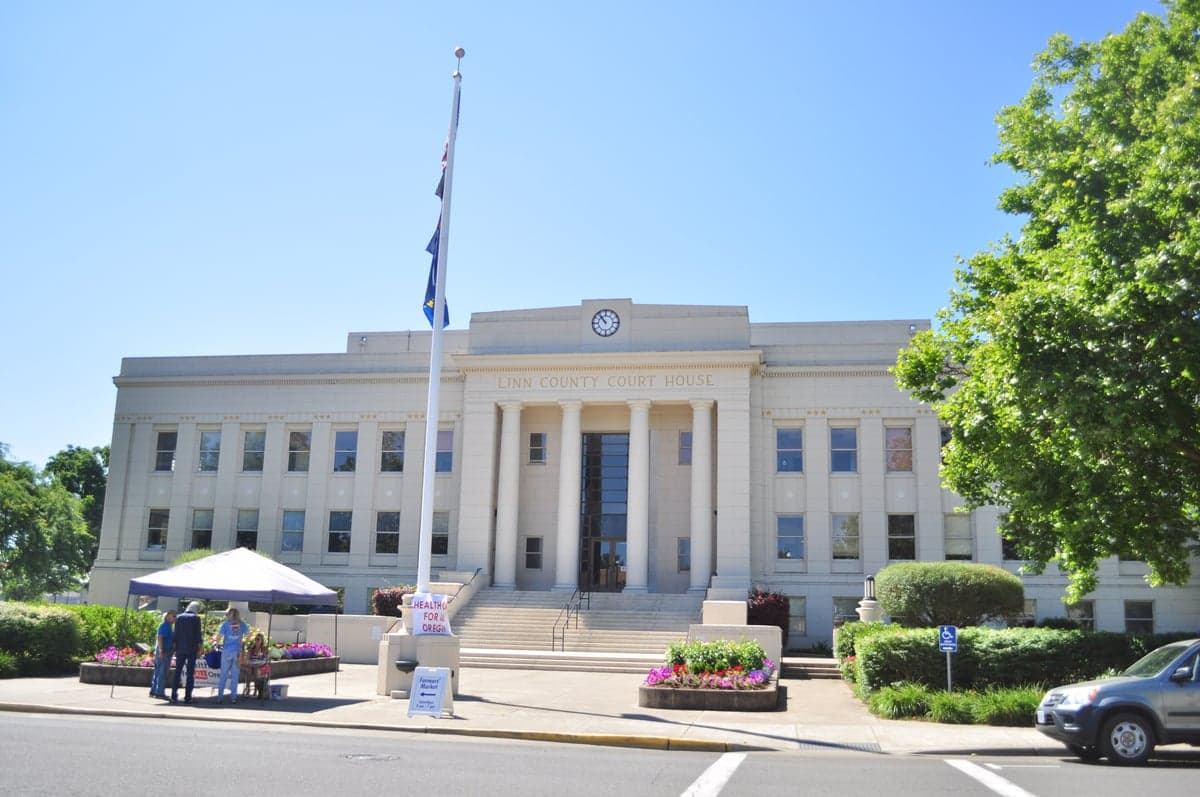
Photo: Wikipedia
Personal Sovereignty in Linn County
Viable for self-reliance. Generally workable, though some barriers may limit total independence.
What does Personal Sovereignty tell us?
Personal Sovereignty measures your capacity for self-reliance and independence with minimal government friction. Higher scores mean fewer barriers between you and the way you want to live... but it assumes you have the space you need and good neighbors.
What does this tell us?
Personal Sovereignty measures your capacity for self-reliance and independence with minimal government friction. Higher scores mean fewer barriers between you and the way you want to live... but it assumes you have the space you need and good neighbors.
State Policy
Energy independence: Importer (35% of energy produced in-state)
Personal Liberty
Homesteading

Personal Liberty Analysis
Linn County offers a mixed sovereignty landscape where Oregon's state-level regulatory reach collides with a deeply independent, rural frontier culture. In towns like Sweet Home and Brownsville, you will find a hands-off attitude toward daily life that stands in sharp contrast to the Portland metro area, but you are still operating under Oregon's relatively high state income tax and land use restrictions. For the individual or family who values self-reliance and wants to avoid government overreach, Linn County provides a meaningful buffer compared to the West Coast's urban centers, but it is not a libertarian paradise—you trade one set of constraints for another, and the smart move is knowing exactly where those trade-offs lie.
Tax burden and regulatory posture in Linn County versus Oregon's urban centers
Oregon imposes a state income tax that reaches 9.9% on income over $125,000 for single filers (higher brackets for joint filers), with no sales tax to offset it—meaning the state takes a significant bite out of earnings regardless of where you live. Linn County itself is fiscally restrained relative to Multnomah County, with property tax rates averaging around $10.50 per $1,000 of assessed value (slightly below the state median), but the real constraint comes from Oregon's statewide land use system under Senate Bill 100. This law heavily restricts development on farm and forest land, which hits homesteaders hard: if you buy a parcel outside city limits in unincorporated areas like Crawfordsville or Foster, you cannot simply build a cabin and call it home without navigating a labyrinth of exclusive farm use (EFU) zoning rules. Cities like Albany and Lebanon have more flexible residential zoning for small-acreage lots, but they also come with city fees and building permits that add thousands to any construction project. The regulatory posture in Linn County is best described as moderate for the West Coast, but if you are coming from Texas or Idaho, the paperwork burden will feel like a political statement against personal freedom.
Self-defense and gun law specifics in Linn County's culture and enforcement
Oregon allows permitless concealed carry for residents 21 and older (effective 2022 after HB 2006), but a 2023 voter-approved measure (Measure 114) mandates a permit to purchase any firearm and bans magazines over 10 rounds—though it remains blocked by court injunction as of early 2026. The practical reality in Linn County is that local sheriffs and law enforcement are by and large hostile to Measure 114. The Linn County Sheriff's Office has explicitly stated it will not enforce magazine bans unless the measure's constitutionality is resolved, and the culture in Sweet Home, Brownsville, and Scio remains firmly pro-Second Amendment. Gun stores in Lebanon and Harrisburg continue to sell standard-capacity magazines openly, and private sales between individuals do not require a background check under Oregon law (only licensed dealers conduct checks). Range access is abundant: the Albany Rifle & Pistol Club offers a public facility, and federal land in the Willamette National Forest east of Sweet Home provides endless recreational shooting spots. If you prioritize self-defense with minimal state interference, Linn County is one of the better Oregon options, but you still must navigate a legal environment that could shift if Measure 114 eventually takes effect.
Self-reliance and homesteading viability across Linn County's diverse zones
The ability to live off-grid varies dramatically within Linn County. The eastern foothills near the Willamette National Forest—areas around Foster Reservoir, Cascadia, and the unincorporated stretches east of Sweet Home—offer the best shot at true self-reliance: parcels of 5 to 40 acres are common, wells are feasible (average depth 100–300 feet), and septic systems are permitted provided you meet Oregon's strict DEQ standards (which require a certified site evaluation). Solar power is viable with net metering through Pacific Power, but state code requires a licensed electrician for grid-tied systems, and completely off-grid setups still must comply with county building permits for habitable structures—no wiggle room on that. Urban growth boundaries around Albany and Lebanon restrict most large-lot homesteading, so towns like Harrisburg and Halsey in the southern part of the county offer a middle ground: larger lots (one to five acres) with fewer restrictions than the EFU-zoned land that dominates the rural west. Water rights are a major issue: Oregon follows the prior appropriation doctrine, and any new domestic well in a groundwater-limited area may require a permit from the Water Resources Department, which can take months. For the serious prepper, the eastern hills offer the best combination of low population density, forest resources, and distance from government scrutiny, but you must accept that Oregon's building code and water law will never fully let you be free.
Personal liberties: parental rights, medical autonomy, speech, and property in Linn County
Parental rights in Oregon are under ongoing tension. The state mandates vaccine coverage for school entry (with medical and religious exemptions available), but Linn County's school districts—especially in rural Brownsville and Sweet Home—tend to be more accommodating of opt-outs than Portland-area districts. Medical autonomy is heavily restricted by Oregon's legal framework: assisted suicide is legal, but so is broad vaccine mandates for healthcare workers and school employees, and naturopathic doctors are regulated by the state, not the county. Speech and assembly are protected under the First Amendment, and the rural culture in Linn County is far more open to conservative viewpoints than any urban area west of the Cascades. Property rights are the strongest card here: Oregon's Measure 49 (2007) allows landowners to build up to three homes on EFU-zoned land if they meet hardship criteria, and Linn County's planning department is pragmatic compared to Washington County's. That said, the state can still impose new regulations via the Land Conservation and Development Commission (LCDC), so tenure is not absolute. The county's overall climate for personal liberty is solid for the Pacific Northwest, but if you are comparing to a state like Idaho, Linn County still operates under a state government that feels comfortable regulating your health choices and land use from Salem.
Compared to other areas in the Pacific Northwest, Linn County offers a stronger sovereignty profile than most of Western Oregon—especially the Portland metro—but it falls short of the near-zero regulatory environments you find in rural Idaho or Eastern Washington. For the conservative individual or family who wants to balance a decent tax burden, a gun-friendly culture, and the ability to homestead on a modest scale, Linn County is a realistic choice, provided you accept that Oregon's state-level government will always exert control over your medical decisions and land use. The best strategy is to locate east of Sweet Home or south near Harrisburg, where local culture and enforcement give you the most breathing room, and to stay vigilant about state policy changes that could chip away at those freedoms over time. It is not a fortress of personal sovereignty, but it is a defensible position in a region that is otherwise hostile to it.

* Values derived from national, state, county, city and local statistics and may differ in a specific area. Last updated: 2026-06-02T03:31:09.000Z
Narrative content on this page is AI-generated and may contain mistakes. Verify any details that matter before acting on them.
ReloMaps may earn a commission from affiliate links at no extra cost to you.

