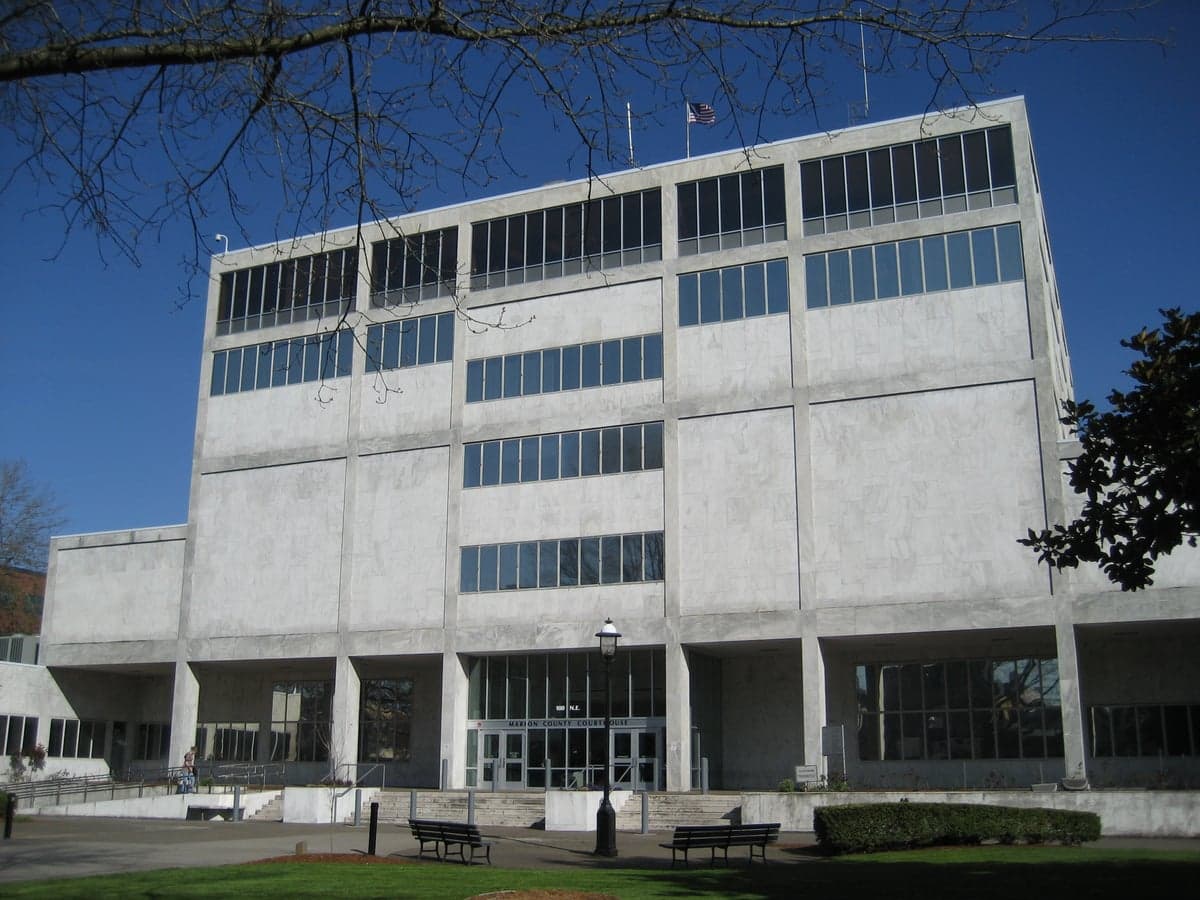
Photo: Wikipedia
Demographics of Marion County
Affluence Level in Marion County
A middle-class area roughly in line with national averages across income, home values, education, and employment.
People of Marion County
Marion County, Oregon, today is a study in contrasts: a predominantly white (61.8%) but increasingly Hispanic (28.3%) population living in a mix of the state capital Salem, its suburban satellite Keizer, and dozens of small agricultural towns like Woodburn, Silverton, and Mount Angel. The county’s identity is shaped by a deep agricultural heritage—nurseries, berry fields, and tree fruit orchards—alongside state government employment in Salem. Though only 26.0% of adults hold a four-year degree, the population is relatively stable, with 8.6% foreign-born, and the Hispanic share has more than doubled in the last three decades, shifting the cultural and political landscape.
Settlement & growth (pre-1960)
The original inhabitants were the Kalapuya people, who lived in seasonal villages along the Willamette River for millennia. European contact brought devastating epidemics, and by the 1850s most Kalapuya were forcibly removed to the Grand Ronde Reservation. American settlement began in earnest with the Oregon Trail; between 1843 and 1850, families from the Midwest and Upper South filed Donation Land Claims along the Willamette Valley, founding the city of Salem (the future capital) and towns like Silverton and Jefferson. These early settlers were predominantly American-born Protestants of English and Scots-Irish descent.
A distinct wave of German Catholic and Swiss immigrants arrived in the 1860s–1880s, drawn by land availability and religious community. They founded Mount Angel (originally named “Fillmore” before the Benedictine Abbey’s influence), Sublimity, and Stayton. Their descendants still dominate these towns’ cultural identity—Mount Angel’s Oktoberfest and St. Mary’s Catholic Church remain central. Meanwhile, smaller groups of Italian and French immigrants settled in the Salem area, working as stonemasons and vineyard laborers.
Asian immigration before 1960 was minimal but significant: Japanese farmers arrived in the first decade of the 20th century, establishing truck farms and nurseries around Woodburn and Gervais. However, most were forcibly interned during World War II, and few returned. The 1940s–1950s Bracero program brought Mexican laborers to the county’s fruit and hop fields. Many stayed, creating the first significant Hispanic enclaves in Woodburn and the agricultural south of Salem. By 1960, Marion County was 95% white (including Hispanics counted as white) and heavily rural.
Modern era (post-1965)
The 1965 Hart-Cellar Act ended national-origin quotas and triggered sustained immigration from Latin America. Mexican and, later, Central American workers steadily moved into Marion County’s agricultural sector. Today, Woodburn is over 60% Hispanic, and the Hispanic share in Salem’s “southeast” neighborhood and in Keizer has risen dramatically. This wave was joined by a smaller but visible number of Vietnamese refugees after 1975, who settled in Salem and operate restaurants and nail salons; East/Southeast Asians now make up 1.8% of the county. The Indian-subcontinent community (0.3% of the population) is even smaller, concentrated in Salem’s medical and tech fields.
Domestic migration has also reshaped the county. From the 1990s onward, Californians and other West Coast transplants seeking lower housing costs moved into expanding suburbs like Keizer, West Salem, and Aumsville. This in-migration has been mostly white and college-educated, widening the gap between Salem’s growing professional class and the rural, older white population of Silverton and Stayton. Meanwhile, the African American population remains tiny (1.1%), mostly in Salem, with roots in railroad and military service.
The result is a county where the white non-Hispanic population has slipped from roughly 85% in 1980 to 61.8% today, while the Hispanic share surged from 8% to 28.3%. The most dramatic shifts are in Woodburn and Gervais, where Hispanic residents now form the majority. The county remains politically split: Salem tilts Democratic, while the rural towns of Jefferson, Sublimity, and Mount Angel vote heavily Republican.
The future
Marion County’s Hispanic population is still growing, both through immigration and higher birth rates. Projections suggest the Hispanic share could reach 35–38% by 2040, while the white non-Hispanic share falls to around 55%. The county is not tribalizing into rigidly separate enclaves—neighborhoods in Keizer and Salem’s south side are increasingly integrated—but distinct cultural zones remain, especially Woodburn’s bilingual retail corridor and Mount Angel’s German Catholic stronghold. East/Southeast Asian and Indian communities, though small, are growing slowly through professional migration and family reunification.
In-migration from California has slowed as housing costs in the Willamette Valley have risen, but the county continues to attract families seeking a lower-cost alternative to Portland. The cultural identity of Marion County is becoming more Hispanic-influenced: bilingual signage is now common in Salem stores, and the annual “Fiesta Mexicana” in Woodburn draws tens of thousands. Yet the conservative, rural ethos in towns like Silverton and Stayton persists, anchored by farming, logging, and Evangelical and Catholic churches. The next 10–20 years will likely see a gradual blending: a younger, more diverse population living alongside older, white conservative residents, with Salem’s government and healthcare sectors acting as a moderating force.
For someone moving in now, Marion County offers a snapshot of middle America in transition—a place where agricultural tradition meets suburban growth, and where cultural change is incremental rather than abrupt. The county is not becoming a liberal bastion, nor is it resisting all change; it is evolving into a pragmatically diverse community where work—whether in government, nurseries, or warehouses—bridges many of the divides.

* Values derived from national, state, county, city and local statistics and may differ in a specific area. Last updated: 2026-05-22T20:19:50.000Z
Narrative content on this page is AI-generated and may contain mistakes. Verify any details that matter before acting on them.
ReloMaps may earn a commission from affiliate links at no extra cost to you.

