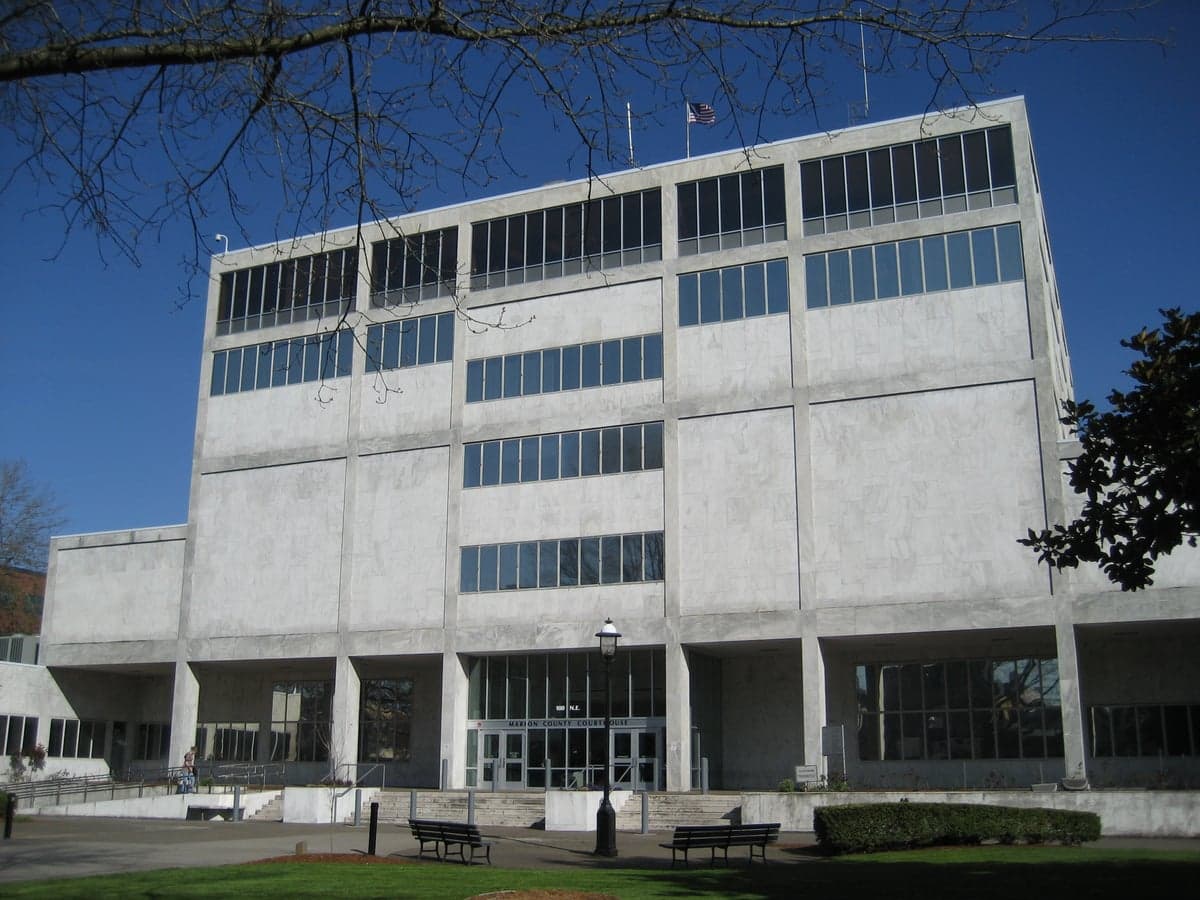
Photo: Wikipedia
Political ClimatePolitical Climate in Marion County
Showing district-level results — no local-only data available.
Local Political AnalysisPolitical Analysis of Marion County
Marion County, Oregon, has a Cook Partisan Voting Index of D+4, making it noticeably more conservative than the state as a whole, which sits at D+8. While Oregon has been trending blue for years, Marion County has held onto a more moderate-to-conservative identity, though the political winds are shifting here too. The county is a real battleground, with the city of Salem pulling hard to the left while the rural towns and farm communities push back just as hard to the right. It’s a place where you can drive 15 minutes and feel like you’ve crossed into a completely different state politically.
How it compares
The D+4 rating means Marion County is about 4 points more Republican-leaning than Oregon’s overall D+8 rating. That gap might sound small, but it plays out in real, tangible ways. In the 2022 gubernatorial race, Democrat Tina Kotek won Oregon by about 3 points, but she lost Marion County by nearly 4 points to Republican Christine Drazan. That’s a 7-point swing from the state average. The divide is stark inside the county: Salem’s urban core, especially around the state capitol and Willamette University, votes reliably blue, while towns like Silverton, Mt. Angel, and Woodburn lean red or purple. Woodburn is a fascinating swing area—its large Latino population has historically voted Democratic, but recent elections show a noticeable shift toward Republican candidates, especially on economic and public safety issues. Meanwhile, Keizer is a classic swing town, often deciding county-wide races by a few hundred votes. The rural areas east of I-5, like the communities around Stayton and Sublimity, are deeply red and feel increasingly alienated from Salem’s progressive policies.
What this means for residents
For folks who value personal freedoms and limited government, Marion County offers a bit more breathing room than Portland or Eugene, but that’s getting squeezed. The Salem City Council has pushed through zoning changes that effectively reduce single-family home neighborhoods, and the county’s health department has been aggressive with mask and vaccine mandates in past years. Property taxes are a sore spot—Oregon’s system is already complex, but Marion County’s levies for schools and libraries keep creeping up. On the plus side, the county’s Second Amendment sanctuary status, passed in 2020, means local law enforcement won’t enforce certain state gun laws they deem unconstitutional. That’s a big deal for residents who see Measure 114 (the 2022 gun control law) as a direct overreach. The tension is real: you can feel it at town halls and school board meetings, where debates over curriculum and parental rights are getting heated.
The cultural and policy distinctions in Marion County are sharp. Salem’s city government is increasingly aligned with Portland’s progressive agenda, while the county commission remains more balanced, with two Republicans and one Democrat. This creates a constant tug-of-war over land use, homelessness policies, and law enforcement funding. The long-term trend is concerning for conservatives: as Salem grows and attracts more state workers and out-of-state transplants, the county’s political center of gravity is shifting left. But the rural towns aren’t going quietly—they’re organizing, showing up at meetings, and voting in force. If you’re looking for a place where you can still have a say in how your community is run, Marion County is one of the last holdouts in western Oregon, but you’ll need to stay engaged to keep it that way.

State Political ClimatePolitical Climate in Oregon
State Political AnalysisPolitical Environment in the State
Oregon is a politically complex state with a Cook PVI of D+8, meaning it leans Democratic by a comfortable margin, but that number hides a deep and growing chasm between its urban strongholds and its vast, conservative-leaning rural interior. Over the last 20 years, the state has shifted from a purple-ish battleground to a solidly blue state at the statewide level, driven almost entirely by explosive growth in the Portland metro area and the Willamette Valley. If you’re a conservative considering a move here, you need to understand that Oregon’s politics are a tale of two states: the urban core that votes like Seattle, and the rest of the state that votes like Idaho.
Urban vs. rural divide
The political map of Oregon is stark. Multnomah County (Portland) alone delivers a Democratic margin of roughly 300,000 votes, enough to swamp the entire rest of the state. Washington County (suburban Portland) and Lane County (Eugene) add another 100,000+ Democratic votes combined. Meanwhile, the rural eastern half of the state—places like Baker City, Pendleton, and Lakeview—vote Republican by 70-80% margins. The real battlegrounds are the exurban and suburban counties that have been trending blue: Clackamas County (south of Portland) and Deschutes County (Bend) both flipped from red to blue in the last decade. Bend itself is now a liberal enclave, while its surrounding high desert remains conservative. The I-5 corridor from Portland to Eugene is a solid blue wall, while everything east of the Cascades is deep red. The coast is a mixed bag, with Astoria and Newport leaning left, but Coos Bay and Brookings staying conservative.
Policy environment
Oregon’s policy environment is a case study in progressive governance, and it’s a major reason conservatives hesitate to move here. The state has no sales tax, but it makes up for it with the highest personal income tax rate in the nation (top marginal rate of 9.9%) and high property taxes. The regulatory climate is heavy: the Oregon Land Use Act (SB 100) strictly controls development, making housing scarce and expensive. Education policy is dominated by teachers’ unions, and the state has struggled with low graduation rates and chronic absenteeism. Healthcare is heavily regulated, with a state-run insurance exchange and Medicaid expansion. Election laws are among the most progressive: Oregon was the first state to vote entirely by mail (1998), and it automatically registers voters via the DMV. There’s no voter ID law, which concerns many conservatives about election integrity. The state also has a sanctuary state law (HB 3264) that prohibits local law enforcement from cooperating with federal immigration authorities.
Trajectory & freedom
Oregon is becoming less free by almost any conservative measure. The most alarming trend is the erosion of Second Amendment rights. In 2023, the state passed Measure 114, which requires a permit to purchase a firearm, bans magazines over 10 rounds, and mandates a waiting period. It’s currently tied up in court, but the trajectory is clear. On parental rights, the state passed HB 2002 in 2023, which allows minors to access abortion and gender-affirming care without parental consent—a major red flag for conservative parents. On speech, the state has no specific anti-SLAPP law, making it easier for wealthy interests to sue critics. Medical autonomy took a hit with the state’s strict COVID-19 vaccine mandates for healthcare workers and teachers, which were among the most aggressive in the nation. Property rights are constrained by the aforementioned land use laws, and the state’s homelessness crisis has led to court rulings that effectively decriminalize camping on public property, reducing the value of urban neighborhoods. The only bright spot for freedom is the lack of a sales tax, but that’s cold comfort when income taxes are so high.
Civil unrest & political movements
Oregon has a long history of political activism, and recent years have been explosive. The Portland protests of 2020 were a national flashpoint, with months of nightly demonstrations, property destruction, and clashes between far-left antifa groups and federal law enforcement. The city became a symbol of progressive governance gone awry. On the right, the Oregon Republican Party has become more militant, with some rural counties threatening to secede and join Idaho (the “Greater Idaho” movement). In 2023, Jefferson County and Malheur County voted to explore secession, though it’s a long shot. Immigration politics are tense: the sanctuary state law has led to friction between Portland and ICE, and rural counties have passed resolutions declaring themselves “Second Amendment sanctuaries” in defiance of Measure 114. Election integrity remains a hot-button issue, with many conservatives distrusting the all-mail system, especially after the 2020 election saw widespread use of ballot drop boxes. The state’s independent redistricting commission has been criticized for gerrymandering that favors Democrats.
Projection
Over the next 5-10 years, Oregon will likely become more progressive, not less. The demographic trends are clear: the Portland metro area continues to grow, while rural counties are losing population. In-migration from California and Washington brings more left-leaning voters, and the state’s housing crisis is pushing younger, liberal renters into formerly conservative suburbs like Hillsboro and Gresham. The “Greater Idaho” movement will remain a fringe issue, but it reflects a real frustration that will only intensify. Expect more gun control, more restrictions on parental rights, and higher taxes as the state grapples with a massive pension liability (PERS) and underfunded social programs. The homelessness crisis will likely worsen, as the state’s policies have failed to reduce it. For a conservative moving in now, the best bet is to settle in a rural or exurban county like Crook County (Prineville) or Union County (La Grande), where local governance is more aligned with your values, but you’ll still be subject to state-level overreach.
Bottom line for a new resident: If you’re a conservative, Oregon is a beautiful state with a high quality of life in many areas, but you’ll be swimming against a strong political current. Your vote will be largely irrelevant in statewide elections, and you’ll face a policy environment that actively works against your values on guns, education, and parental rights. The best you can hope for is to find a like-minded community in a rural county and accept that the state government will be hostile to your worldview. If that sounds like a dealbreaker, you might be happier in Idaho or Texas. But if you’re willing to fight for your freedoms locally, Oregon’s natural beauty and lack of sales tax might still make it worth the trade-off.
* Values derived from national, state, county, city and local statistics and may differ in a specific area. Last updated: 2026-05-22T20:19:50.000Z
Narrative content on this page is AI-generated and may contain mistakes. Verify any details that matter before acting on them.
ReloMaps may earn a commission from affiliate links at no extra cost to you.

