Photo: Wikipedia
Demographics of Oswego, NY
Affluence Level in Oswego, NY
A below-average socioeconomic profile. Incomes, home values, and educational attainment trail the U.S., with higher poverty and unemployment.
People of Oswego, NY
The people of Oswego, New York, today form a small, predominantly white, working-to-middle-class community of 17,028 residents, shaped by centuries of industrial boom and bust. The city is notably less diverse than the national average, with a foreign-born population of just 0.8% and a racial makeup that is 88.6% white, 4.6% Hispanic, 1.0% Indian (subcontinent), and 0.9% Black. This is a place where deep-rooted family ties, a strong blue-collar identity, and a sense of isolation from larger Upstate metros define the local character, with a college attainment rate of 28.5% that trails state averages.
How the city was settled and grew
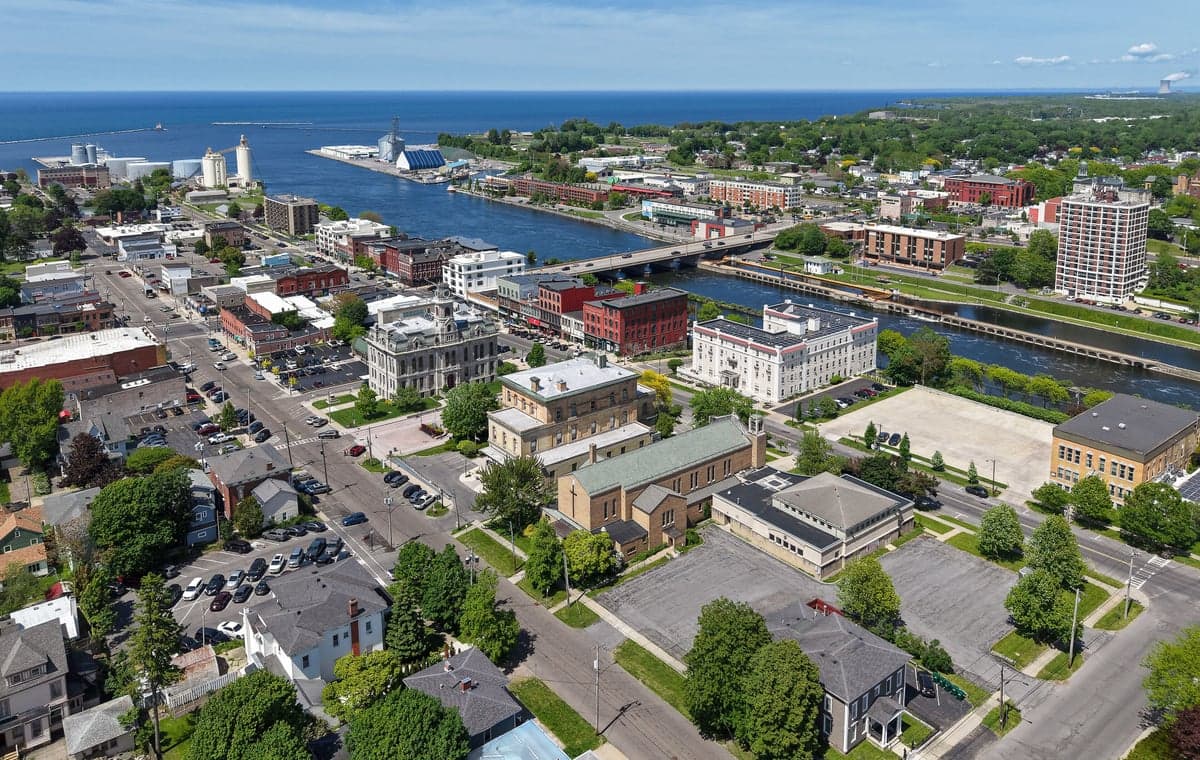
Oswego’s human history begins with its strategic location at the mouth of the Oswego River on Lake Ontario, a natural gateway for the fur trade and military fortification. The first major wave of European settlers arrived after the American Revolution, with land grants drawing Yankees from New England and New York’s Hudson Valley. These early settlers established the core of what is now the West Side Historic District, building Federal-style homes and the first commercial wharves. The city’s explosive growth came in the 19th century with the opening of the Erie Canal’s Oswego Canal in 1828, which turned the port into a major hub for grain, lumber, and coal. This industrial boom drew a massive wave of Irish immigrants, who dug the canal and built the railroads, settling in the working-class neighborhoods of Fourth Ward (east of the river) and the area around East Seneca Street. They were followed by German and Polish immigrants in the late 1800s, who found work in the city’s flour mills, paper mills, and foundries. These groups concentrated in the First Ward (west of the river, near the lakefront) and the East Side neighborhoods around East Utica Street, building distinct ethnic parishes like St. Mary’s (Irish) and St. Paul’s (German). By 1900, Oswego was a bustling industrial city of over 22,000, overwhelmingly white and European-born.
Modern era (post-1965)
Post-1965, Oswego did not experience the large-scale immigration from Asia, Africa, or Latin America seen in many U.S. cities. The city’s industrial base began a long decline after World War II, with the closure of major mills and factories, leading to population loss and economic stagnation. The foreign-born share fell to its current 0.8%, and the city became more ethnically homogeneous. The small Hispanic population (4.6%) is largely of Puerto Rican descent, with families concentrated in the Washington Square area and the lower-income rental stock near the SUNY Oswego campus. The Indian (subcontinent) community (1.0%) is a very recent addition, almost entirely tied to the university and the local hospital system, with households scattered in the Lake Ontario Bluff area and newer subdivisions west of the city. The East/Southeast Asian community (0.7%) is similarly small and university-linked. The Black population (0.9%) has remained tiny and stable, with no historic Black neighborhood forming; families are dispersed across the city’s older housing stock. The dominant demographic trend has been the out-migration of young adults seeking jobs elsewhere, leaving an aging white population and a shrinking tax base.
The future
Oswego’s population is projected to continue a slow decline, mirroring the broader Upstate New York trend. The city is not becoming more diverse in any meaningful sense; the white share remains above 88%, and the small minority populations are growing only incrementally, primarily through university-related migration. The Hispanic share may rise slightly as families move from larger Upstate cities like Syracuse for lower housing costs, but this is a trickle, not a wave. The Indian and East/Southeast Asian communities will likely remain small and tied to SUNY Oswego and the health sector, with no single neighborhood emerging as an ethnic enclave. The cultural identity of the city is evolving from a fading industrial port to a college town and a bedroom community for Syracuse commuters. For someone moving in now, Oswego offers a stable, low-cost, and safe environment, but one with limited economic opportunity and little racial or ethnic diversity. The city’s future depends on whether it can attract new residents beyond the university orbit, a challenge that has so far gone unmet.
In short, Oswego is a historically white, working-class city that has become quieter and more insular as its industries have left. The population is aging, slowly shrinking, and only marginally diversifying through the university. A new resident should expect a tight-knit, traditional community where change comes slowly and where the dominant culture remains rooted in the city’s Irish, German, and Polish past.

* Values derived from national, state, county, city and local statistics and may differ in a specific area. Last updated: 2026-08-12T18:27:45.000Z
Narrative content on this page is AI-generated and may contain mistakes. Verify any details that matter before acting on them.
ReloMaps may earn a commission from affiliate links at no extra cost to you.

