Photo: Wikipedia
Demographics of Oxford, AL
Affluence Level in Oxford, AL
A middle-class area roughly in line with national averages across income, home values, education, and employment.
People of Oxford, AL
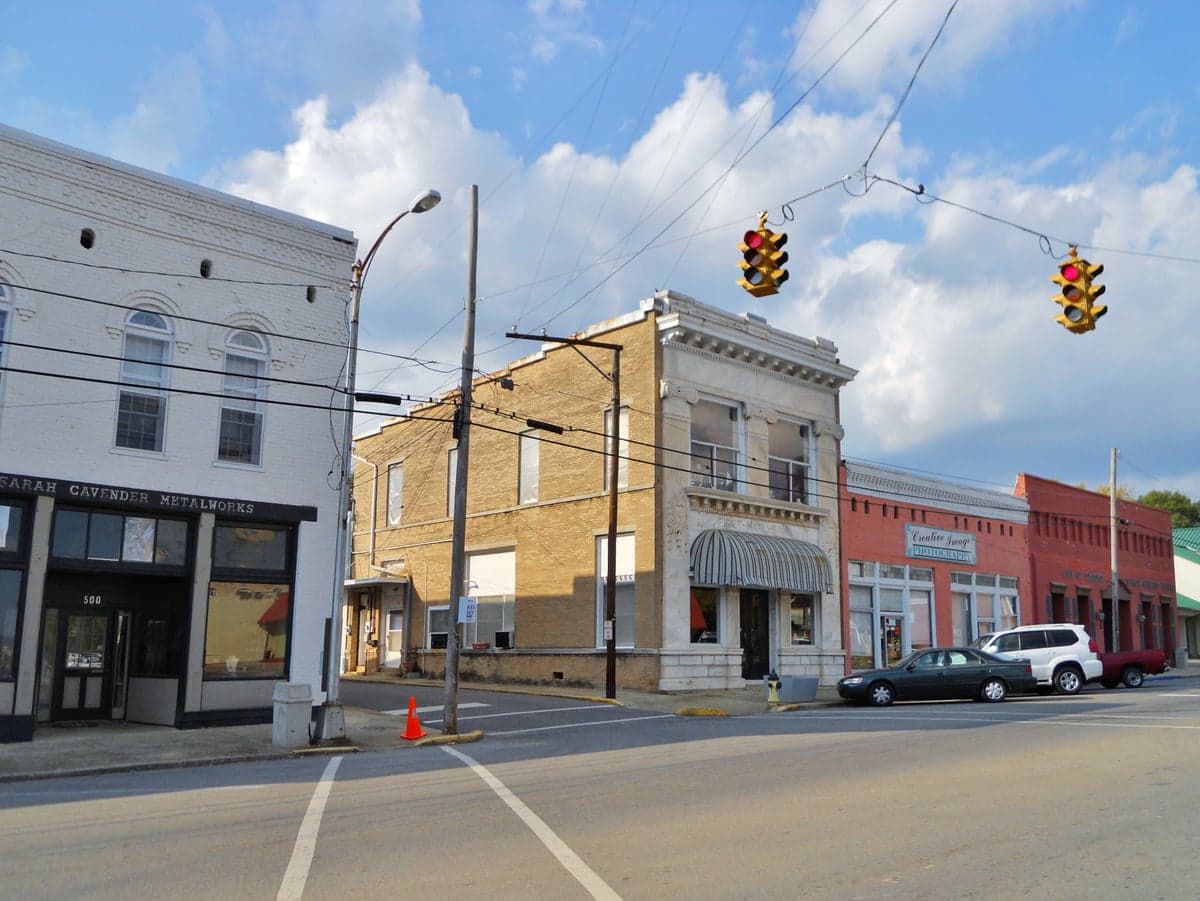
The people of Oxford, Alabama, today number 22,063, forming a predominantly white (73.0%) and native-born (97.0% U.S.-born) community with a notable Black minority (16.3%) and a small but growing Hispanic presence (6.3%). The city’s character is distinctly suburban and family-oriented, anchored by a strong sense of local identity tied to its schools, churches, and the nearby Talladega National Forest. With only 24.8% of adults holding a college degree, the population skews toward working-class and middle-class households employed in manufacturing, retail, and healthcare, giving Oxford a practical, blue-collar feel rather than a cosmopolitan one.
How the city was settled and grew
Oxford was originally settled in the 1830s as a small farming community along the Choccolocco Creek, drawing Anglo-American families from Georgia and the Carolinas who were granted land through the Cherokee Removal and subsequent land lotteries. The arrival of the Selma, Rome and Dalton Railroad in the 1880s transformed the hamlet into a cotton-shipping depot, attracting a wave of white tenant farmers and sharecroppers who built modest homes in what is now the Historic Oxford Depot District. By the early 1900s, a small Black population had formed, concentrated in the Choccolocco Bottom area near the creek, where they worked as farm laborers and domestic servants. The city incorporated in 1902, and through the mid-20th century, growth remained slow and rural, with the population hovering around 1,500 as late as 1950.
Modern era (post-1965)
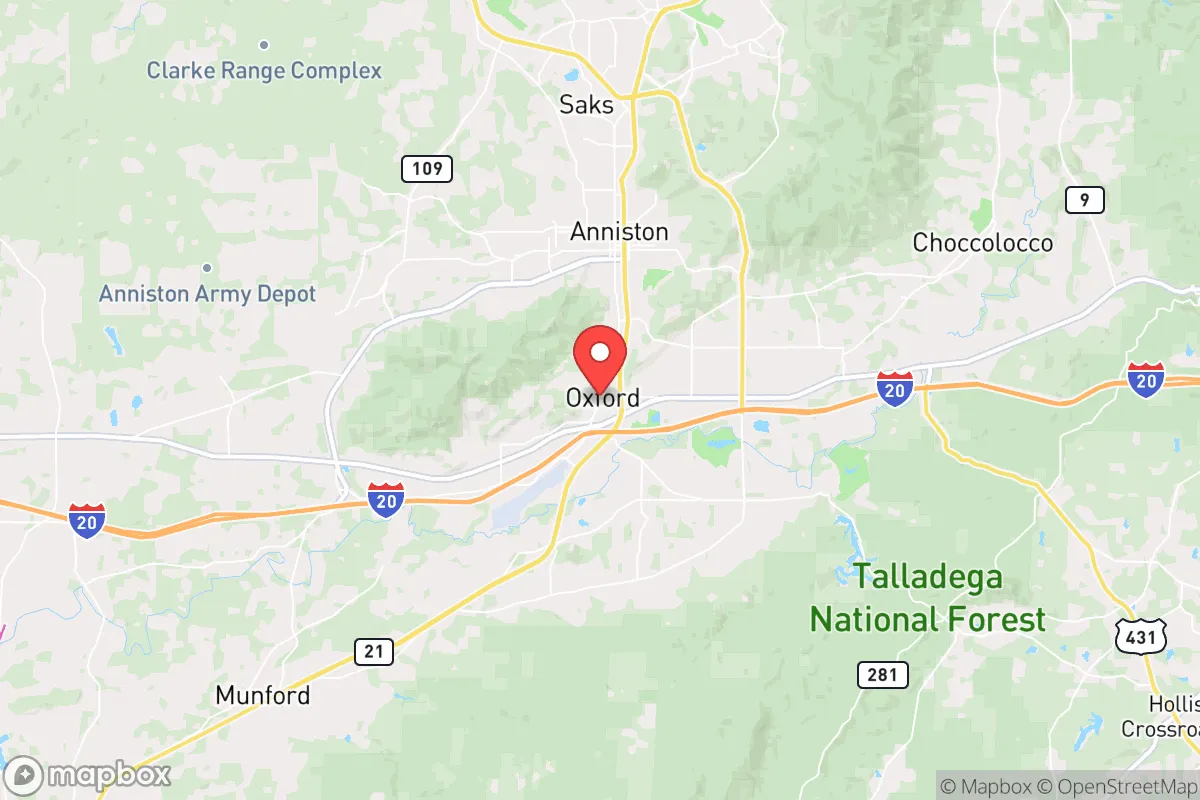
The post-1965 period brought dramatic change. The completion of Interstate 20 in the 1970s made Oxford a bedroom community for Anniston and the expanding Fort McClellan military base, triggering suburban-style development. White families from Anniston and surrounding rural areas moved into new subdivisions like Sunset Ridge and Deerwood Estates, drawn by lower taxes and newer schools. The Black population, which had been largely rural and concentrated in Choccolocco Bottom, began moving into the East Oxford area near the city’s eastern edge, where affordable housing developments opened in the 1980s and 1990s. Hispanic migration began in the late 1990s, driven by construction and poultry-processing jobs at nearby plants in Gadsden and Piedmont; these families settled primarily in the Golden Springs corridor along U.S. 78, where rental apartments and mobile home parks offered low-cost entry. The Asian population (1.0%) is almost entirely East and Southeast Asian, with a small cluster of Vietnamese and Filipino families who arrived after 2000, mostly working in healthcare and manufacturing; they are scattered rather than concentrated in a single neighborhood. The Indian-subcontinent population (0.1%) is negligible, limited to a handful of professionals in the medical field.
The future
Oxford’s population is projected to grow modestly, reaching roughly 25,000 by 2040, driven by continued spillover from Anniston and the expansion of the Honda Manufacturing of Alabama plant in nearby Lincoln. The white share is slowly declining (down from 80% in 2000) as the Hispanic and Black shares inch upward, but the city is not experiencing rapid diversification—the foreign-born share remains just 3.0%, well below the national average. The Hispanic community is growing organically through family reunification and higher birth rates, but it remains small enough that assimilation into the broader white working-class culture is the norm; no distinct ethnic enclave has formed. The Black population is stable at roughly 16%, concentrated in East Oxford and older sections of the Depot District, but there is little new Black in-migration. The city is homogenizing in terms of lifestyle—new subdivisions like Oxford Commons are attracting a mix of white and Hispanic families who share similar income levels and school preferences—while remaining tribalized by neighborhood, with clear racial boundaries between East Oxford, Golden Springs, and the newer white-majority subdivisions.
For someone moving in now, Oxford is a stable, slow-growing Southern suburb where the population is becoming slightly more diverse but remains overwhelmingly native-born and English-speaking. The practical implication is that newcomers will find a community where racial lines are visible but not volatile, schools are a priority, and the social fabric is built around church, family, and local sports rather than ethnic or cultural institutions. It is not a place of rapid demographic change, but one of gradual, quiet evolution.

* Values derived from national, state, county, city and local statistics and may differ in a specific area. Last updated: 2026-04-19T19:03:59.000Z
Narrative content on this page is AI-generated and may contain mistakes. Verify any details that matter before acting on them.
ReloMaps may earn a commission from affiliate links at no extra cost to you.

