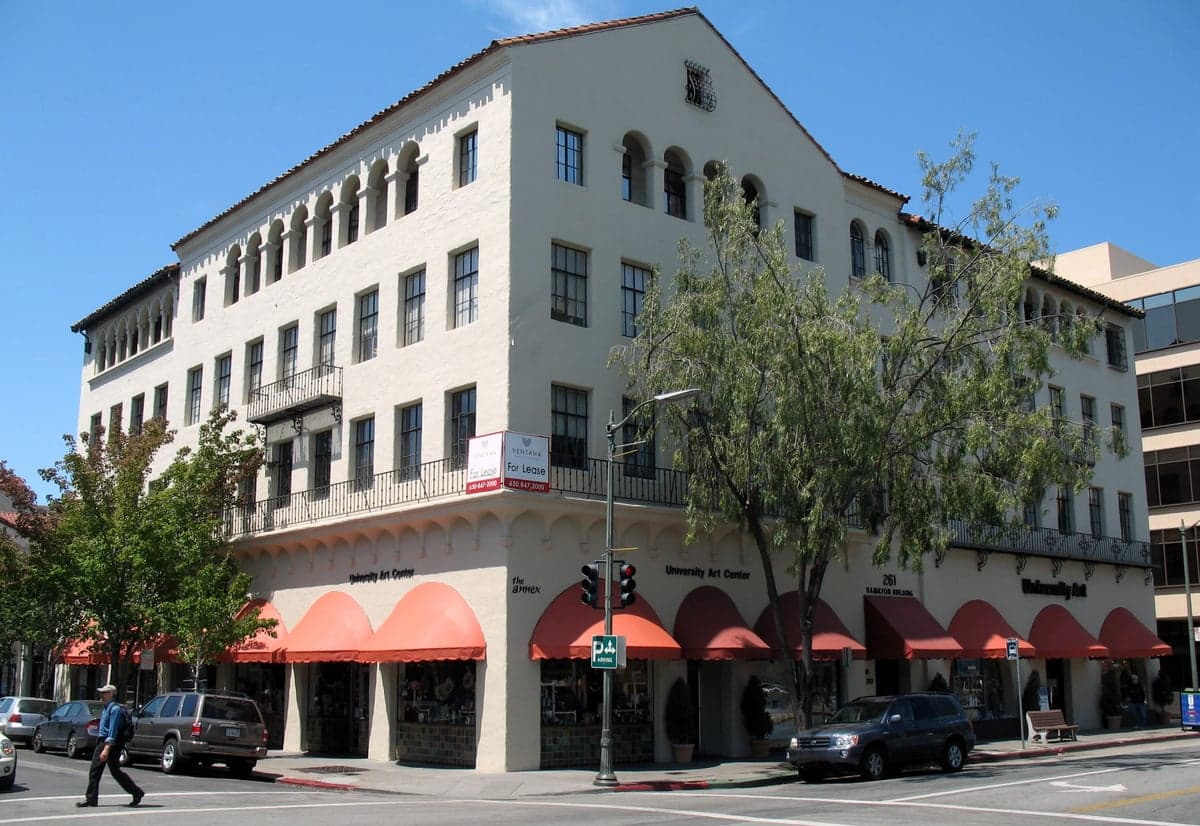
Photo: Wikipedia
Demographics of Palo Alto, CA
Affluence Level in Palo Alto, CA
An elite concentration of wealth — high incomes, strong home values, advanced degrees, and minimal poverty signal a top-tier socioeconomic profile.
People of Palo Alto, CA
Palo Alto’s 67,231 residents form one of the most highly educated and professionally concentrated populations in the United States, with 82.4% holding a bachelor’s degree or higher. The city is predominantly white (47.3%) and East/Southeast Asian (29.3%), with a notable Indian-subcontinent community (6.8%) and a small Hispanic (7.1%) and Black (2.1%) presence. Foreign-born residents make up 15.6% of the population, a figure that understates the cultural and economic influence of immigrant-founded tech families. The city’s identity is defined less by ethnic diversity than by a shared professional culture rooted in the technology sector, creating a dense, affluent, and politically progressive environment that nonetheless exhibits sharp internal economic divides.
How the city was settled and grew
Palo Alto was founded in 1894 by Leland Stanford, who established Stanford University on his former horse farm and envisioned a residential community for faculty and staff. The original population was overwhelmingly white, Anglo-Saxon Protestant, drawn from the East Coast academic elite and local ranching families. The Professorville neighborhood, just west of downtown, was built specifically for Stanford professors in the 1890s and remains a historic district of Craftsman homes. A second wave arrived during World War II, when the U.S. Navy established Moffett Field and the Ames Research Center nearby, bringing engineers and military personnel. These workers settled in the Evergreen Park and Midtown neighborhoods, which were developed as modest single-family subdivisions in the 1940s and 1950s. The postwar boom also attracted a small but growing Hispanic population, primarily Mexican-American laborers who worked in agriculture and construction; they concentrated in the Ventura neighborhood, a working-class area near the southern edge of the city that remains the most Hispanic part of Palo Alto today.
Modern era (post-1965)
The 1965 Hart-Cellar Act opened immigration from Asia, and Palo Alto’s proximity to Stanford and the emerging tech corridor made it a magnet for highly skilled East/Southeast Asian professionals. Chinese and Taiwanese engineers arrived first in the 1970s and 1980s, settling in Barron Park and Green Acres, neighborhoods with large lots and good schools. Korean and Vietnamese families followed in the 1990s, often clustering in the South of Oregon Expressway area, where newer townhouse developments offered entry points for dual-income tech households. The Indian-subcontinent community grew later and more rapidly, accelerating after 2000 as H-1B visa holders and Stanford graduate students established roots. Indian families concentrated in College Terrace, near the university, and in the Duveneck/St. Francis area, drawn by the high-performing elementary schools. Domestic in-migration during this period was dominated by white and Asian professionals from other tech hubs—Seattle, Boston, the Bay Area itself—who bought into established neighborhoods like Old Palo Alto and Crescent Park, pushing home prices above $3 million. The Hispanic share of the population declined from roughly 12% in 1990 to 7.1% today, as rising rents displaced many working-class families from Ventura and the few remaining affordable pockets.
The future
Palo Alto’s population is homogenizing along educational and income lines rather than tribalizing into distinct ethnic enclaves. The East/Southeast Asian and Indian communities are increasingly assimilated into the same professional class as white residents, living in the same neighborhoods and sending children to the same schools. The Hispanic population is plateauing at a low share, with little new immigration from Latin America and ongoing out-migration to more affordable cities like East Palo Alto and San Jose. The Black population, already tiny at 2.1%, has been stable for decades and shows no sign of growth. Over the next 10–20 years, Palo Alto will likely become even more dominated by tech-sector households, with foreign-born residents remaining a steady 15–18% of the population but shifting toward higher-skilled, higher-income streams from China, India, and South Korea. The city’s strict zoning laws and limited housing construction mean that population growth will be minimal—projections suggest 68,000–70,000 by 2040—and that new arrivals will increasingly be those who can afford $2 million entry-level homes. The working-class and middle-class diversity that once characterized Ventura and parts of Midtown will continue to erode.
Palo Alto is becoming a city of tech professionals and their families, where educational attainment and income matter more than ethnic background for social integration. For a conservative-leaning mover, this means a community that is safe, highly educated, and politically liberal, but also expensive and increasingly homogeneous in lifestyle and worldview. The city offers exceptional schools and low crime, but little economic or cultural diversity outside the professional class. Anyone moving in should expect a population that values achievement, order, and environmentalism, and that is largely comfortable with the trade-offs of extreme affluence and limited demographic change.

* Values derived from national, state, county, city and local statistics and may differ in a specific area. Last updated: 2026-04-15T23:40:51.000Z
Narrative content on this page is AI-generated and may contain mistakes. Verify any details that matter before acting on them.
ReloMaps may earn a commission from affiliate links at no extra cost to you.

