Photo: Wikipedia
Demographics of Pawtucket, RI
Affluence Level in Pawtucket, RI
A middle-class area roughly in line with national averages across income, home values, education, and employment.
People of Pawtucket, RI
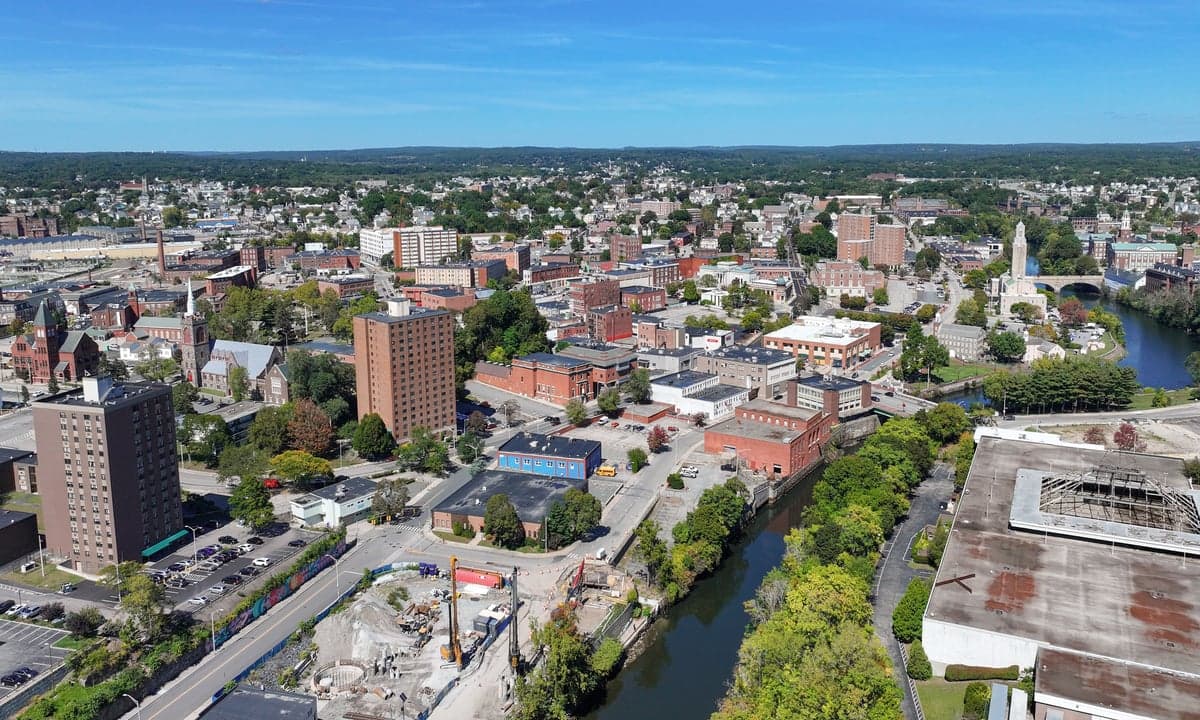
The people of Pawtucket, Rhode Island today number 75,280, forming a dense, working-class city with a distinctly diverse character. The population is majority-minority, with a White share of 47.7%, a Hispanic share of 24.6%, and a Black share of 12.6%, alongside smaller East/Southeast Asian (0.8%) and Indian subcontinent (0.6%) communities. Only 23.5% of adults hold a college degree, reflecting the city's historic blue-collar identity, while 8.1% of residents are foreign-born, a figure that has reshaped neighborhoods over the past half-century. Pawtucket is a city of distinct ethnic enclaves, where the legacy of 19th-century immigration meets a newer wave of Hispanic and Black settlement, creating a patchwork of communities that remain economically modest but culturally vibrant.
How the city was settled and grew
Pawtucket's population history begins with its role as the birthplace of the American Industrial Revolution. Samuel Slater's 1793 cotton-spinning mill on the Blackstone River drew the first major wave of workers: English and Scottish millwrights who built the early mills and settled in the Slater Park and Woodlawn neighborhoods. By the 1840s, the city's textile mills attracted a massive influx of Irish immigrants fleeing the Great Famine, who formed the backbone of the labor force and established St. Mary's Church in the Fairlawn district. The late 19th century brought French-Canadian families from Quebec, who clustered in the Darlington neighborhood around St. Cecilia's Church, creating a distinct Franco-American enclave that persists today. A final pre-1900 wave of Portuguese and Polish immigrants arrived for mill and jewelry work, settling in the Oak Hill area, where their descendants still maintain cultural societies. By 1920, Pawtucket's population peaked near 77,000, overwhelmingly White and European-born, with a dense urban fabric of triple-decker homes and corner stores.
Modern era (post-1965)
The 1965 Hart-Cellar Act and the decline of textile manufacturing fundamentally reshaped Pawtucket's population. As mills closed through the 1970s and 1980s, White ethnic families began leaving for suburban towns like Lincoln and Cumberland, opening housing in older neighborhoods. The Woodlawn and Fairlawn districts absorbed the first significant Hispanic arrivals, primarily Puerto Ricans and Dominicans, who found affordable triple-deckers and proximity to service jobs. By 2000, the Hispanic share had risen to 15%, concentrated along the Broad Street corridor. The Darlington neighborhood saw a smaller but notable influx of Black families, many moving from Providence for cheaper rents, while the Oak Hill area retained its Portuguese and Polish character but aged significantly. The city's East/Southeast Asian population (0.8%) is tiny and scattered, with no single enclave, while the Indian subcontinent community (0.6%) is even smaller, mostly professionals renting near the I-95 corridor. The White share dropped from 85% in 1980 to 47.7% today, a dramatic shift driven by both out-migration and Hispanic in-migration.
The future
Pawtucket's population is heading toward further diversification, but at a slowing pace. The Hispanic share, now 24.6%, is projected to reach 30-35% by 2040, driven by natural increase and continued migration from Central America. The Black share (12.6%) is stable, with growth limited by competition from cheaper suburbs like Central Falls. The White share will continue to decline, but the rate is slowing as the remaining White population—largely elderly Franco-Americans and Portuguese in Darlington and Oak Hill—ages in place. The city is not homogenizing; instead, it is tribalizing into distinct enclaves: Hispanic Woodlawn, Black Fairlawn, and aging White Darlington. The foreign-born share (8.1%) is plateauing, as second-generation Hispanic families assimilate and move to mixed-income suburbs. The next decade will likely see Pawtucket become a majority-Hispanic city, with a smaller but persistent Black minority and a shrinking White ethnic base.
For someone moving in now, Pawtucket is becoming a predominantly Hispanic working-class city with distinct ethnic pockets. The population is younger and more diverse than surrounding suburbs, but educational attainment remains low, and economic opportunity is tied to service and healthcare jobs rather than manufacturing. The city offers affordable housing and a dense, walkable urban feel, but the demographic trajectory points toward a future where Hispanic culture dominates public life, while older White and Black enclaves persist as smaller, aging communities. It is a place of transition, not stagnation—but the transition is toward a more homogeneous Hispanic identity, not a melting pot.

* Values derived from national, state, county, city and local statistics and may differ in a specific area. Last updated: 2026-04-20T17:55:19.000Z
Narrative content on this page is AI-generated and may contain mistakes. Verify any details that matter before acting on them.
ReloMaps may earn a commission from affiliate links at no extra cost to you.

