
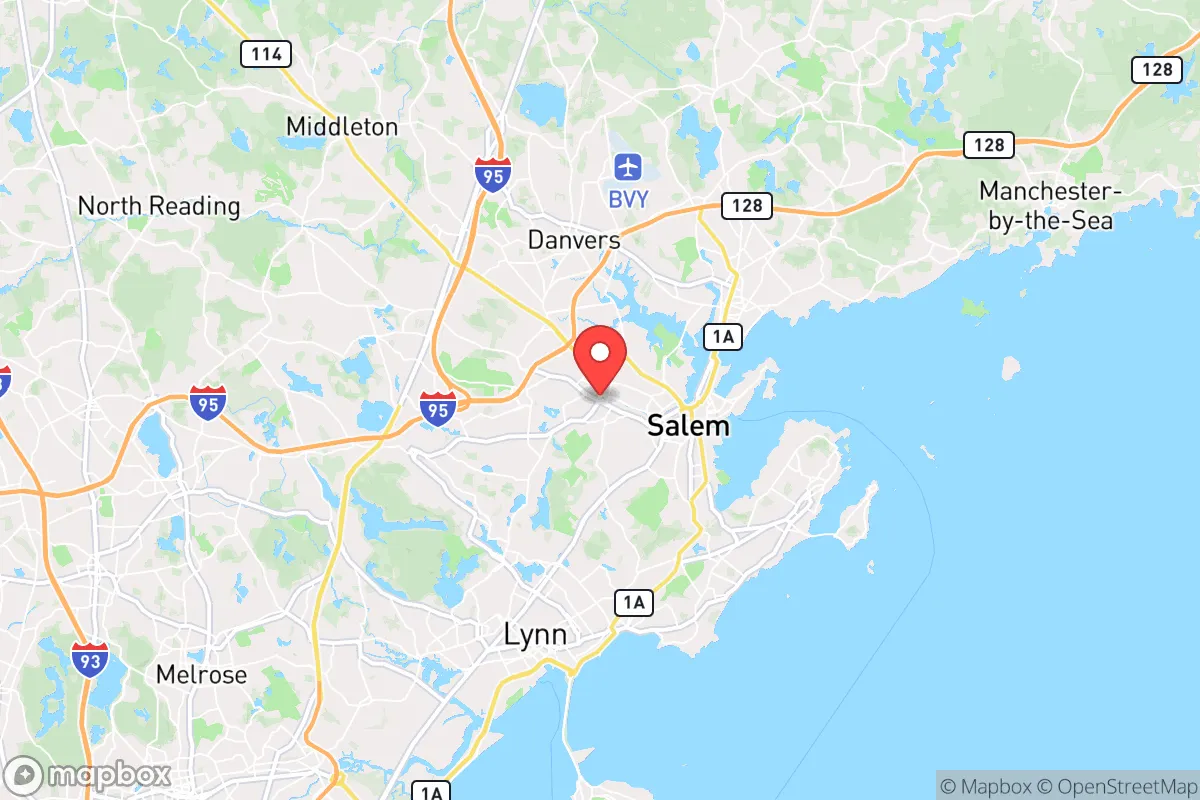
Photo: Wikipedia
Personal Sovereignty in Peabody, MA
Moderate friction. Expect trade-offs in some aspect of personal liberty and independence.
What does Personal Sovereignty tell us?
Personal Sovereignty measures your capacity for self-reliance and independence with minimal government friction. Higher scores mean fewer barriers between you and the way you want to live... but it assumes you have the space you need and good neighbors.
What does this tell us?
Personal Sovereignty measures your capacity for self-reliance and independence with minimal government friction. Higher scores mean fewer barriers between you and the way you want to live... but it assumes you have the space you need and good neighbors.
State Policy
Energy independence: Importer (5% of energy produced in-state)
Personal Liberty
Homesteading

Personal Liberty Analysis
Peabody, Massachusetts, presents a complex picture for those prioritizing personal sovereignty, where the state’s progressive regulatory framework often clashes with individual autonomy. While the city itself offers a relatively stable, family-oriented environment, residents must navigate a web of state-level mandates that significantly constrain personal choice in areas like taxation, self-defense, and medical freedom. For a conservative-leaning individual or parent evaluating relocation, Peabody’s appeal lies in its community stability and access to resources, but the trade-off is a persistent tension with state government overreach that demands careful strategic consideration.
Tax burden and regulatory posture in Peabody
Massachusetts is a high-tax state, and Peabody residents feel this acutely. The state’s income tax rate is a flat 5.0% on most income, with a surtax of 4% on income over $1 million, and the sales tax is 6.25%. Property taxes in Peabody are moderate for the region, with a rate of approximately $12.50 per $1,000 of assessed value (2025 data), but home values are high—median home prices hover around $550,000—meaning a typical annual property tax bill can exceed $6,800. The regulatory environment is dense: Massachusetts has strict building codes, environmental regulations (including the Wetlands Protection Act), and a statewide energy code that pushes for electrification, limiting options for off-grid or alternative energy setups. Zoning in Peabody is primarily suburban residential, with most lots between 0.1 and 0.5 acres, making large-scale self-sufficiency projects difficult without variances. The state’s vehicle excise tax (a yearly tax on car value) and high registration fees add another layer of cost. For a prepper or survivalist, the cumulative tax burden and regulatory red tape mean less disposable income for preparedness supplies and fewer legal pathways to build independent infrastructure.
Self-defense and gun law specifics in Massachusetts
Massachusetts has some of the most restrictive gun laws in the nation, and Peabody residents must comply fully. The state requires a License to Carry (LTC) for both open and concealed carry, which is issued by the local police department—in Peabody, the chief has discretion, and approvals are generally consistent but can be delayed. The LTC process includes a background check, fingerprinting, a firearms safety course, and a fee of around $100. Assault weapons are banned by state law, as are magazines holding more than 10 rounds. The state also has a “red flag” law (Extreme Risk Protective Order) allowing authorities to seize firearms based on a complaint, with no criminal conviction required. Stand-your-ground laws do not exist; Massachusetts imposes a duty to retreat before using deadly force in public, though the Castle Doctrine applies inside one’s home. For a conservative concerned with self-defense, these laws represent significant government overreach into a fundamental right. Peabody’s police department is professional but operates within this restrictive framework, meaning any self-defense incident will be scrutinized under state law. Stockpiling ammunition or firearms for preparedness is legally constrained, and out-of-state purchases are heavily regulated. The practical takeaway: if gun rights are a non-negotiable priority, Peabody—and Massachusetts as a whole—is a challenging environment.
Self-reliance and homesteading viability in Peabody
Peabody’s suburban density and zoning codes limit traditional homesteading. Most residential lots are 0.1 to 0.25 acres, with a few larger parcels in the more rural West Peabody area. Raising chickens is allowed with a permit, but no livestock (goats, pigs, etc.) is permitted on standard residential lots. Gardening is unrestricted, but soil contamination from the city’s industrial past (tanneries, leather works) is a concern—raised beds with tested soil are advisable. Off-grid living is effectively illegal: the city requires connection to municipal water and sewer, and solar panels must be grid-tied under state net metering rules. Rainwater collection is allowed but limited to 55 gallons per downspout for outdoor use only. For a prepper, the lack of land and restrictive building codes mean self-reliance must focus on urban preparedness: stockpiling food, water filtration, and community networking. The nearby North Shore offers coastal foraging and fishing (with a state license), but public access is limited. The Essex County Greenbelt provides some open space, but it’s not private. In short, Peabody is not a homesteading destination; it’s a place for those who prioritize community stability and urban amenities over land-based self-sufficiency.
Personal liberties: parental rights, medical autonomy, speech, and property
Massachusetts has a strong record of state intervention in personal and family matters, which directly impacts parental rights and medical autonomy. The state mandates comprehensive sex education in public schools (opt-out allowed but not widely advertised) and has a vaccination requirement for school attendance—only medical exemptions are accepted, not religious or philosophical. During the COVID-19 pandemic, Massachusetts had one of the nation’s longest-lasting mask mandates and vaccine requirements for healthcare workers, reflecting a pattern of government control over health decisions. Parental rights are further limited by the state’s “Chapter 119” child welfare laws, which give the Department of Children and Families broad authority to investigate and intervene in family matters based on anonymous reports. Medical freedom is constrained: the state has a prescription drug monitoring program and strict telemedicine laws. On speech, Massachusetts has a public nuisance law that has been used to target protestors, and the state’s hate crime statutes add penalties for speech deemed biased. Property rights are relatively strong for existing homeowners, but the state’s Chapter 40B law allows developers to bypass local zoning for affordable housing projects, which can disrupt neighborhood character. For a conservative, these policies represent a steady erosion of personal sovereignty, with the state acting as a de facto arbiter of family and health decisions.
Overall, Peabody offers a mixed sovereignty profile. The city itself is safe, with a strong sense of community and good schools, but it sits within a state that actively limits personal freedoms through high taxes, restrictive gun laws, and intrusive health and education mandates. For a survivalist or prepper, the area’s strengths—proximity to the coast, access to Boston’s medical and economic resources, and a stable local government—are offset by the constant need to navigate state overreach. Compared to states like New Hampshire or Texas, where personal sovereignty is more robust, Peabody requires a defensive posture: focus on legal compliance, urban preparedness, and building local networks. It’s a place for those who can adapt to a high-regulation environment while quietly maintaining their own autonomy, not for those seeking a frontier of freedom.

* Values derived from national, state, county, city and local statistics and may differ in a specific area. Last updated: 2026-04-19T10:18:06.000Z
Narrative content on this page is AI-generated and may contain mistakes. Verify any details that matter before acting on them.
ReloMaps may earn a commission from affiliate links at no extra cost to you.

