Photo: Wikipedia
Demographics of Pecos, TX
Historical data isn't available for Pecos, TX. Trends shown are for Reeves County, TX.
Affluence Level in Pecos, TX
A low-income area with significant economic hardship. Household wealth and educational attainment are well below national averages.
People of Pecos, TX
The people of Pecos, Texas today form a predominantly Hispanic community of 11,485 residents, with 86.9% identifying as Hispanic or Latino, 10.9% as White alone, and small Black (1.6%), East/Southeast Asian (0.1%), and Indian subcontinent (0.3%) populations. The city is notably young and family-oriented, with a median age around 30, and carries a distinctive West Texas borderlands character shaped by generations of railroad, oil, and agricultural work. Foreign-born residents make up 12.1% of the population, a share that reflects ongoing cross-border ties rather than recent rapid immigration. Pecos remains a working-class town where Spanish is widely spoken and where community life centers on family, church, and the annual Cantaloupe Festival.
How the city was settled and grew
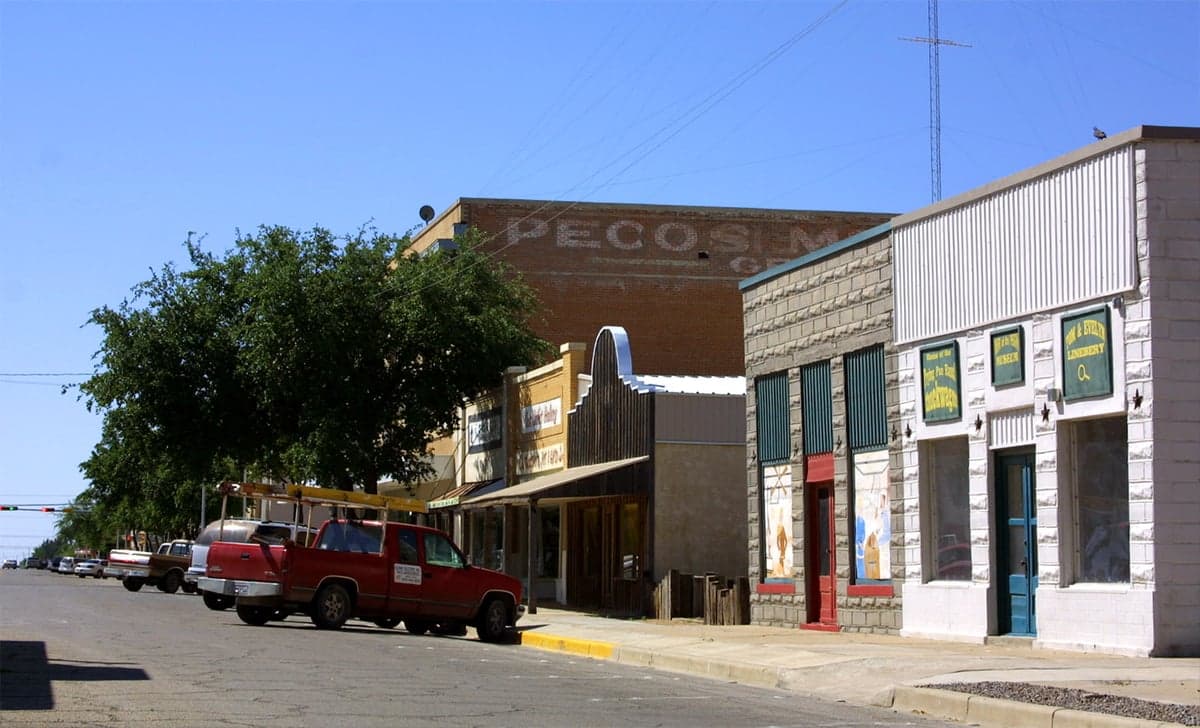
Pecos was founded in 1881 as a railroad town on the Texas and Pacific Railway, which drew the first wave of settlers: Anglo-American railroad workers, cattle ranchers, and merchants who built the original downtown Pecos district around the depot. The city's early growth was fueled by the arrival of the railroad and the subsequent development of irrigated agriculture, particularly cantaloupe farming, which earned Pecos the title "Cantaloupe Capital of the World." By the early 1900s, Mexican and Mexican-American laborers began arriving in significant numbers to work the railroad and the expanding cotton and cantaloupe fields, settling in what became known as Barrio Segundo and Barrio Tercero — historically Hispanic neighborhoods south of the railroad tracks. The oil boom of the 1920s and 1930s brought a second wave of Anglo and Mexican workers, with oilfield camps and new housing sprouting in the West Pecos area. By 1950, Pecos had grown to roughly 8,000 residents, with a population that was roughly two-thirds Anglo and one-third Hispanic, living in largely separate neighborhoods — Anglos concentrated north of the tracks in North Pecos and around the courthouse square, while Hispanic families remained in the barrios to the south and east.
Modern era (post-1965)
The post-1965 period brought dramatic demographic change to Pecos, driven by the Immigration and Nationality Act of 1965 and the expansion of oil and gas employment in the Permian Basin. Hispanic in-migration accelerated through the 1970s and 1980s, as families from the Rio Grande Valley and northern Mexico moved to Pecos for work in the oil fields and in the expanding service sector. By 1990, the Hispanic share of the population had risen to roughly 60%, and by 2000 it exceeded 75%. The East Pecos neighborhood, originally settled by Anglo and Black families in the mid-20th century, saw significant Hispanic in-migration and is now predominantly Hispanic. The South Pecos area, including the old Barrio Segundo and Barrio Tercero, remains overwhelmingly Hispanic and working-class, with many homes dating to the 1920s-1950s. The Anglo population, which once dominated the city's civic and business life, has steadily declined through out-migration to larger Texas cities and through natural demographic change. Today, the North Pecos neighborhood retains the highest concentration of non-Hispanic White residents, though even there the share has fallen below 30%. The Black population, never large, has remained stable at around 1-2% since the 1970s, concentrated in the East Pecos area near the old segregated school sites. The East/Southeast Asian and Indian subcontinent populations are negligible, reflecting Pecos's limited draw for professional immigrants compared to larger Texas metros.
The future
Pecos's population is trending toward further homogenization as the Hispanic share continues to rise and the Anglo share continues to shrink. The city's population has been roughly flat since 2010, fluctuating between 11,000 and 12,000, suggesting that out-migration of non-Hispanic families roughly balances Hispanic natural increase and limited new immigration. The foreign-born share of 12.1% is moderate by Texas standards and has not risen sharply in recent years, indicating that the Hispanic growth is primarily driven by U.S.-born families rather than new arrivals. The college-educated share of just 7.2% — far below the Texas average of roughly 32% — points to a workforce that remains oriented toward blue-collar and service jobs in oil, agriculture, and retail. Over the next 10-20 years, Pecos is likely to become even more uniformly Hispanic, with the non-Hispanic White population potentially falling below 5% by 2040. The city shows little sign of tribalizing into distinct ethnic enclaves; instead, the remaining Anglo and Black residents are increasingly dispersed across neighborhoods that are becoming predominantly Hispanic. For a newcomer, Pecos offers a stable, family-oriented, Spanish-influenced community with a strong local identity, but limited economic and educational diversity.
Pecos is becoming a nearly monolithic Hispanic working-class town, shaped by deep roots in railroad, oil, and agricultural labor, with a population that is young, family-centered, and locally anchored. For someone moving in now, the city offers a tight-knit, culturally cohesive environment where Spanish fluency is an asset and where the economy remains tied to the Permian Basin's oil cycles. The trade-off is limited professional opportunity, low educational attainment, and a demographic trajectory that will make Pecos even more homogeneous in the years ahead.

* Values derived from national, state, county, city and local statistics and may differ in a specific area. Last updated: 2026-04-22T02:13:51.000Z
Narrative content on this page is AI-generated and may contain mistakes. Verify any details that matter before acting on them.
ReloMaps may earn a commission from affiliate links at no extra cost to you.

