 Popular
Photo: Wikipedia
Demographics of Pella, IA
Affluence Level in Pella, IA
A middle-class area roughly in line with national averages across income, home values, education, and employment.
People of Pella, IA
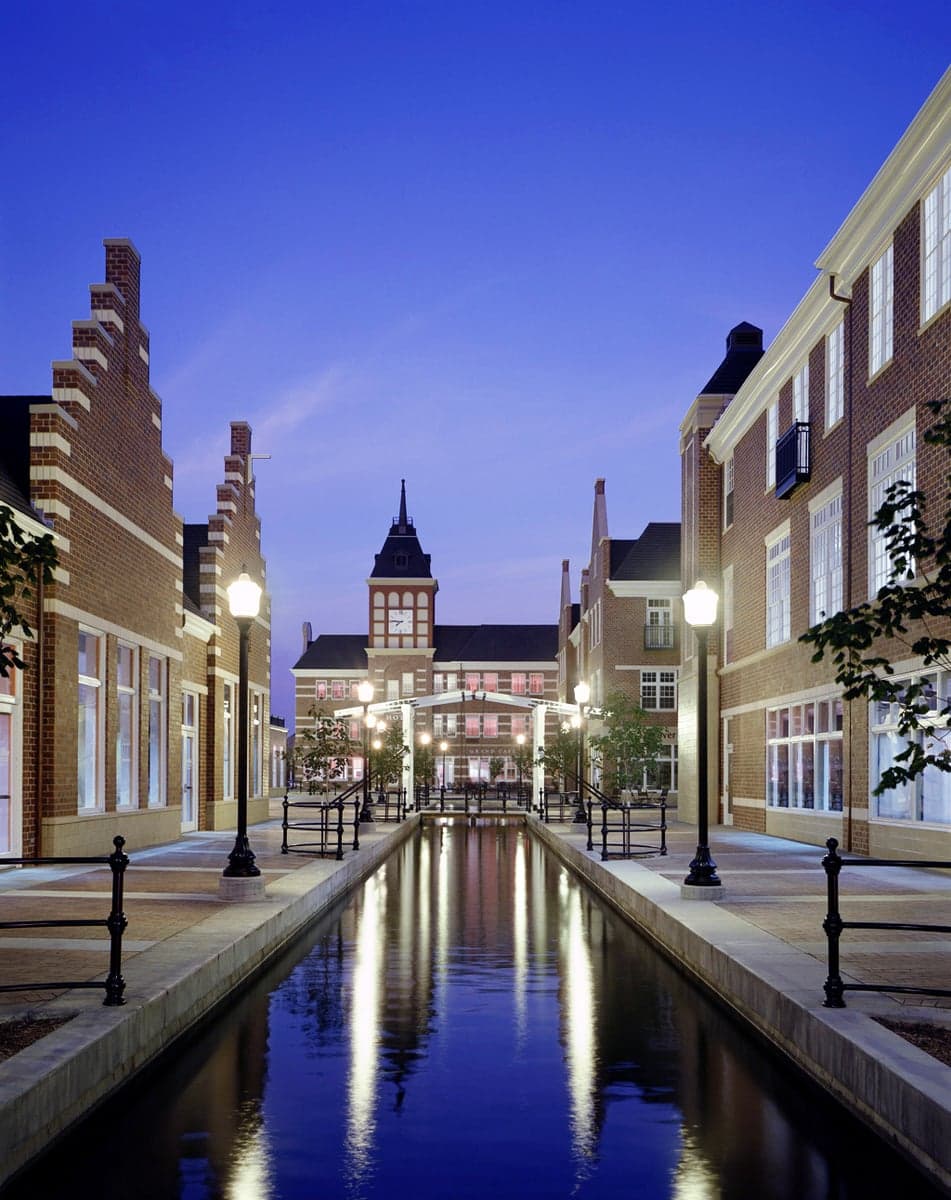
Today, Pella, Iowa is a community of 10,624 residents that is overwhelmingly white (93.0%) and notably well-educated, with 47.8% holding a college degree. The city’s population density and character are shaped by its Dutch Reformed heritage, visible in its downtown architecture, the annual Tulip Time festival, and a social fabric that remains tight-knit and culturally homogeneous. With a foreign-born population of just 2.0% and a Hispanic share of 3.2%, Pella is less diverse than the national average, but its small East/Southeast Asian (0.8%) and Indian-subcontinent (0.9%) communities represent recent, targeted growth tied to the local economy.
How the city was settled and grew
Pella was founded in 1847 by a wave of Dutch immigrants led by Dominie Hendrik Peter Scholte, who sought religious freedom from the state-controlled Dutch Reformed Church. These first settlers, mostly farmers and artisans from the Netherlands, established the Original Plat (now the historic downtown core) and built the first homes along what is now Franklin Street. A second major wave arrived in the 1850s and 1860s, drawn by land grants and the promise of a self-governing Dutch colony. These later families settled in the West Side neighborhood, near the Pella Cooperative Store and the first windmill, creating a dense ethnic enclave where Dutch was the primary language into the early 1900s. By 1900, the population had grown to roughly 2,500, almost entirely of Dutch descent, with the East Side (around East 1st Street) developing as a working-class extension for laborers in the town’s new brickyards and flour mills. The city’s growth remained slow and ethnically stable through the mid-20th century, with the South Side (south of the railroad tracks) filling in during the 1920s and 1930s as a mix of second-generation Dutch families and a small number of German and Irish migrants who worked in the local manufacturing plants.
Modern era (post-1965)
After the 1965 Immigration and Nationality Act, Pella saw little immediate change; the city’s Dutch Reformed social structure and rural location limited new immigration. The most significant demographic shift began in the 1980s and 1990s, driven by the expansion of Pella Corporation (the window and door manufacturer) and Vermeer Manufacturing. These employers recruited skilled workers from outside the region, bringing in a small but steady stream of East/Southeast Asian engineers and technicians, who settled primarily in the North Ridge subdivision (north of Highway 163), a newer area built in the 1990s with larger homes and easy access to the industrial parks. The Indian-subcontinent community, numbering about 96 residents today, arrived later, largely in the 2000s and 2010s, as professionals in healthcare (Pella Regional Health Center) and engineering. They concentrated in the Sunset Heights neighborhood, a mid-2000s development near the golf course, where homes are newer and more diverse in ownership. The Hispanic population, at 3.2%, grew primarily through domestic migration from other Midwestern states, not direct immigration, and is dispersed across the South Side and older rental stock near the railroad corridor. Notably, the Black population remains very small (0.7%), and there is no significant Arab community. The city’s white share has declined only slightly from 98% in 1990 to 93% today, reflecting a slow but real diversification driven by employer-led recruitment rather than chain migration.
The future
Pella’s population is likely to remain predominantly white and Dutch-heritage for the foreseeable future, but the small East/Southeast Asian and Indian-subcontinent communities are expected to grow modestly, driven by continued hiring at Pella Corporation and Vermeer. These groups are not forming distinct ethnic enclaves; instead, they are assimilating into the North Ridge and Sunset Heights neighborhoods, where homeownership rates are high and cultural integration is encouraged by local employers. The Hispanic population is plateauing, as domestic migration from other Iowa towns slows, and the foreign-born share (2.0%) is unlikely to rise significantly given the city’s limited rental housing and lack of a refugee resettlement program. The biggest demographic trend is aging: the median age is 38.5, and the 65+ cohort is growing as younger adults leave for larger cities. This could lead to a slight population decline over the next decade unless the city attracts more families through housing development in the West Ridge area, a planned expansion west of the current city limits. Pella is not tribalizing into distinct enclaves; it is slowly homogenizing as newer residents adopt the local Dutch-influenced culture, while the small non-white communities remain integrated and upwardly mobile.
For someone moving in now, Pella offers a stable, safe, and culturally cohesive environment with strong schools and a clear Dutch-American identity. The population is becoming slightly more diverse in professional sectors but remains overwhelmingly white and conservative-leaning, with little ethnic or religious tension. The city’s future is one of slow, managed growth, where new residents—especially those in engineering or healthcare—will find a welcoming but insular community that values tradition and order over rapid change.

* Values derived from national, state, county, city and local statistics and may differ in a specific area. Last updated: 2026-04-30T01:35:13.000Z
Narrative content on this page is AI-generated and may contain mistakes. Verify any details that matter before acting on them.
ReloMaps may earn a commission from affiliate links at no extra cost to you.

