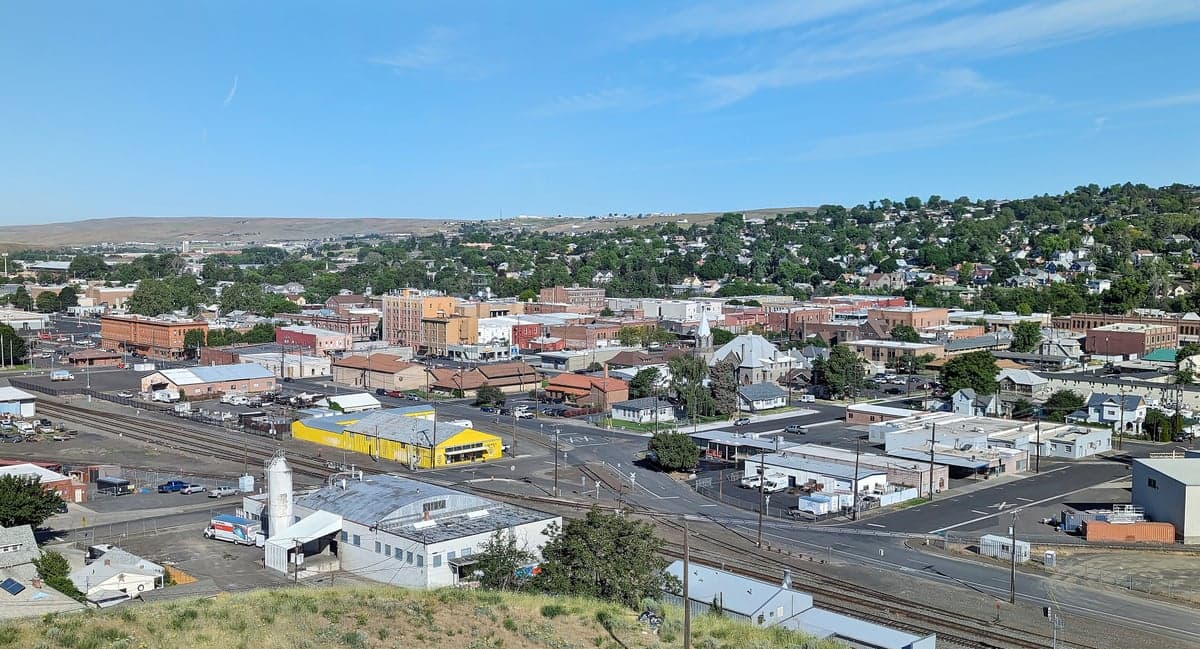
Photo: Wikipedia
Political ClimatePolitical Climate in Pendleton, OR
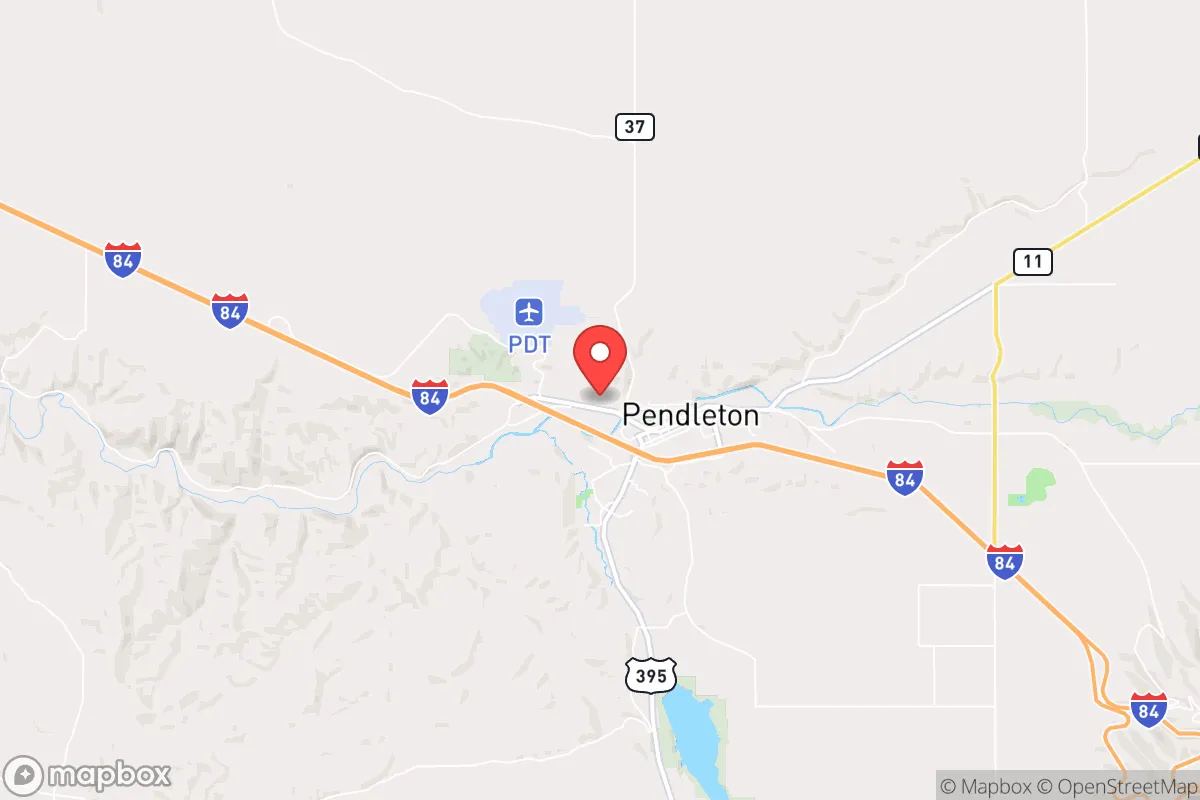
District shown is the primary district for this city’s centroid. Cities may span multiple districts.
Local Political AnalysisPolitical Analysis of Pendleton, OR
Pendleton, Oregon, sits solidly on the conservative side of the political map, with a Cook Partisan Voting Index (PVI) of R+14, meaning the area consistently votes about 14 points more Republican than the national average. This isn’t a recent shift—it’s been a deeply rooted part of Umatilla County’s identity for generations. The rest of Oregon, especially the Willamette Valley and Portland metro, leans hard the other way with a statewide PVI of D+8, creating a real cultural and political divide between Pendleton and the power centers out west.
How it compares to Oregon’s liberal strongholds
The difference between Pendleton and the state as a whole is stark, and it’s not just numbers on a map. Portland, Eugene, and Salem drive that D+8 rating with policies on land use, environmental regulations, and social issues that feel miles away from life in eastern Oregon. In Pendleton, the political atmosphere is more about local control and personal responsibility—things like water rights, grazing access, and keeping the government out of local business decisions. Out here, the Oregon state legislature’s push toward higher taxes, stricter gun laws, and top-down mandates on housing and energy are seen as overreach, not progress. Places like Hermiston (just west) and La Grande (east) share similar sentiments, but Pendleton wears its R+14 lean as a badge of lived experience, not just a voting pattern.
What this means for residents day-to-day
For someone living in Pendleton, the political climate means fewer restrictions on personal freedoms compared to the Portland metro area. You don’t see the same level of government intrusion into how you run your small business, build on your property, or exercise your Second Amendment rights. The local economy is built on agriculture, the Pendleton Round-Up, and a solid base of family-owned operations—things that thrive when regulations stay sensible and community decisions are made by neighbors, not bureaucrats in Salem. The shift toward progressive ideology in the state capitol is a real concern because it often leads to one-size-fits-all laws that ignore how different life is east of the Cascades.
At the local level, the Pendleton City Council and Umatilla County Commission have held the line fairly well on property rights and fiscal restraint, but the constant pressure from state-level mandates—on land use, energy standards, and wildlife management—keeps residents on edge. There’s a growing sense that Salem doesn’t understand or respect the rural way of life, and that tension is only going to intensify as Oregon’s western population grows. Pendleton’s political identity isn’t just about voting Republican; it’s about preserving a culture where your word still means something, and where you’re trusted to run your own life without a state agency looking over your shoulder. That’s what’s at stake, and that’s why the R+14 lean here isn’t changing anytime soon.

State Political ClimatePolitical Climate in Oregon
State Political AnalysisPolitical Environment in the State
Oregon wears a deceptive shade of blue. Despite its reputation as a Pacific Northwest liberal stronghold, the state’s Cook PVI of D+8 masks a deep, churning political chasm. The reality is that Portland and its immediate suburbs drive virtually the entire Democratic margin, while the rest of the state—east of the Cascades, the southern valleys, and even parts of the Willamette Valley—votes more like Idaho or rural Nevada. Over the last 10-20 years, the trajectory has been a slow, grinding shift leftward in metro areas, punctuated by a fierce, organized conservative backlash in the hinterlands. This isn’t a purple state slowly turning blue; it’s a state where two completely different Americas coexist under one governor.
Urban vs. rural divide
You cannot understand Oregon’s politics without first understanding its geography. Portland (Multnomah County) alone accounts for roughly 20% of the state’s vote, and it reliably delivers margins of +40 to +50 points for Democrats. Neighboring Washington County (suburban tech hub) and Clackamas County (outer-ring suburbs) have drifted leftward in recent cycles, but remain more moderate than Portland proper. The real political freezer burns are east and south. Bend (Deschutes County) was once a conservative haven but has been inching left as Californians move in; it’s now a true swing county. Meanwhile, Medford and Grants Pass (Jackson and Josephine counties) are deep red, with Republican margins of 15-25 points. The rural eastern counties—Malheur, Harney, Lake—often vote Republican by 50 to 60 points. The flip side: Joe Biden won Oregon in 2020 by 16 points, but Donald Trump carried 31 of the state’s 36 counties. That’s not a purple state; that’s a gerrymandered reality where a handful of hyper-dense metros override the landmass.
Policy environment
Oregon’s policy climate is a study in contrasts. It has no state sales tax, which sounds like a conservative win, but it has the nation’s highest combined state and local income tax rate (9.9% top bracket) and a corporate tax structure that drives small businesses to neighboring Washington or Idaho. The regulatory posture is heavy-handed: the state has a land-use planning system (Metro in Portland) that restricts housing supply, inflating costs. Education policy is dominated by powerful teachers unions and progressive school boards; Portland Public Schools recently adopted a “racial equity” grading policy that has caused parental exodus to private schools or homeschooling. Healthcare is robust but expensive, with Oregon being one of the earliest states to institute a Medicaid expansion via the Oregon Health Plan. Election laws are famously permissive: automatic voter registration, all mail-in ballots, ballot drop boxes accepted until 8 PM Election Day, and no voter ID requirement. This has led to persistent low-level controversy about election integrity, especially in rural counties where clerks have flagged ballot harvest concerns.
Trajectory & freedom
If you value personal liberty, Oregon is trending in the wrong direction. On gun rights, Measure 114 (passed in 2022, partially blocked by courts as of 2026) requires a permit to purchase, a 48-hour waiting period, and bans magazines over 10 rounds. That was a gut punch to rural and suburban gun owners. On parental rights, the state passed SB 159 (2023), which mandates that schools cannot disclose a student’s gender identity or sexual orientation to parents without the child’s consent—effectively cutting parents out of the loop. On medical autonomy, Oregon was the first state to legalize assisted suicide (Death with Dignity Act, 1997) and has some of the most lenient drug decriminalization laws (Measure 110, 2020), though a 2024 recriminalization bill rolled back some excesses after visible public drug use crises in Portland metro. On property rights, the state’s 1973 land-use law (SB 100) gives the government immense control over development, making it hard to build even on your own rural acreage. The trajectory is clear: more regulation, more government involvement in family and medical decisions, and a creeping erosion of the libertarian frontier ethos that once defined the state.
Civil unrest & political movements
Oregon’s protest history is shaped by Portland’s leadership. The 2020 George Floyd protests were centered here, with 100+ consecutive nights of demonstrations, property damage, and federal intervention under the Trump administration. The “Wall of Moms” movement started in Portland. On the right, the Oregon Citizens Alliance and more recently the “Greater Idaho” movement (a serious secession attempt where rural eastern and southern counties want to join Idaho) gained signatures in 2024 to put the question on local ballots. That movement reflects genuine alienation—residents in Klamath Falls and Lakeview feel governed by Portland liberals who don’t share their values. Immigration tensions simmer: Portland is a sanctuary city, and Multnomah County has resisted cooperation with ICE, leading to occasional flashpoints. Election integrity remains a live wire, with Republican activists in counties like Douglas and Linn pushing for hand-count audits and raising public distrust of the all-mail system. A new resident moving to any metro area will see visible homeless encampments, open drug use in some downtowns (Portland, Eugene), and a palpable tension between the activist population and more traditional residents.
Projection
Over the next 5-10 years, Oregon is likely to harden its existing divisions. The Portland metro will continue to attract high-income, highly educated, left-leaning transplants from California and elsewhere, deepening the urban blue. Rural counties will continue to lose population but will become more politically entrenched and organized, with the “Greater Idaho” movement gaining ballot wins but facing a constitutional wall in the legislature. The state’s growth is slow—Oregon’s population growth rate is below the national average (0.8% annually vs. 1.2% nationally)—so demographic change is incremental. Expect more progressive policy pushes on rent control, expanded land-use restrictions, and potential new taxes on high-income earners. The conservative counterweight will be litigious and rhetorical, but unlikely to flip statewide offices. If you move to Oregon in 2026, expect to live in a state where your local government likely mirrors your values if you choose your county carefully, but where state-level politics will feel increasingly one-party dominant and hostile to traditional freedoms.
Bottom-line for a new resident: Oregon offers stunning natural beauty and a low sales tax, but the trade-off is a high regulatory burden, progressive social policies imposed from Portland, and a cultural tension that won’t ease. If you’re a conservative single or parent, you’ll find community in the suburbs of Clackamas County, the Bend area, or the southern corridor (Medford/Grants Pass)—but you’ll be fighting an uphill battle at the ballot box and in the classroom. Come for the mountains and the rivers, but know you’re moving into a state where your personal freedoms are increasingly managed from Salem, not protected.
* Values derived from national, state, county, city and local statistics and may differ in a specific area. Last updated: 2026-05-30T09:23:09.000Z
Narrative content on this page is AI-generated and may contain mistakes. Verify any details that matter before acting on them.
ReloMaps may earn a commission from affiliate links at no extra cost to you.

