 Popular
Photo: Wikipedia
Demographics of Piedmont, SC
Affluence Level in Piedmont, SC
A below-average socioeconomic profile. Incomes, home values, and educational attainment trail the U.S., with higher poverty and unemployment.
People of Piedmont, SC
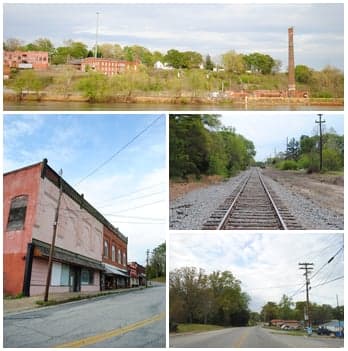
Piedmont, South Carolina, is a small, tight-knit community of 5,786 residents that remains predominantly white (73.4%) and native-born (only 1.5% foreign-born), with a significant Black minority (15.4%) and a growing Hispanic population (5.7%). The city’s identity is rooted in its textile-mill past and rural Southern character, with a low college attainment rate (12.9%) reflecting a historically working-class population. Today, Piedmont feels like a crossroads between its industrial heritage and its role as a quieter, more affordable alternative to the booming Greenville metro area just 15 miles north.
How the city was settled and grew
Piedmont’s population history begins not with colonial settlement but with the post-Civil War textile boom. The city was incorporated in 1890, built around the Piedmont Manufacturing Company, a cotton mill that drew its first workers from the surrounding rural white population of upstate South Carolina. These early residents—largely subsistence farmers displaced by the collapse of the plantation economy—settled in what is now Old Mill Village, a historic district of mill-owned houses along the Saluda River. The mill also employed a small number of Black workers, who lived separately in the Mill Village South area, a pattern of racial segregation common across Southern mill towns. A second wave arrived in the 1910s and 1920s as the mill expanded, attracting more white families from the Appalachian foothills, who filled the Northside neighborhood. By 1930, Piedmont’s population was nearly all white and native-born, with a tiny Black community concentrated in the Riverbend area near the mill’s waste ponds. The Great Depression and subsequent mechanization slowed growth, and the mill’s decline in the 1950s and 1960s led to a population plateau that lasted until the 1990s.
Modern era (post-1965)
After the 1965 Hart-Cellar Act, Piedmont saw virtually no immigration—its foreign-born share remains just 1.5% today, one of the lowest in the Greenville metro. Instead, the modern era has been defined by domestic in-migration. The 1990s and 2000s brought white retirees and families from the Rust Belt and Northeast, drawn by lower taxes and the proximity to Greenville’s job growth. These newcomers settled in newer subdivisions like Saluda Ridge and Piedmont Pointe, which sit on former farmland east of the old mill district. The Black population, which had hovered around 8-10% through the 1970s and 1980s, grew to 15.4% by 2020, driven by Black families moving from Greenville’s inner city seeking cheaper housing in the West Piedmont area along Highway 86. The Hispanic population, now 5.7%, is a more recent arrival—mostly Mexican and Central American workers employed in construction and landscaping, concentrated in rental duplexes near Piedmont Crossing off U.S. 25. East/Southeast Asian and Indian populations are negligible (0.0% and 0.4%, respectively), reflecting the area’s lack of tech or professional job magnets. The city’s college-educated share (12.9%) is far below the state average (28%), underscoring that Piedmont remains a blue-collar bedroom community rather than a knowledge-economy hub.
The future
Piedmont’s population is slowly diversifying, but the pace is modest. The Hispanic share is expected to rise to 8-10% by 2035, driven by continued construction demand in the Greenville metro, with new arrivals likely settling in the Piedmont Crossing corridor. The Black population may stabilize or grow slightly as Greenville’s gentrification pushes more Black families southward into West Piedmont. The white share, while still dominant, will likely decline to around 68-70% as the Hispanic cohort expands. However, the city’s low college attainment and lack of high-skill employment mean it will not attract significant Asian or Indian populations, which tend to cluster near universities and tech corridors. The most transformative trend is the spillover of Greenville’s suburban growth: new subdivisions like Saluda Ridge Phase II and Piedmont Preserve are drawing young white families who commute to Greenville or Simpsonville, gradually raising the median income and home values. This could create a cultural tension between long-time mill-town families and newer, more affluent transplants, but the overall trajectory is toward a more economically mixed, slightly more diverse, but still predominantly white and native-born community.
For someone moving in now, Piedmont offers a low-cost, low-hassle entry point into the Greenville orbit, with a population that is stable, family-oriented, and rooted in its mill-town past. The city is becoming a quieter, more affordable alternative to Greenville’s booming suburbs, but it remains a place where the old guard still outnumbers the newcomers, and where the pace of change is slow enough that the local identity—Southern, working-class, and self-reliant—is likely to persist for at least another generation.

* Values derived from national, state, county, city and local statistics and may differ in a specific area. Last updated: 2026-10-10T16:28:41.000Z
Narrative content on this page is AI-generated and may contain mistakes. Verify any details that matter before acting on them.
ReloMaps may earn a commission from affiliate links at no extra cost to you.

