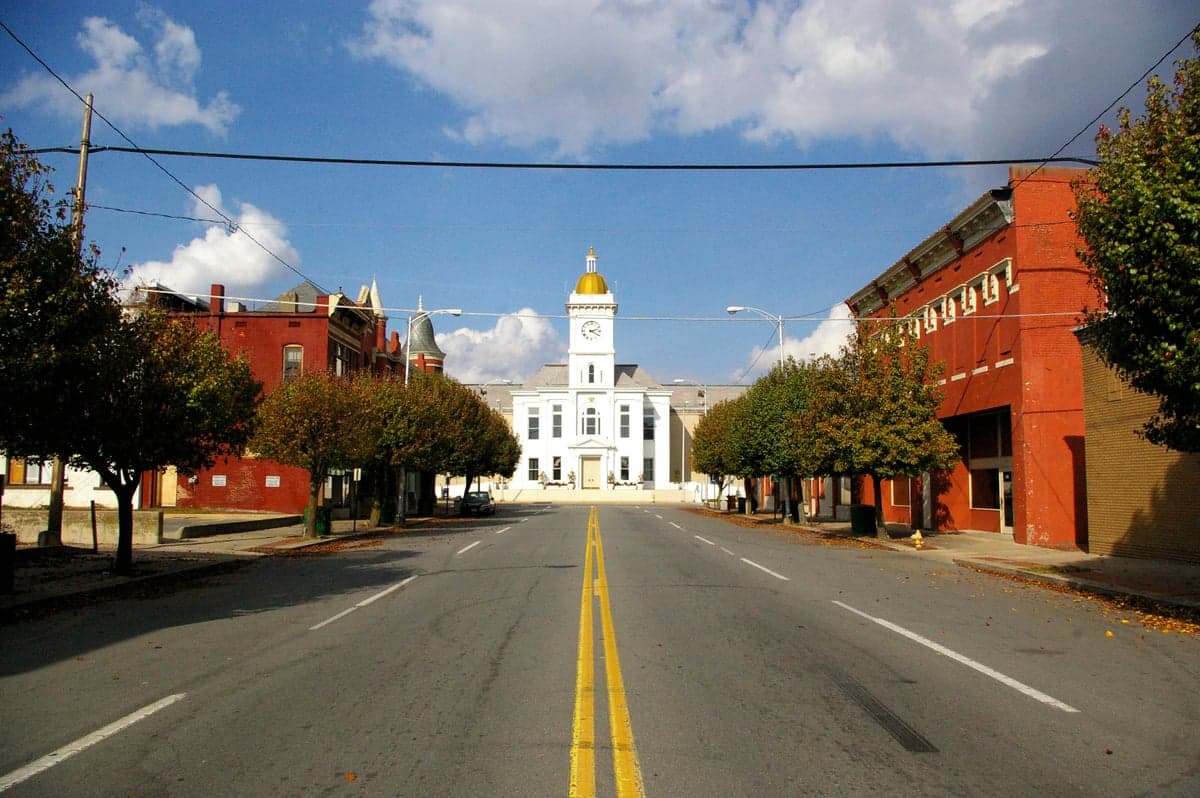
Photo: Wikipedia
Personal Sovereignty in Pine Bluff, AR
Viable for self-reliance. Generally workable, though some barriers may limit total independence.
What does Personal Sovereignty tell us?
Personal Sovereignty measures your capacity for self-reliance and independence with minimal government friction. Higher scores mean fewer barriers between you and the way you want to live... but it assumes you have the space you need and good neighbors.
What does this tell us?
Personal Sovereignty measures your capacity for self-reliance and independence with minimal government friction. Higher scores mean fewer barriers between you and the way you want to live... but it assumes you have the space you need and good neighbors.
State Policy
Energy independence: Importer (35% of energy produced in-state)
Personal Liberty
Homesteading

Personal Liberty Analysis
For individuals and families prioritizing personal sovereignty, Pine Bluff, Arkansas, offers a strategic environment where state-level protections for gun rights, low taxation, and minimal land-use restrictions create a foundation for self-reliant living, though local governance and economic decline introduce practical challenges that require careful navigation. Arkansas as a whole ranks among the most liberty-oriented states in the South, with a constitutional right to keep and bear arms, no state income tax on capital gains for certain entities, and a regulatory climate that generally defers to property owners. Pine Bluff, however, sits within Jefferson County, where local politics and a shrinking tax base have led to higher property tax rates than the state average and a municipal government that has occasionally pursued nuisance property ordinances that preppers and homesteaders should vet closely. The net assessment is that Pine Bluff provides strong state-level sovereignty buffers, but the city's fiscal struggles mean that personal autonomy depends heavily on choosing the right parcel and staying informed on local code enforcement trends.
Tax burden and regulatory posture for self-reliant households
Arkansas imposes a state income tax with a top marginal rate of 4.9% as of 2026, but the state has been phasing down rates and offers significant deductions for retirees and military pensions. Pine Bluff's property tax rate is approximately 55 mills, which is higher than the Arkansas average of roughly 48 mills, driven by school district and county levies. For a prepper household seeking acreage, this means a 10-acre parcel assessed at $100,000 would carry an annual tax bill around $5,500 — a notable expense compared to rural counties like Lincoln or Cleveland. Sales tax in Pine Bluff totals 9.5% (state 6.5% plus local 3%), which is high for Arkansas but typical for urbanized Delta areas. The regulatory posture is generally light: no state-level building codes in unincorporated areas, no county-wide zoning in most of Jefferson County outside city limits, and no state permit required for rainwater catchment systems. However, Pine Bluff city limits enforce a zoning code that restricts livestock, limits accessory dwelling units, and requires permits for structures over 200 square feet. For maximum regulatory freedom, buyers should target parcels outside city limits but within a 15-minute drive of Pine Bluff's amenities, such as areas near the Arkansas River or along Highway 79 South.
Self-defense rights and gun law specifics in Arkansas
Arkansas is a constitutional carry state, meaning no permit is required to carry a concealed or open firearm for anyone legally allowed to possess a gun. This applies fully in Pine Bluff and Jefferson County. The state preempts local firearm ordinances, so Pine Bluff cannot ban carry in city parks or impose magazine capacity limits. Stand-your-ground law is codified, with no duty to retreat in any place where the individual is lawfully present. Castle doctrine extends to vehicles and occupied structures. Arkansas also has a "Second Amendment Protection Act" that prohibits state agencies from enforcing federal gun laws deemed infringing, though this has not been tested in court against federal preemption. For preppers, the practical implication is that building a defensive firearms inventory — including NFA items like suppressors and short-barreled rifles — is legal under state law, though federal NFA registration still applies. The local sheriff's office in Jefferson County has historically been supportive of gun rights, with a reasonable track record on issuing concealed carry permits before constitutional carry took effect. Ammunition and reloading components are available at several shops in Pine Bluff, including Big Daddy's Guns and Ammo on Hazel Street. One caution: property crime rates in Pine Bluff are high, with a violent crime rate roughly 3x the national average, so a robust home defense plan — including security systems, reinforced entry points, and neighborhood watch participation — is not optional but essential for sovereignty-minded residents.
Self-reliance and homesteading viability: lot sizes, zoning, and off-grid feasibility
Pine Bluff's surrounding rural areas offer some of the most affordable land in the South for homesteading, with raw acreage selling for $2,000 to $4,000 per acre as of 2026. Parcels of 5 to 40 acres are common within a 20-minute drive of downtown, particularly along the Jefferson/Lincoln county line and near the White River bottomlands. Zoning in unincorporated Jefferson County is essentially nonexistent: no minimum lot size for agricultural use, no restrictions on livestock (including goats, chickens, and cattle), and no prohibition on mobile homes or tiny houses on permanent foundations. Off-grid feasibility is high: Arkansas law explicitly protects the right to install solar panels without homeowners association interference, and no state permit is required for private wells or septic systems (though county health department approval is needed for septic). Rainwater collection is unrestricted, and the region receives about 50 inches of annual rainfall, making cistern-based water supply viable. However, Pine Bluff city limits impose a 1-acre minimum for keeping horses or cattle, and the city's nuisance ordinance allows code enforcement to cite properties with "excessive vegetation" over 12 inches tall — a potential issue for preppers practicing camouflage or natural landscaping. The most sovereignty-friendly approach is to buy land in an unincorporated area with a rural fire district, such as the communities of Altheimer, Wabbaseka, or Sherrill, where county oversight is minimal and neighbors tend to share a live-and-let-live ethos.
Personal liberties: parental rights, medical autonomy, speech, and property
Arkansas has been at the forefront of parental rights legislation, with Act 372 of 2021 requiring schools to notify parents of any medical or counseling services offered to students and to obtain parental consent for any mental health assessments. The state also passed the Arkansas Parental Rights Amendment in 2024, which enshrines the right of parents to direct the upbringing, education, and healthcare of their children. This means Pine Bluff parents can opt their children out of any curriculum or activity they find objectionable without penalty, and the local school district — Pine Bluff School District, which has about 3,800 students — has a policy of deferring to parental authority on medical decisions. Medical autonomy is strong: Arkansas has no state vaccine mandate for adults, and while childhood vaccines are required for school attendance, medical and philosophical exemptions are available with minimal paperwork. The state also prohibits any COVID-19 vaccine mandate by private employers, and no mask or lockdown mandates have been imposed since 2022. Free speech protections are robust, with no state-level hate speech laws that could chill political expression. Property rights are protected by Arkansas's "private property rights protection act," which requires government to compensate landowners for any regulatory taking that reduces property value by more than 20%. One area of concern for preppers: Arkansas has a "right to farm" law that protects agricultural operations from nuisance lawsuits, but it does not apply to urban homesteads within city limits, so a backyard chicken coop in Pine Bluff could theoretically be challenged by a neighbor under the city's nuisance code.
Overall, Pine Bluff offers a mixed sovereignty profile that rewards strategic location choices. The state-level framework is among the most liberty-oriented in the country, with constitutional carry, parental rights amendments, low income tax, and minimal land-use regulation in rural areas. The city itself, however, suffers from high property crime, a declining tax base that pressures local government to increase fees and enforcement, and a school district that, while legally deferential to parents, struggles with academic performance and safety. For the survivalist or prepper, the optimal play is to establish a homestead in unincorporated Jefferson County within 20 minutes of Pine Bluff's grocery stores and hardware outlets, leveraging the state's strong sovereignty protections while insulating yourself from the city's fiscal and crime challenges. Compared to similar-sized cities in the Delta region — like Greenville, MS, or Monroe, LA — Pine Bluff's state-level legal environment is significantly more favorable to personal autonomy, though its local governance is less predictable than in Arkansas's more prosperous northwest corridor. With careful parcel selection and a proactive approach to self-defense and self-sufficiency, Pine Bluff can serve as a viable base for a sovereignty-oriented lifestyle.

* Values derived from national, state, county, city and local statistics and may differ in a specific area. Last updated: 2026-04-29T22:36:07.000Z
Narrative content on this page is AI-generated and may contain mistakes. Verify any details that matter before acting on them.
ReloMaps may earn a commission from affiliate links at no extra cost to you.

