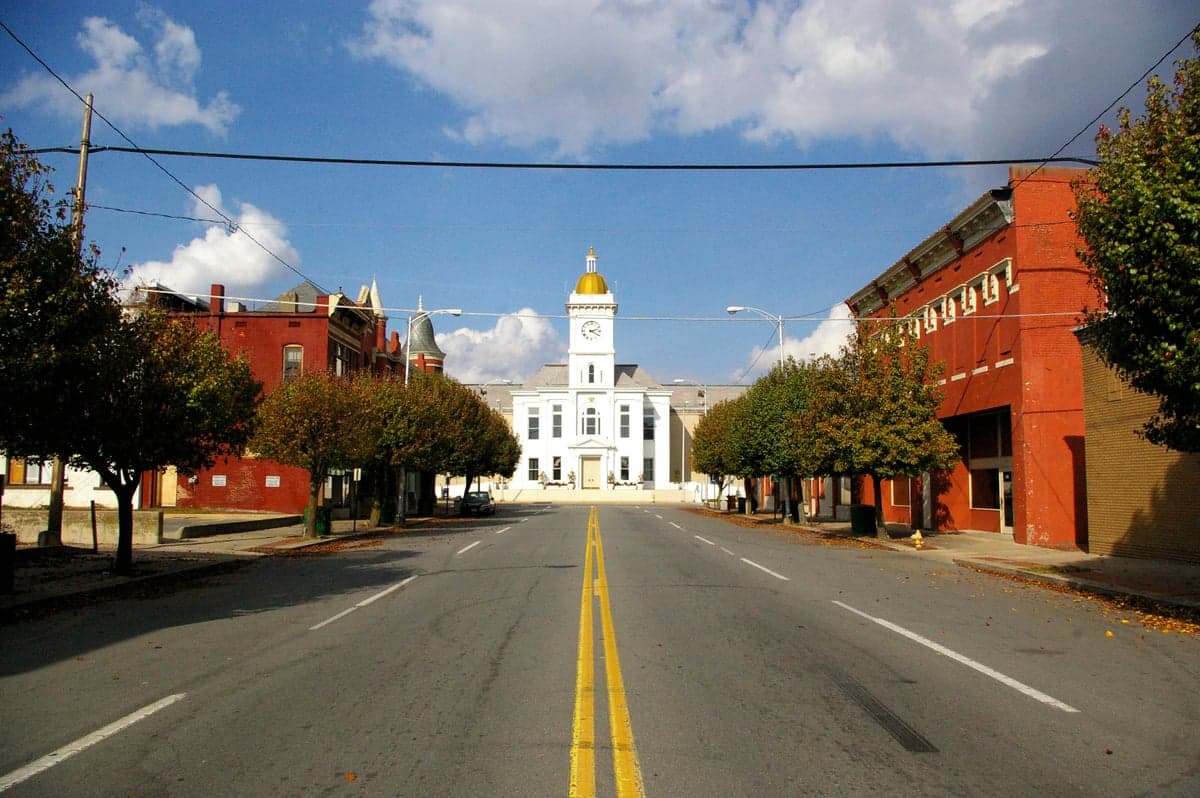
Photo: Wikipedia
Demographics of Pine Bluff, AR
Affluence Level in Pine Bluff, AR
A below-average socioeconomic profile. Incomes, home values, and educational attainment trail the U.S., with higher poverty and unemployment.
People of Pine Bluff, AR
Pine Bluff, Arkansas, is a city of roughly 40,400 residents defined by its deep majority-Black population (77.2%) and a starkly small foreign-born share (1.2%), making it one of the most ethnically homogeneous small cities in the Delta. Its people are overwhelmingly native-born, with a low college attainment rate (21.0%) and a demographic profile that reflects decades of out-migration and racial consolidation rather than new immigration. The city’s identity today is shaped by a post-industrial decline, a shrinking tax base, and a population that is older and more rooted than the fast-growing suburbs of central Arkansas.
How the city was settled and grew
Pine Bluff was founded in the 1830s as a river port on the Arkansas River, drawing its earliest white settlers from the upland South—primarily Tennessee, Kentucky, and Mississippi—who came to farm cotton on the rich Delta bottomlands. By the 1850s, the city had become a regional cotton market, and the enslaved Black population that worked the surrounding plantations formed the first large African American presence. After the Civil War, freedmen and their families concentrated in neighborhoods like East Pine Bluff and the Martin Luther King Jr. Boulevard corridor, building independent churches, schools, and businesses. The post-Reconstruction era saw the arrival of a small but influential Jewish merchant community, centered around downtown Pine Bluff, who established dry goods stores and cotton brokerage firms. The early 20th century brought a second wave of Black in-migration from rural Jefferson County as sharecropping collapsed, filling neighborhoods such as South Pine Bluff and West Pine Bluff with working-class families employed in the city’s sawmills, railroad yards, and cotton compresses. By 1950, Pine Bluff’s population peaked at roughly 37,000, with a white majority and a substantial Black minority living in largely segregated but adjacent districts.
Modern era (post-1965)
The post-1965 period in Pine Bluff is defined not by immigration but by a dramatic racial turnover and population loss. The Hart-Cellar Act had little direct effect here—the foreign-born share has never exceeded 2%—but the civil rights era and the mechanization of Delta agriculture triggered a sustained white flight to suburban Jefferson County and out of state. Between 1970 and 2020, the city lost nearly 20,000 residents, and the white share collapsed from over 50% to 17.2%. The Black population, which had been concentrated in East Pine Bluff and South Pine Bluff, expanded into formerly white neighborhoods like West Pine Bluff and the Pine Bluff Country Club area as white families departed. Today, the city’s residential geography is largely homogeneous: the vast majority of neighborhoods are over 80% Black, with the small white population concentrated in a few pockets near the University of Arkansas at Pine Bluff and along the northern edge of town. The East/Southeast Asian population (0.1%) and Indian-subcontinent population (0.5%) are tiny and scattered, with no distinct ethnic enclave. The Hispanic share (1.8%) is slightly larger but remains a thin presence, mostly in service-industry roles near the Highway 65 corridor.
The future
Pine Bluff’s population is heading toward further shrinkage and homogenization. The city lost 12% of its population between 2010 and 2020, and the trend continues as younger, college-educated residents—both Black and white—leave for Little Rock, Dallas, or Atlanta. The foreign-born share is so low (1.2%) that even a modest uptick would register statistically, but there is no sign of a new immigrant wave: the local economy lacks the industrial or agricultural jobs that draw newcomers, and the city’s reputation for high crime and poor schools deters relocation. The Black share is likely to edge higher as the remaining white population ages out, while the Hispanic and Asian shares may grow slightly but will remain negligible. The city is not tribalizing into distinct enclaves—it is simply becoming more uniformly Black and lower-income, with the small middle-class and professional class concentrated near the university and the hospital. For a conservative-leaning single person or parent considering relocation, Pine Bluff offers very low housing costs and a quiet, slow-paced life, but the demographic trajectory points to continued population loss, a shrinking tax base, and limited economic opportunity. The city is becoming a smaller, older, and more insular place—a choice for those who value deep community roots over growth and diversity.

* Values derived from national, state, county, city and local statistics and may differ in a specific area. Last updated: 2026-04-29T22:36:07.000Z
Narrative content on this page is AI-generated and may contain mistakes. Verify any details that matter before acting on them.
ReloMaps may earn a commission from affiliate links at no extra cost to you.

