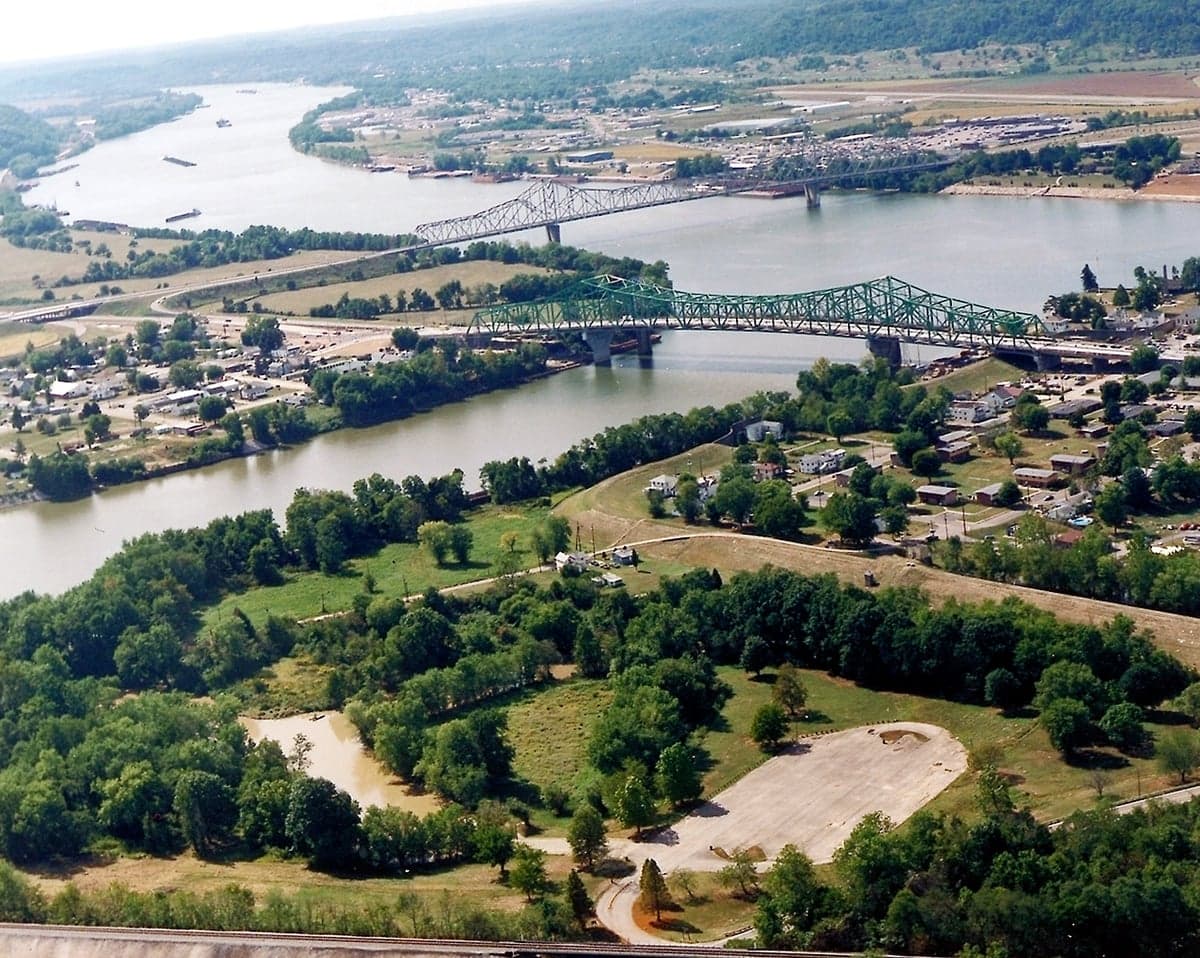
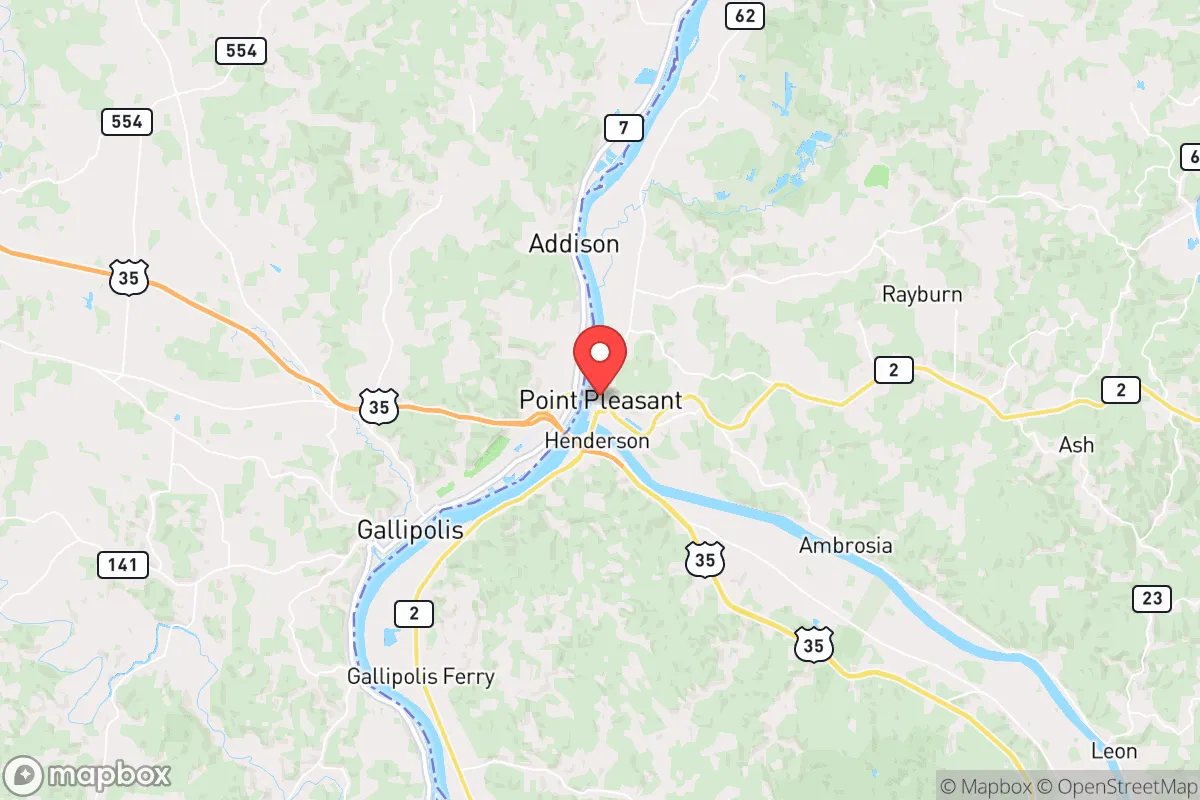
Photo: Wikipedia
Political ClimatePolitical Climate in Point Pleasant, WV
District shown is the primary district for this city’s centroid. Cities may span multiple districts.
Local Political AnalysisPolitical Analysis of Point Pleasant, WV
Point Pleasant, West Virginia, sits deep in reliably conservative territory, with a Cook PVI of R+22 that reflects generations of traditional values and a healthy skepticism of federal overreach. This isn't a place that flips on a dime; the political lean here is as steady as the Ohio River current. If anything, the area has only hardened its conservative stance in recent years, as folks watch neighboring states and bigger cities experiment with progressive policies that often feel disconnected from everyday life. The trajectory is clear: Point Pleasant isn't just staying put—it's digging in, prioritizing local control and personal freedoms over top-down mandates.
How it compares
Drive an hour north to Charleston, and you'll find a different political animal—Mason County's seat is a blue dot in a red state, with the capital's government jobs and university influence pulling it left. Head east to Huntington, and you'll see a similar split: a more diverse economy and younger population create a more mixed political scene. But Point Pleasant? It's surrounded by counties that vote even more conservatively. Gallia County, just across the river in Ohio, and Meigs County to the north both lean harder right, creating a regional bloc that's resistant to the cultural shifts you see in bigger metros. The contrast is stark: while Charleston debates housing ordinances and bike lanes, Point Pleasant's county commission is more likely to be fielding questions about Second Amendment rights or property tax caps.
What this means for residents
For the people who live here, this political climate translates into a government that mostly stays out of your business. You won't find the kind of zoning battles or mask mandates that dominate headlines elsewhere. The local school board keeps curriculum focused on basics, not social experiments. Property taxes stay low, and there's a general understanding that your land is your land—no one's coming to tell you what you can plant or how to build your shed. The downside? Some folks worry that the area's resistance to change could hold back economic development. But for most residents, that's a trade-off they're willing to make. The long-term outlook is stable: as long as the Ohio River keeps flowing and the factories keep humming, Point Pleasant will likely stay the kind of place where a handshake means something and the government knows its place.
Culturally, this conservative bent shows up in the little things: church parking lots are full on Sunday mornings, the local gun shop does steady business, and the annual Mothman Festival draws crowds without any political drama. There's a quiet pride in being a place that hasn't bent to every national trend. The policy distinctions are subtle but real—Mason County has resisted the kind of renewable energy mandates you see in more progressive areas, and there's a strong local pushback against any talk of red flag laws or stricter firearm regulations. For a newcomer, the message is simple: if you value personal freedom, low taxes, and a community that looks out for its own without government interference, Point Pleasant will feel like home. If you're looking for progressive change, you'll find the welcome mat is a little thinner here—and that's exactly how most residents want it.

State Political ClimatePolitical Climate in West Virginia
State Political AnalysisPolitical Environment in the State
West Virginia has long been one of the most reliably Republican states in the nation, but that wasn’t always the case. As recently as the 1990s, the Mountain State was a Democratic stronghold at the local level, but a massive realignment over the past 20 years has flipped it deep red. In 2024, Donald Trump carried the state by nearly 40 points, and Republicans now hold supermajorities in both chambers of the legislature, every statewide office, and both U.S. Senate seats. The shift has been driven by cultural conservatism, union-member disillusionment with national Democrats, and a fierce independence that resents federal overreach. If you’re looking for a place where conservative values still hold sway, West Virginia is about as solid as it gets.
Urban vs. rural divide
The political map of West Virginia is surprisingly simple: the rural counties are overwhelmingly red, and the few urban pockets are only slightly less so. The state’s largest city, Charleston, leans Democratic but is hardly a progressive stronghold—Kanawha County voted for Trump by about 15 points in 2024. Huntington and Morgantown are the other notable blue-ish dots. Morgantown, home to West Virginia University, has a younger, more transient population that tilts left, but Monongalia County still went for Trump by a narrow margin. The real action is in the rural counties like Mingo, Logan, and McDowell, where Trump won by 60 to 70 points. The Eastern Panhandle—including Berkeley and Jefferson counties—has seen an influx of former D.C. area residents, and while it’s still red, it’s more moderate than the rest of the state. The Northern Panhandle around Wheeling and Weirton is reliably conservative, driven by a strong working-class identity and a deep distrust of coastal elites.
Policy environment
West Virginia’s policy environment is aggressively conservative, and it’s been getting more so. The state has no personal income tax on Social Security benefits, and in 2023, the legislature passed a bill to phase out the state income tax entirely, with a 4% flat rate currently in place and scheduled reductions tied to revenue growth. Property taxes are among the lowest in the nation, and there’s no estate or inheritance tax. The regulatory climate is business-friendly, with a right-to-work law on the books and a tort reform system that caps noneconomic damages. On education, the state has a robust school choice program: the Hope Scholarship, enacted in 2021, provides state funding for private school tuition or homeschooling expenses. In 2024, the legislature expanded it to cover all students, not just those in low-performing districts. Healthcare is a mixed bag—West Virginia expanded Medicaid under the Affordable Care Act, but the state has also passed laws restricting abortion to the first eight weeks, with no exceptions for rape or incest. Election laws are strict: voter ID is required, early voting is limited to 10 days, and absentee voting requires an excuse. The state also purged over 100,000 inactive voters from the rolls in 2023, a move that drew praise from election integrity advocates and criticism from the left.
Trajectory & freedom
West Virginia is moving decisively toward more personal freedom, at least as conservatives define it. The biggest recent win was the passage of Constitutional Carry in 2023, allowing any adult who can legally possess a firearm to carry it openly or concealed without a permit. The state also passed a Parental Bill of Rights in 2022, requiring schools to notify parents about curriculum changes and medical services, and to obtain consent before any survey or questionnaire touching on sexual behavior or family beliefs. On medical autonomy, West Virginia banned gender transition procedures for minors in 2023, and the legislature overrode the governor’s veto to pass a ban on COVID-19 vaccine mandates by private employers. Property rights got a boost with a 2024 law limiting the use of eminent domain for economic development. The one area where freedom advocates are still fighting is taxation—the income tax phase-out is real, but it’s slow, and local governments still have significant leeway to raise property taxes. Still, the trajectory is clear: West Virginia is becoming a state where the government stays out of your life, your business, and your family decisions.
Civil unrest & political movements
West Virginia has a long history of labor unrest, but modern political movements are more focused on cultural and constitutional issues. The 2021 teachers’ strike was a flashpoint, but it was more about pay and benefits than ideology. Since then, the state has seen organized opposition to vaccine mandates, with large rallies at the Capitol in 2022. The West Virginia Citizens Defense League is active and influential, pushing for gun rights expansions. On the left, the West Virginia Working Families Party has a small but vocal presence, mostly in Charleston and Morgantown. Immigration politics are muted—the state has one of the smallest foreign-born populations in the country—but there have been local resolutions in Harpers Ferry and Shepherdstown opposing federal immigration enforcement. Election integrity remains a hot topic; the 2020 and 2024 elections were certified without major controversy, but the legislature has passed multiple bills tightening voting procedures. You won’t see the kind of street-level political violence you might in Portland or Seattle, but the political temperature is high, especially around school board meetings and county commission hearings on library books and curriculum.
Projection
Over the next 5 to 10 years, West Virginia will likely become even more conservative. The state is losing population overall—down about 3% since 2020—but the people leaving are disproportionately younger and more liberal, while those moving in are often retirees or remote workers from blue states seeking lower taxes and fewer restrictions. The Eastern Panhandle will continue to moderate as D.C. exurbs expand, but the rest of the state will harden its red hue. The income tax phase-out, if it continues, will make West Virginia even more attractive to conservatives looking to escape high-tax states like New York and California. The biggest wild card is the energy transition—coal production is declining, and the state’s economy is still heavily dependent on fossil fuels. If the federal government pushes a green agenda, West Virginia will push back hard, and that could accelerate the cultural and political divide. For someone moving in now, expect a state that is stable, safe, and increasingly aligned with traditional values, but also one that is aging and economically fragile. The political climate will remain fiercely independent, with a deep suspicion of federal authority and a strong preference for local control.
For a conservative individual or family, West Virginia offers a rare combination of low taxes, strong gun rights, school choice, and a government that largely stays out of your personal life. The trade-offs are a struggling economy, limited job opportunities outside of healthcare and energy, and a population that is older and less diverse than the national average. If you value freedom over convenience and are willing to trade urban amenities for a slower, more self-reliant lifestyle, West Virginia is one of the best bets in the country. Just know that the politics here are not theoretical—they show up in the way people treat their neighbors, run their schools, and vote in every election. It’s a place where your vote actually counts, and where the direction of the state is firmly in the hands of people who want to keep it that way.
* Values derived from national, state, county, city and local statistics and may differ in a specific area. Last updated: 2026-04-19T09:35:57.000Z
Narrative content on this page is AI-generated and may contain mistakes. Verify any details that matter before acting on them.
ReloMaps may earn a commission from affiliate links at no extra cost to you.

