Photo: Wikipedia
Demographics of Point Pleasant, WV
Affluence Level in Point Pleasant, WV
A low-income area with significant economic hardship. Household wealth and educational attainment are well below national averages.
People of Point Pleasant, WV
The people of Point Pleasant, West Virginia, today number roughly 4,009, forming a compact, predominantly white community with a distinct small-town character rooted in river and industrial history. The city is notably homogenous: 94.0% of residents identify as white, with a Black population of 3.2% and negligible Asian (0.5%) and foreign-born (0.2%) shares. This is a place where generational roots run deep, and the population is slowly contracting, shaped by economic shifts and out-migration rather than new immigration.
How the city was settled and grew
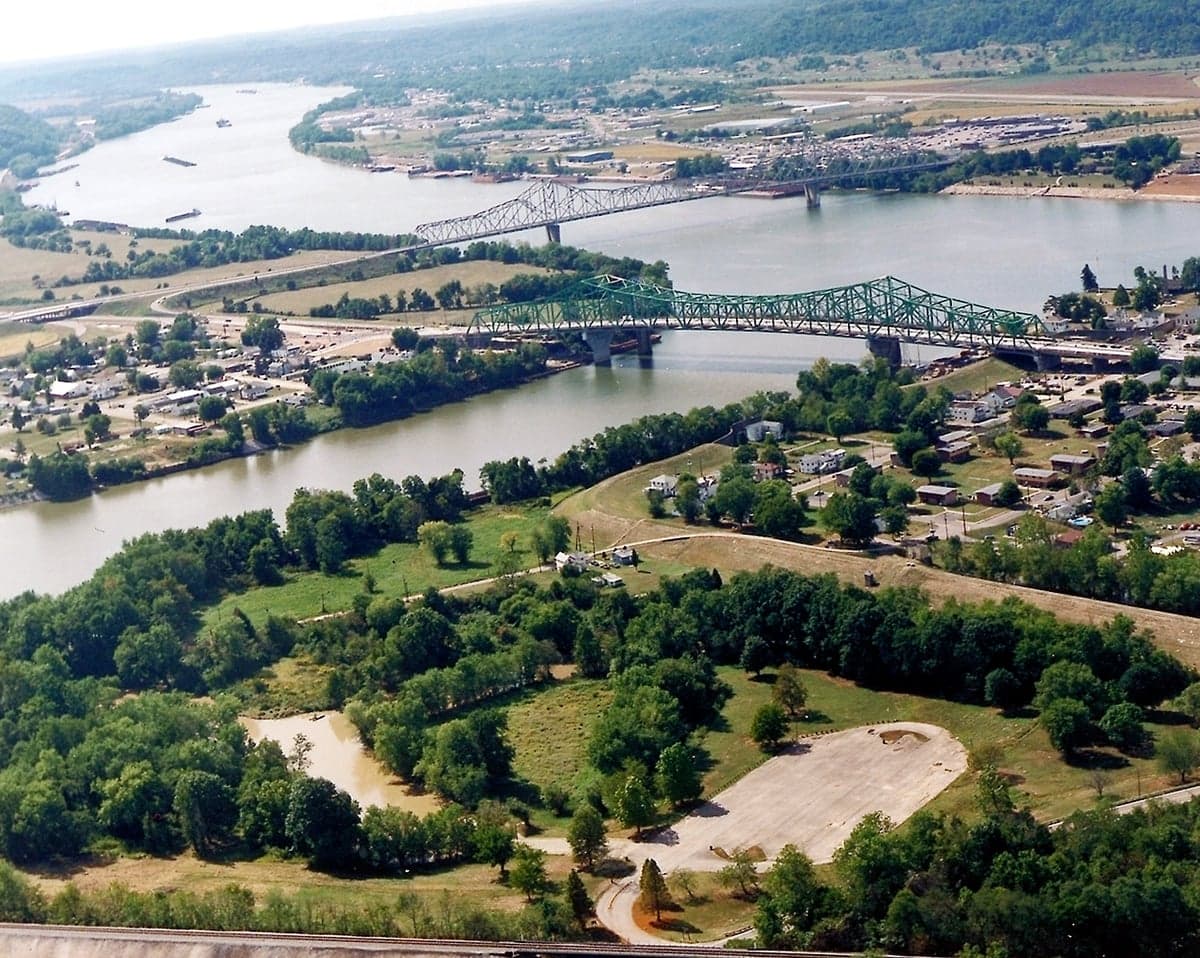
Point Pleasant’s human history begins at the confluence of the Ohio and Kanawha Rivers, a strategic location that first drew Native American tribes, notably the Shawnee and Mingo, for trade and settlement. European-American settlement accelerated after the 1774 Battle of Point Pleasant, which opened the region to Virginian and Pennsylvanian pioneers. The city was formally laid out in the early 1800s, and its early growth was fueled by river commerce, shipbuilding, and later the arrival of the Chesapeake and Ohio Railway in the 1870s. The original white settlers—largely of English, Scots-Irish, and German stock—built the core of what is now Historic Downtown Point Pleasant, centered around Main Street and the riverfront. By the late 19th century, the city’s industrial base expanded with glass factories and a foundry, drawing a small wave of immigrant laborers, including Irish and Italian workers who settled in the West End neighborhood, near the rail yards and factory sites. The Black population, which peaked at around 8% in the early 1900s, largely concentrated in the North Point Pleasant area, near the river and industrial jobs, though segregation kept these communities distinct. The city’s population hit its historic high of roughly 6,000 in the 1950s, buoyed by manufacturing and the nearby McClintic Wildlife Management Area’s construction projects.
Modern era (post-1965)
After the 1965 Immigration and Nationality Act, Point Pleasant saw virtually no new foreign-born influx—today, only 0.2% of residents are foreign-born, one of the lowest rates in the state. Instead, the post-1965 era has been defined by domestic out-migration. The decline of manufacturing, particularly the closure of the Owens-Illinois glass plant in the 1980s and the gradual contraction of river-based industry, triggered a steady population loss from the 1970s onward. The white population has remained dominant, but its share has slightly increased as the small Black community (3.2% today) has also aged and shrunk. The East End neighborhood, once a mix of middle-class white and Black families, has become nearly entirely white and older, while South Point Pleasant, near the river, has seen some newer single-family home construction but remains overwhelmingly white. The Hispanic population is effectively zero, and East/Southeast Asian residents (0.5%) are a tiny, scattered presence, often tied to the small medical or academic sectors. Suburbanization has been minimal; the city’s boundaries have not expanded, and newer subdivisions like Pleasant Valley (an unincorporated area just outside city limits) have drawn some younger families, but these remain demographically similar to the core.
The future
Point Pleasant’s population is heading toward further contraction and homogenization. The median age is rising (estimated at 44, above the national average), and the college-educated share is just 22.6%, limiting the city’s ability to attract knowledge-economy workers. No significant immigrant community is growing or plateauing; the foreign-born rate is effectively zero and is unlikely to rise given the lack of economic pull or ethnic enclaves. The small Black population is aging and not being replaced by younger Black families, who tend to move to larger cities like Charleston or Columbus. The city is not tribalizing into distinct enclaves—it is simply thinning out, with younger residents leaving for job markets elsewhere. The next 10–20 years will likely see the population dip below 3,500, with an even older, whiter demographic profile. The only potential counterweight is the rise of remote work, which could draw a small number of new residents seeking low-cost riverfront living, but this is unlikely to alter the city’s fundamental character.
For someone moving in now, Point Pleasant is becoming a quieter, more insular place—a community where deep family roots and a slow pace of life are the norm, but where economic opportunity and demographic diversity are limited. It is best suited for those seeking a low-cost, low-stress environment with strong local identity, rather than for those looking for career growth or a multicultural setting.

* Values derived from national, state, county, city and local statistics and may differ in a specific area. Last updated: 2026-04-19T09:35:57.000Z
Narrative content on this page is AI-generated and may contain mistakes. Verify any details that matter before acting on them.
ReloMaps may earn a commission from affiliate links at no extra cost to you.

