
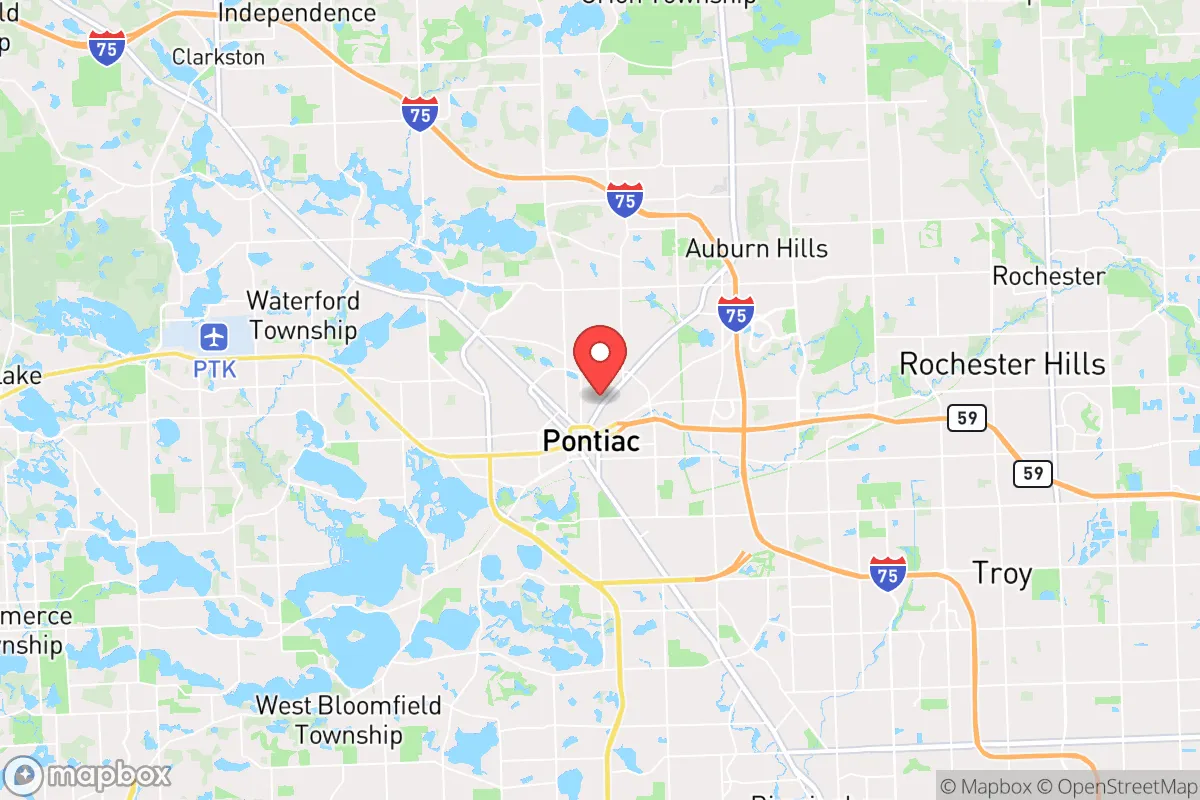
Photo: Wikipedia
Personal Sovereignty in Pontiac, MI
Strong independent fundamentals that actively favor personal liberty and low regulation.
What does Personal Sovereignty tell us?
Personal Sovereignty measures your capacity for self-reliance and independence with minimal government friction. Higher scores mean fewer barriers between you and the way you want to live... but it assumes you have the space you need and good neighbors.
What does this tell us?
Personal Sovereignty measures your capacity for self-reliance and independence with minimal government friction. Higher scores mean fewer barriers between you and the way you want to live... but it assumes you have the space you need and good neighbors.
State Policy
Energy independence: Importer (20% of energy produced in-state)
Personal Liberty
Homesteading

Personal Liberty Analysis
Pontiac, Michigan, presents a deeply conflicted environment for personal sovereignty, where the state's aggressive tax and regulatory apparatus clashes with a local landscape that still offers pockets of self-reliance. For a conservative-leaning individual or family prioritizing autonomy, the city itself is a high-risk proposition due to its fiscal distress and crime, but the surrounding Oakland County and broader Michigan context provide a mixed bag of opportunities and threats. The key takeaway is that while Michigan's constitutional framework offers some protections—particularly around self-defense—the state's political trajectory leans heavily toward government overreach, making Pontiac a location that demands constant vigilance and a prepper mindset rather than offering any inherent freedom.
Tax burden and regulatory posture in Michigan and Pontiac
Michigan's tax burden is a significant drag on personal sovereignty. The state levies a flat 4.25% individual income tax, which, while not progressive, still represents a direct claim on your labor. Property taxes are notoriously high, with an average effective rate of about 1.54% of home value—among the highest in the Midwest. In Pontiac, where property values are depressed, the millage rates are often higher to compensate for a shrinking tax base, meaning you pay a larger percentage of your home's assessed value. The state's regulatory posture is equally concerning: Michigan has a complex business tax structure, strict environmental regulations that can hamper homesteading (e.g., wetland and riparian rules), and a heavy-handed Department of Environment, Great Lakes, and Energy (EGLE) that can make even simple land improvements a bureaucratic nightmare. For a survivalist, this means every acre you own comes with strings attached, and the state's appetite for revenue is unquenchable. The city of Pontiac itself has been under state financial oversight for years, a clear sign of local government failure that translates into higher fees and less responsive services.
Self-defense and gun law specifics in Michigan
On the positive side, Michigan is a "shall-issue" state for concealed pistol licenses (CPL), and since 2023, it has allowed permitless concealed carry for adults 21 and older who are not prohibited persons. This is a major win for personal sovereignty. You can carry a firearm for self-defense without begging the government for permission, though a CPL is still recommended for reciprocity and legal clarity. The state preempts local gun ordinances, so Pontiac cannot enact its own bans—a critical protection against city-level overreach. However, the state has also passed "red flag" laws (extreme risk protection orders) that allow courts to temporarily seize firearms based on hearsay from family or police, without a criminal conviction. This is a direct threat to due process and a tool for government overreach. Additionally, Michigan has universal background checks for all firearm sales, including private transfers, which creates a paper trail that could be weaponized against law-abiding gun owners. For a prepper, the legal landscape is a double-edged sword: you can defend your home and person, but the state retains mechanisms to disarm you based on subjective claims.
Self-reliance and homesteading viability: lot sizes, zoning, and off-grid feasibility
Pontiac's urban core is hostile to self-reliance. Lot sizes are small (typically 5,000 to 7,000 square feet), zoning is restrictive, and the city's code enforcement is aggressive. Raising chickens, keeping bees, or gardening on a meaningful scale is difficult without running afoul of ordinances. However, the surrounding areas of Oakland County—such as Orion Township, Oxford, or Brandon Township—offer rural zoning with acreage lots (2-10 acres) that are far more permissive. In these townships, you can often keep livestock, build outbuildings, and even pursue limited off-grid living, though you must still comply with state building codes and health department regulations for wells and septic systems. Off-grid feasibility is limited by Michigan's climate: you need a reliable heating source (wood or propane), and the state's net metering policies for solar are mediocre, with utilities like DTE Energy making grid-tied solar economically unattractive. True off-grid independence—no grid connection, no municipal water—is legally possible in unincorporated areas but requires significant capital and a willingness to fight the bureaucracy. For a prepper, the best bet is to buy land in a rural township within commuting distance of Pontiac's job centers, not in the city itself.
Personal liberties: parental rights, medical autonomy, speech, and property
Michigan's record on personal liberties is troubling. Parental rights have been eroded by the state's expansion of "reproductive health" laws, which allow minors to obtain abortions and gender-transition procedures without parental consent. This is a direct assault on family sovereignty. The state also mandates comprehensive sex education in public schools, which many conservative parents find objectionable. Medical autonomy is under siege: Michigan has strict vaccine mandates for school attendance (though religious exemptions exist), and during the COVID-19 pandemic, the governor imposed sweeping emergency orders that shut down businesses and churches—a clear example of executive overreach. Free speech is constitutionally protected, but local governments in Oakland County have been known to enforce "disorderly conduct" ordinances selectively against conservative protesters. Property rights are relatively strong under Michigan's "takings" law, but the state's use of eminent domain for private development (e.g., the infamous "Kelo" precedent) remains a concern. For a survivalist, the message is clear: the state views your children, your body, and your property as subject to its authority, and you must be prepared to push back legally and culturally.
Overall, Pontiac and its Michigan context offer a fragile and conditional sovereignty that requires constant defense. The state's gun laws are a bright spot, but its tax burden, regulatory creep, and assault on parental and medical autonomy make it a challenging environment for those seeking true independence. Compared to states like Texas or Idaho, Michigan is far more interventionist. Compared to Illinois or California, it is marginally better. For a conservative prepper, the best strategy is to locate in a rural township outside Pontiac, invest in legal self-defense training, and prepare for a long-term cultural and political struggle against state overreach. This is not a place where freedom is handed to you—it is a place where you must carve it out, inch by inch, against a government that does not trust you to run your own life.

* Values derived from national, state, county, city and local statistics and may differ in a specific area. Last updated: 2026-04-30T02:55:04.000Z
Narrative content on this page is AI-generated and may contain mistakes. Verify any details that matter before acting on them.
ReloMaps may earn a commission from affiliate links at no extra cost to you.

