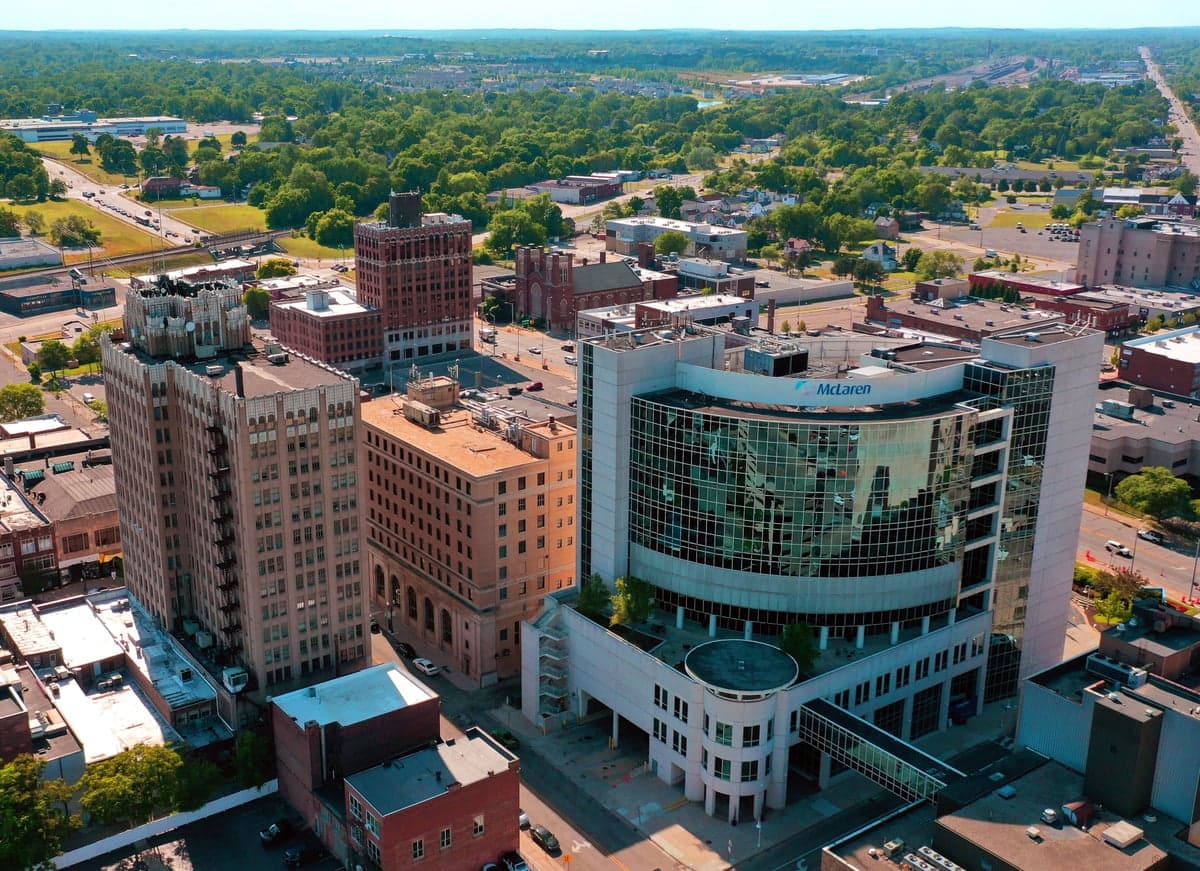
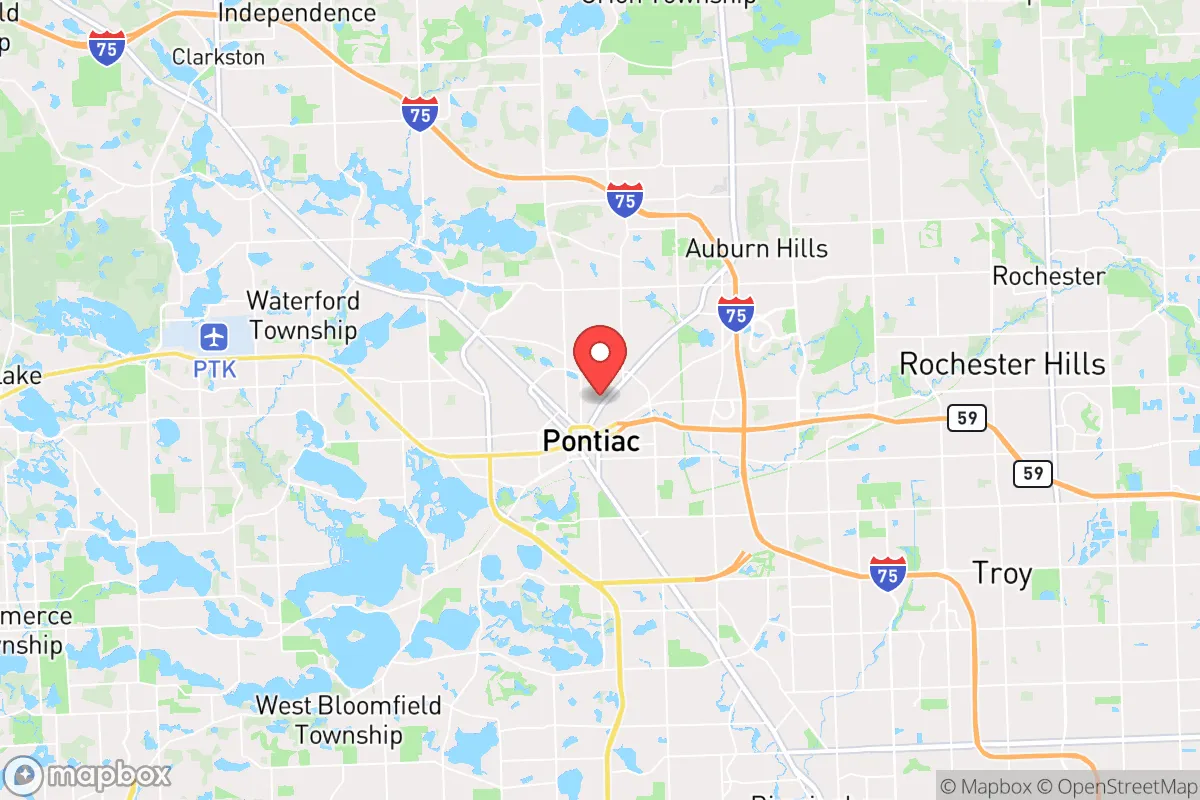
Photo: Wikipedia
Demographics of Pontiac, MI
Affluence Level in Pontiac, MI
A below-average socioeconomic profile. Incomes, home values, and educational attainment trail the U.S., with higher poverty and unemployment.
People of Pontiac, MI
Pontiac, Michigan, is a city of 61,914 residents defined by its working-class roots, a majority-Black population (46.0%), and a significant Hispanic community (21.7%) that together create a dense, urban character distinct from its suburban neighbors. The city is notably less affluent than surrounding Oakland County, with only 16.2% of adults holding a college degree, and its population has been slowly declining since the 2000s. Pontiac’s identity is shaped by a history of industrial boom, racial transition, and recent efforts to stabilize a shrinking tax base, making it a place of both struggle and resilience for families and single individuals seeking affordable housing near Detroit.
How the city was settled and grew
Pontiac’s population history begins with its founding in 1818 as a stagecoach stop and later a railroad hub, but the city’s real growth came with the automobile industry. By the early 20th century, General Motors’ Pontiac Motor Division and other auto plants drew waves of European immigrants—primarily Polish, Italian, and Irish—who settled in working-class neighborhoods like Woodland Estates and the Downtown area near the factories. These groups built the city’s early infrastructure, including churches and union halls, and by 1950 Pontiac’s population peaked at over 80,000, overwhelmingly white and blue-collar. The post-World War II boom also attracted Black workers from the South during the Great Migration, who initially concentrated in the North Hill neighborhood, though housing discrimination kept them segregated from white ethnic enclaves.
Modern era (post-1965)
The 1967 Detroit riot and subsequent white flight reshaped Pontiac dramatically. Between 1970 and 2000, the city’s white population plummeted from over 70% to roughly 25%, while Black residents became the majority, spreading into formerly white areas like Ottawa Hills and South Boulevard. The 1965 Hart-Cellar Act also opened doors for new immigrants: Hispanic families, primarily of Mexican descent, began arriving in the 1970s to work in remaining auto plants and service jobs, settling in the Bagley Street corridor and the Westside near the GM plant. Today, East/Southeast Asian communities (3.3%) and Indian-subcontinent residents (0.4%) are small but present, often in newer subdivisions near the city’s edges, though Pontiac remains far less diverse than nearby Troy or Farmington Hills. The city’s foreign-born share (7.6%) is modest, reflecting limited recent immigration compared to the broader region.
The future
Pontiac’s population is slowly shrinking—down from 66,337 in 2000—and aging, with a median age of 35. The Hispanic share is the fastest-growing segment, projected to rise from 21.7% toward 30% by 2040, driven by higher birth rates and continued migration from Mexico and Central America. The Black population is stable but slightly declining as some middle-class families move to suburbs like Auburn Hills or Waterford. The white population (22.4%) is concentrated in a few pockets, such as the Dodge Park area, but is not growing. The city is not homogenizing; instead, it is tribalizing into distinct enclaves: Hispanic families cluster around Bagley Street, Black residents dominate the central and eastern wards, and a small but growing number of East/Southeast Asian families are moving into the Pine Knob area near the northern border. The next 10-20 years will likely see Pontiac become a majority-Hispanic city, with the Black share falling below 40% and the white share remaining under 25%, while overall population continues a slow decline unless new development—such as the redevelopment of the former GM plant site—attracts younger families.
For a single individual or parent considering a move to Pontiac, the city offers affordable housing and a strong sense of community in its ethnic enclaves, but it is a place of demographic transition rather than stability. The population is becoming more Hispanic and less Black, with limited growth in Asian or Indian communities, and the overall trend is toward a lower-income, less-educated population unless economic revitalization reverses the outflow. Pontiac is not a homogenizing suburb but a city where distinct neighborhoods—Bagley Street for Hispanic families, North Hill for Black residents, and Dodge Park for white households—define daily life, making it a place where newcomers should expect to live within a specific cultural corridor rather than a melting pot.

* Values derived from national, state, county, city and local statistics and may differ in a specific area. Last updated: 2026-04-30T02:55:04.000Z
Narrative content on this page is AI-generated and may contain mistakes. Verify any details that matter before acting on them.
ReloMaps may earn a commission from affiliate links at no extra cost to you.

