Photo: Wikipedia
Demographics of Port Chester, NY
Affluence Level in Port Chester, NY
A middle-class area roughly in line with national averages across income, home values, education, and employment.
People of Port Chester, NY
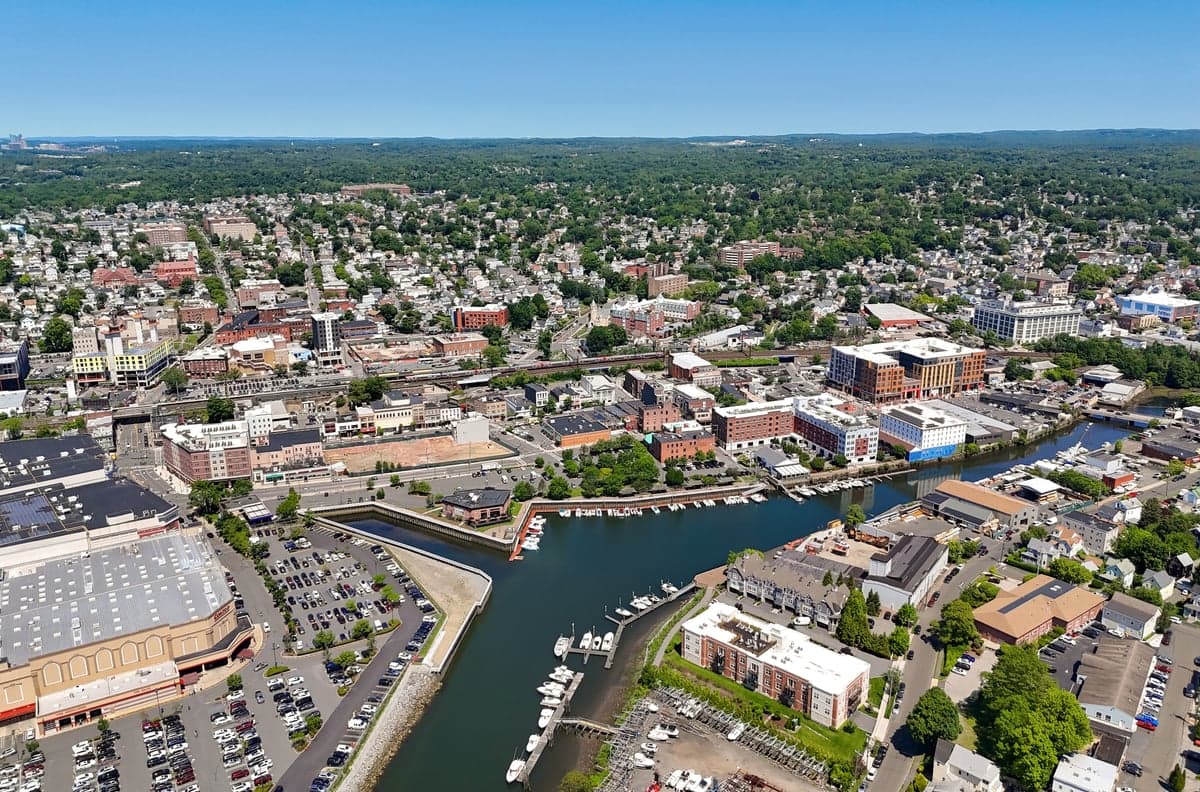
Today, Port Chester, New York is a densely packed, majority-Hispanic village of 31,162 residents, where nearly 26% of the population is foreign-born and the median age is a relatively young 36.5. The village is defined by its working-class energy, a vibrant downtown commercial corridor, and a distinctive identity as a primary landing point for Central and South American immigrants in Westchester County. While the historic white ethnic and Italian-American character of the village has faded, the population is now overwhelmingly Hispanic (59.7%), with a small but stable Black community (6.9%) and modest East/Southeast Asian (1.5%) and Indian (1.0%) populations.
How the city was settled and grew
Port Chester’s original European settlement began in the 1660s as part of the larger town of Rye, with English colonists farming the land along the Byram River. The village’s modern identity was forged in the 19th century, when its location on the Long Island Sound and the arrival of the New York and New Haven Railroad in 1848 transformed it into a manufacturing hub. Factories producing everything from pianos to corsets drew successive waves of immigrants. The first major group was Irish laborers, who settled in the South End near the waterfront and the railroad yards, building St. Peter’s Catholic Church in 1851. They were followed by German and Italian immigrants in the late 1800s and early 1900s, who clustered in the West End and around King Street, establishing tight-knit neighborhoods anchored by social clubs and parish churches like the Church of the Resurrection. By the mid-20th century, Port Chester was a classic white ethnic, blue-collar village, with a population that was overwhelmingly of Italian, Irish, and German descent.
Modern era (post-1965)
The demographic transformation of Port Chester began in earnest after the 1965 Immigration and Nationality Act, but the shift accelerated dramatically in the 1980s and 1990s. Political instability and economic hardship in Central and South America—particularly from Guatemala, El Salvador, and Colombia—drove a wave of immigration that reshaped the village. These new arrivals found affordable housing and a ready-made ethnic economy in the Downtown Core along Westchester Avenue and North Main Street, where Spanish-language storefronts, bodegas, and restaurants now dominate. The Fox Island neighborhood, historically a working-class area near the Byram River, also absorbed a significant share of the Hispanic population, as did the Pemberwick section along the Greenwich border. By 2000, the Hispanic share of the population had surpassed 40%, and by the 2020 Census, it reached nearly 60%. The white population, which had been over 90% in 1970, dropped to 28.9% as older ethnic families aged out or moved to less dense suburbs. The Black population, historically small and concentrated near Grace Church Street, has remained relatively stable at around 7%.
The future
Port Chester’s population is not homogenizing; it is becoming more distinctly Hispanic and more foreign-born. The 25.9% foreign-born share is among the highest in Westchester County, and the flow of new arrivals from Central America shows no sign of plateauing. The village’s relatively affordable housing stock (compared to neighboring Greenwich, CT and Rye, NY) and its direct Metro-North train service to Grand Central Terminal continue to attract both immigrant families and a small number of younger white and Asian professionals seeking an urban edge. However, the East/Southeast Asian and Indian populations remain very small (1.5% and 1.0% respectively), and there is no evidence of a significant Asian or Indian enclave forming. The white population is likely to continue its slow decline, while the Hispanic community will solidify its majority status. The key demographic question for the next decade is whether the village will see a wave of assimilation and upward mobility—with second-generation Hispanic residents moving to the suburbs—or whether continued immigration will sustain the current ethnic concentration.
For a conservative-leaning individual or family considering a move to Port Chester, the bottom line is this: the village is a dense, majority-Hispanic, working-class community with a strong immigrant character and a lively downtown. It is not a homogenizing suburb but a distinct ethnic enclave that is likely to remain so for the foreseeable future. Those seeking a traditional white-ethnic or assimilated suburban environment will find a better fit in nearby Rye or Greenwich, while those comfortable with a vibrant, Spanish-speaking, blue-collar community will find Port Chester to be an authentic and affordable option in an otherwise expensive region.

* Values derived from national, state, county, city and local statistics and may differ in a specific area. Last updated: 2026-04-19T05:20:06.000Z
Narrative content on this page is AI-generated and may contain mistakes. Verify any details that matter before acting on them.
ReloMaps may earn a commission from affiliate links at no extra cost to you.

