Photo: Wikipedia
Demographics of Portland, OR
Affluence Level in Portland, OR
A middle-class area roughly in line with national averages across income, home values, education, and employment.
People of Portland, OR
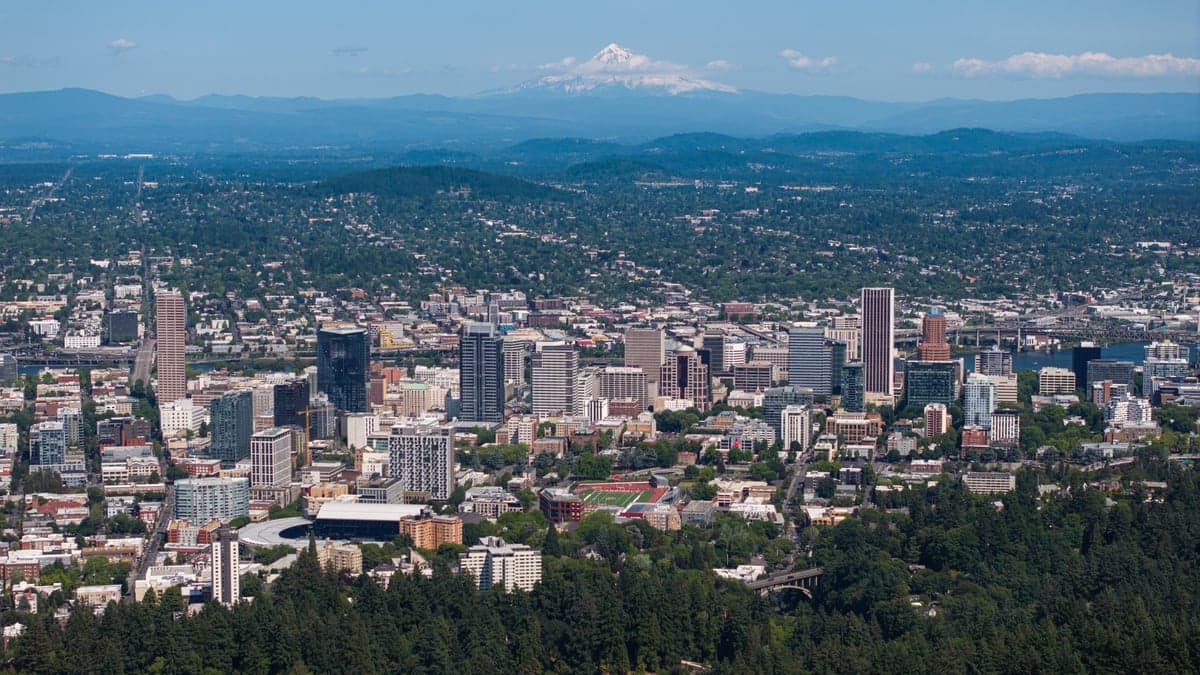
The people of Portland, Oregon, today number 642,715, forming a city that is notably white (67.0%) and highly educated (53.5% college graduates) compared to national averages, yet increasingly diverse. The city’s population is characterized by a long-established liberal political culture, a relatively low foreign-born share (5.2%), and a growing Hispanic (11.3%) and East/Southeast Asian (7.3%) presence. Distinctive identity markers include a strong emphasis on environmentalism, craft culture, and a history of civic activism, though recent years have seen significant out-migration and demographic shifts that are reshaping the city’s character.
How the city was settled and grew
Portland’s original population was drawn by the Donation Land Claim Act of 1850, which offered free land to white settlers willing to farm the Willamette Valley. The city’s founding in 1845 by New Englanders and Midwesterners established a Yankee Protestant core, with early industries in timber, shipping, and later, shipbuilding. The first major non-white wave arrived with Chinese laborers in the 1860s-1880s, who built the transcontinental railroad and then settled in the Old Town/Chinatown district, which became the city’s first ethnic enclave. By the early 20th century, Japanese immigrants established a community in what is now the Pearl District (then a working-class area), while African Americans began arriving during World War I and the 1920s, settling in the Albina neighborhood in North Portland. The Great Depression and World War II brought a second major wave of Black migration for shipyard jobs, concentrating in Vanport (a wartime housing project destroyed in the 1948 flood) and later King and Boise neighborhoods. European immigrants—Germans, Scandinavians, and Irish—filled working-class areas like St. Johns and Sellwood, while the city’s restrictive racial covenants kept most non-white residents confined to North and Northeast Portland through the mid-20th century.
Modern era (post-1965)
The Hart-Cellar Immigration Act of 1965 and the end of racial covenants reshaped Portland’s population, though the city remained less diverse than other West Coast metros. The 1970s and 1980s saw a wave of white, college-educated in-migrants from California and the East Coast, drawn by the city’s reputation for livability and counterculture, settling in Hawthorne and Alberta Arts districts. This influx accelerated gentrification, pushing many Black residents out of North and Northeast Portland to suburbs like Gresham and Beaverton. The Hispanic population grew steadily from the 1990s onward, concentrated in East Portland (east of 82nd Avenue) and Hillsboro, driven by agricultural and service-sector jobs. East/Southeast Asian communities—primarily Vietnamese, Chinese, and Korean—expanded in the Jade District (around 82nd and Division) and Beaverton, while the Indian-subcontinent population (0.7%) remains small and dispersed, with clusters in tech-adjacent suburbs like Hillsboro. The foreign-born share (5.2%) is low for a major U.S. city, reflecting Portland’s relative isolation and lack of a large immigrant gateway economy. The 2010s saw a surge of domestic migration from California and the Northeast, driving rapid population growth and housing cost increases, but this trend reversed sharply after 2020.
The future
Portland’s population is heading toward a period of stabilization or slight decline, following a net loss of roughly 30,000 residents between 2020 and 2024 due to remote work, crime concerns, and high housing costs. The city is becoming more tribalized by income and lifestyle: affluent, college-educated whites dominate the central neighborhoods (Pearl District, Northwest District, Hawthorne), while lower-income and minority populations are pushed to East Portland and inner-ring suburbs. The Hispanic population is the fastest-growing demographic, projected to reach 15-18% by 2040, driven by higher birth rates and continued immigration, with East Portland becoming a majority-minority area. East/Southeast Asian communities are plateauing, as younger generations assimilate and move to suburbs. The Black population, now 5.7%, continues a decades-long decline in the city proper, with many families relocating to North Clackamas and Washington County. The Indian-subcontinent population remains small and unlikely to grow significantly without a major tech employer expansion. The city’s low foreign-born share suggests Portland will not become a classic immigrant gateway; instead, its future population will be shaped by domestic migration patterns, housing affordability, and the ability to retain families.
For someone moving in now, Portland is becoming a city of stark contrasts: a highly educated, white, and liberal core surrounded by a more diverse and less affluent periphery. The city’s population is aging and shrinking, with fewer children and more single-person households. New arrivals should expect a place where neighborhood identity matters deeply, where East Portland offers the most diversity and affordability, and where the central city remains a magnet for young professionals but increasingly hostile to families seeking stability.

* Values derived from national, state, county, city and local statistics and may differ in a specific area. Last updated: 2026-05-04T23:09:15.000Z
Narrative content on this page is AI-generated and may contain mistakes. Verify any details that matter before acting on them.
ReloMaps may earn a commission from affiliate links at no extra cost to you.

