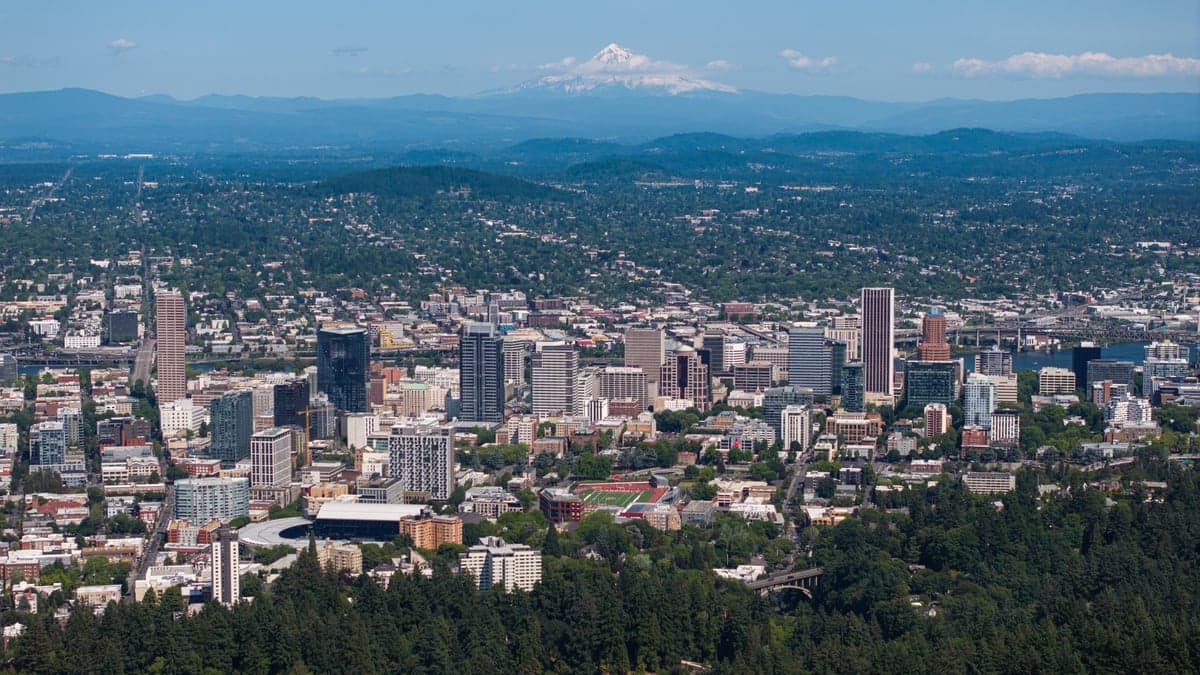
Photo: Wikipedia
Political ClimatePolitical Climate in Portland, OR
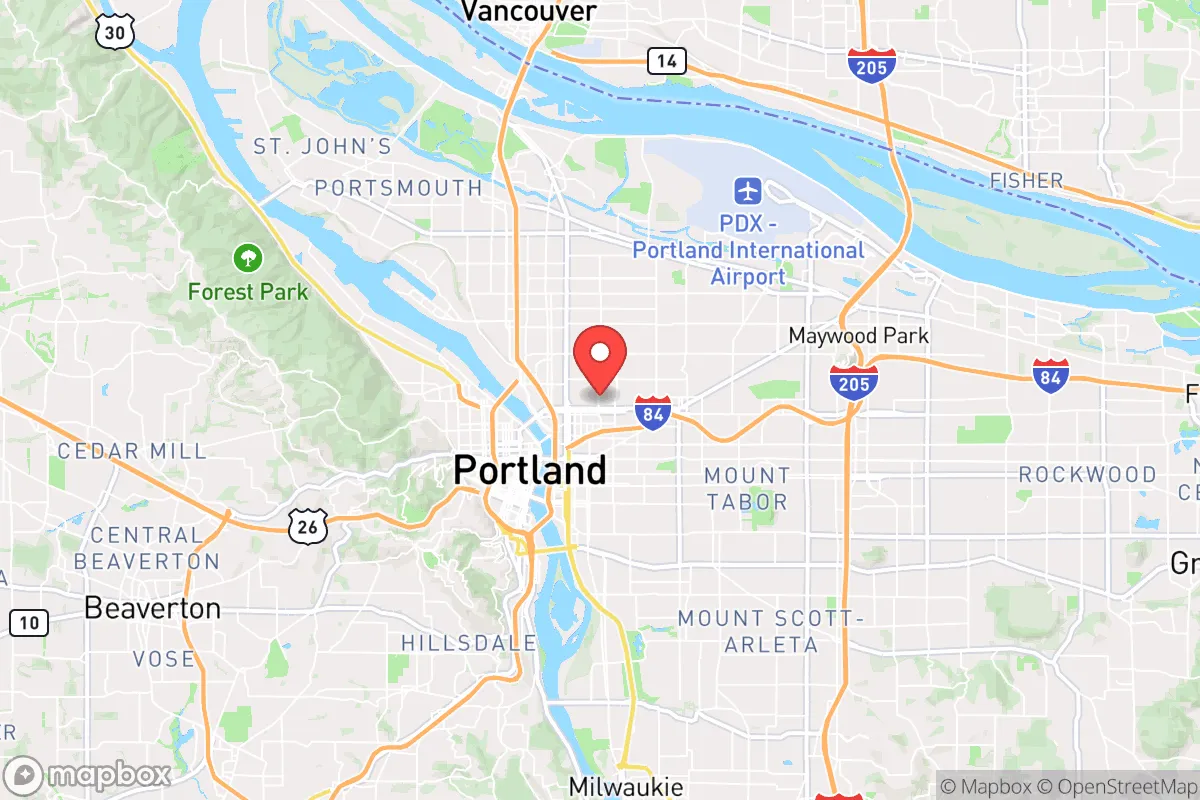
District shown is the primary district for this city’s centroid. Cities may span multiple districts.
Local Political AnalysisPolitical Analysis of Portland, OR
Portland, Oregon, has a Cook PVI of D+24, making it one of the most reliably Democratic-leaning major cities in the country. That’s a full 16 points more liberal than the state of Oregon as a whole, which sits at D+8. If you’ve lived here as long as I have, you’ve watched this shift happen in real time—what was once a quirky, live-and-let-live city has become a place where progressive orthodoxy feels less like a choice and more like a requirement. The trajectory is clear: Portland is moving further left, and the state is slowly following, but not without some serious friction from the more rural and suburban areas.
How it compares
Drive 30 minutes in almost any direction from downtown Portland, and you’ll hit towns that feel like a different country. Beaverton and Hillsboro are more moderate, with a mix of tech workers and families who lean center-left but aren’t as dogmatic about it. Head east to Gresham or south to Oregon City, and you’ll find a lot of folks who voted for Trump in 2020 and 2024, even as Portland proper went 80% for Biden. The contrast is stark: Portland’s city council and mayor have embraced policies like defunding the police, decriminalizing hard drugs (which they’ve since partially walked back after the fentanyl crisis exploded), and implementing strict land-use regulations that drive up housing costs. Meanwhile, the state legislature in Salem is more cautious, often watering down Portland’s most ambitious bills. Multnomah County, which contains Portland, is the engine of Oregon’s leftward momentum, but it’s also the place where the consequences are most visible—homeless encampments, open-air drug use, and a retail exodus from downtown that’s been painful to watch.
What this means for residents
For the average person living here, the political climate translates directly into daily hassles and frustrations. Property crime rates have spiked since 2020, and while the city has started to reverse some of its soft-on-crime policies, the damage to public trust is done. If you own a small business or a car with out-of-state plates, you’ve probably had a window smashed or a catalytic converter stolen. The city’s response has been slow, and many residents feel like their concerns about safety and quality of life are dismissed as “NIMBYism” or “fearmongering.” On the housing front, Portland’s strict zoning and rent control measures have made it harder to build new units, driving up prices for everyone. The irony is that the progressive policies meant to help the vulnerable often end up hurting the middle class—people who work hard, pay taxes, and just want a safe neighborhood and a decent school for their kids.
There’s also a cultural shift that’s hard to ignore. Portland used to be a place where you could disagree without being labeled a bigot. Now, public discourse is dominated by activist groups and city officials who treat any dissent as a moral failing. School board meetings have become battlegrounds over curriculum and parental rights, and the city’s response to homelessness has turned into a tug-of-war between compassion and common sense. If you’re a conservative or even a moderate, you learn to keep your head down in social settings. The long-term outlook? Unless there’s a major course correction—like a repeal of Measure 110 (the drug decriminalization law) or a serious crackdown on crime—Portland will likely continue its slide into a one-party city where the only “choice” is between two shades of progressive. The rest of Oregon might hold the line for a while, but the state’s population centers are growing, and with them, the political gravity pulling everything left.

State Political ClimatePolitical Climate in Oregon
State Political AnalysisPolitical Environment in the State
Oregon has a Cook PVI of D+8, meaning it leans about eight points more Democratic than the national average, but that number hides a deeply fractured political landscape. The state’s progressive coalition is concentrated in the Portland metro area—Multnomah, Washington, and Clackamas counties—while the rest of the state, from the Willamette Valley south to the California border and east across the high desert, votes reliably Republican. Over the last 20 years, the Democratic grip has tightened at the state level, but the rural-urban chasm has widened dramatically, with many small towns feeling abandoned by Salem and Portland.
Urban vs. rural divide
The political map of Oregon is essentially two states. The Portland metro—including Portland, Gresham, Hillsboro, and Beaverton—drives the Democratic supermajority in the legislature, with Multnomah County alone delivering over 75% of its votes to Democrats in recent cycles. Eugene and Corvallis, home to the University of Oregon and Oregon State, add another deep-blue pocket. Meanwhile, the rest of the state is solidly red. Bend in Deschutes County has become a fascinating battleground: once a conservative stronghold, it’s now trending purple as Californians and out-of-state transplants pour in, but the surrounding high desert counties—Lake, Harney, Malheur—vote 70-80% Republican. Medford and Grants Pass in Jackson and Josephine counties are reliably conservative, though the Rogue Valley has seen a slow leftward drift in Ashland. The divide isn’t just electoral; it’s cultural. Rural Oregonians feel the state government in Salem is run by Portland interests, and they’re not wrong.
Policy environment
Oregon’s policy environment is a cautionary tale for anyone valuing limited government. The state has no sales tax, which sounds great, but it’s replaced by some of the highest income and property taxes in the nation—top marginal income tax rate hits 9.9%, and property taxes are capped but still steep. The regulatory posture is aggressive: Oregon’s land-use laws, enacted in the 1970s, are among the strictest in the country, limiting development and driving up housing costs. Education policy is dominated by teachers’ unions, and the state’s Measure 98 (career and technical education) is a rare bright spot, but overall K-12 outcomes are middling despite high per-pupil spending. Healthcare is heavily regulated, with a state-run insurance exchange and Medicaid expansion under the Affordable Care Act. Election laws are among the most progressive: Oregon was the first state to vote entirely by mail (1998), and it automatically registers voters when they get a driver’s license. That convenience has a downside—ballot harvesting and signature verification concerns are persistent topics among conservatives. The state also has no voter ID law, which raises eyebrows for those who prioritize election integrity.
Trajectory & freedom
Oregon is becoming less free by almost any measure, and recent legislation confirms the trend. On gun rights, the state passed Measure 114 in 2022, which requires a permit to purchase a firearm, bans magazines over 10 rounds, and mandates a waiting period—currently tied up in court but a clear infringement on Second Amendment rights. Parental rights took a hit with HB 2002 (2023), which allows minors 15 and older to access gender-affirming care without parental consent, and SB 3 (2019) expanded abortion access to include taxpayer-funded services for all, regardless of age. Medical autonomy is under siege: the state’s Death with Dignity Act (1997) was a pioneer for assisted suicide, but the real concern is the growing push for vaccine mandates and health data collection. Property rights are eroded by the aforementioned land-use laws and a recent rent control measure (2019) that caps annual rent increases at 7% plus inflation, discouraging new construction. On the plus side, Oregon has no personal income tax on Social Security benefits, which is a small win for retirees. But the overall trajectory is toward more government control, not less.
Civil unrest & political movements
Oregon has a long history of civil unrest, and the last five years have been particularly volatile. The Portland protests of 2020—sparked by George Floyd’s death but morphing into months of nightly demonstrations, property destruction, and clashes with federal agents—made national headlines. The city’s Antifa and far-left activist networks remain active, though less visible since 2021. On the right, the Oregon Republican Party has become more militant, with several county-level secession movements (e.g., the “Greater Idaho” movement, which proposes moving 13 eastern Oregon counties into Idaho) gaining traction. Immigration politics are a flashpoint: Portland is a sanctuary city, and the state’s SB 1080 (2021) limits local law enforcement cooperation with federal immigration authorities. Election integrity remains a sore spot—the 2020 and 2022 cycles saw widespread allegations of ballot harvesting and signature irregularities, particularly in Multnomah County, though no major fraud was proven. A new resident would notice the stark contrast: Portland’s streets have a visible homeless crisis and open drug use (decriminalized under Measure 110 in 2020, though partially rolled back in 2024), while rural towns like Baker City or John Day feel like a different country entirely.
Projection
Over the next 5-10 years, Oregon will likely become more Democratic at the state level but more polarized internally. In-migration from California and other blue states continues to fuel growth in Portland, Bend, and the Willamette Valley, while rural counties lose population and political influence. The Greater Idaho movement is a long shot but reflects genuine frustration—if the state continues to ignore rural concerns, you could see more counties trying to leave. The Democratic supermajority in Salem will likely push further on gun control, environmental regulation, and social policy, while the housing crisis worsens due to land-use restrictions. For a conservative-leaning individual or family, the outlook is mixed: the state’s natural beauty and outdoor lifestyle are unmatched, but the political climate is increasingly hostile to traditional values, parental rights, and economic freedom. The best bet for a conservative transplant is to look at central Oregon (Redmond, Prineville) or the Rogue Valley (Grants Pass, Medford), where local governments are more aligned with limited-government principles, but you’ll still be fighting state-level overreach.
Bottom line: If you’re moving to Oregon, understand that you’re buying into a state where the urban core dictates policy for the entire state. Your personal freedoms—gun rights, parental authority, property use—will be under constant pressure from Salem. The rural areas offer a better quality of life and more like-minded neighbors, but you’ll need to be politically active to protect what you value. It’s not a lost cause, but it’s a state that requires vigilance, not complacency.
* Values derived from national, state, county, city and local statistics and may differ in a specific area. Last updated: 2026-05-04T23:09:15.000Z
Narrative content on this page is AI-generated and may contain mistakes. Verify any details that matter before acting on them.
ReloMaps may earn a commission from affiliate links at no extra cost to you.

