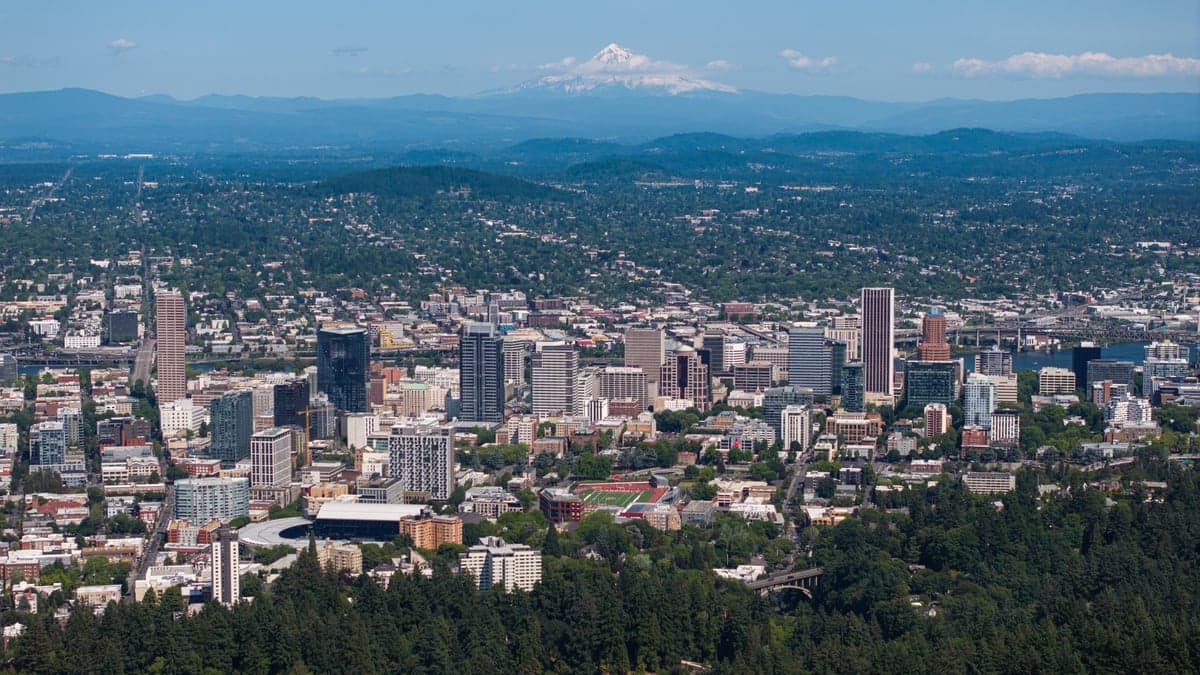
Photo: Wikipedia
Personal Sovereignty in Portland, OR
Viable for self-reliance. Generally workable, though some barriers may limit total independence.
What does Personal Sovereignty tell us?
Personal Sovereignty measures your capacity for self-reliance and independence with minimal government friction. Higher scores mean fewer barriers between you and the way you want to live... but it assumes you have the space you need and good neighbors.
What does this tell us?
Personal Sovereignty measures your capacity for self-reliance and independence with minimal government friction. Higher scores mean fewer barriers between you and the way you want to live... but it assumes you have the space you need and good neighbors.
State Policy
Energy independence: Importer (35% of energy produced in-state)
Personal Liberty
Homesteading

Personal Liberty Analysis
Portland, Oregon, presents a deeply conflicted environment for personal sovereignty, where a progressive municipal government actively restricts individual autonomy in areas like self-defense and property rights, while the state’s constitutional framework and geographic setting offer pockets of resilience for those willing to navigate the regulatory maze. For a conservative-leaning individual or family prioritizing self-reliance, Portland’s urban core is a high-control zone, but the surrounding Multnomah County and nearby rural areas provide a more nuanced picture. The city’s political leadership has consistently pushed policies that erode personal freedoms, from strict gun control to zoning laws that limit off-grid living, yet Oregon’s relatively low property tax rates and absence of sales tax create a fiscal buffer that can be leveraged by those who plan carefully. This analysis examines the specific trade-offs for preppers and survivalists considering relocation, focusing on tax burden, self-defense laws, homesteading feasibility, and broader personal liberties.
Tax burden and regulatory posture: How Oregon’s fiscal policies affect personal autonomy
Oregon’s tax structure offers a mixed bag for those seeking financial sovereignty. The state has no sales tax, which provides immediate savings on large purchases like firearms, ammunition, and survival gear—a direct benefit for preppers stocking supplies. However, Oregon’s state income tax is among the highest in the nation, with a top marginal rate of 9.9% on income over $125,000 for single filers, and Multnomah County adds an additional marginal rate of up to 1.5% for high earners. This progressive tax burden directly reduces the capital available for self-reliant investments like land, solar panels, or water storage systems. Property taxes in Portland are relatively moderate, averaging around 1.0% of assessed value, but the city’s land-use regulations are notoriously restrictive. The Urban Growth Boundary (UGB), enforced by Metro, severely limits development on the city’s fringe, driving up land prices and making it difficult to acquire acreage for homesteading within commuting distance. For a survivalist, the regulatory posture is hostile: Portland’s zoning code prohibits keeping livestock on most residential lots under 10,000 square feet, and permits for rainwater catchment systems require extensive paperwork. The city’s Climate Action Plan further mandates energy efficiency upgrades that can be costly for older homes, effectively penalizing those who want to live off-grid. In short, while Oregon’s lack of sales tax is a win, the income tax and regulatory overhead in Portland make it a high-cost environment for maintaining financial autonomy.
Self-defense and gun law specifics: Navigating Oregon’s restrictive firearms environment
For those who view the Second Amendment as foundational to personal sovereignty, Portland is a challenging jurisdiction. Oregon’s Measure 114, passed by voters in 2022 and currently tied up in court, would require a permit to purchase any firearm, a mandatory background check for all transfers, and a ban on magazines holding more than ten rounds. While the measure is not yet fully enforced due to legal challenges, the political climate in Portland is aggressively anti-gun. The city council has passed resolutions supporting the measure, and the Multnomah County Sheriff’s Office has indicated it will prioritize enforcement if the law takes effect. Even without Measure 114, Oregon already has universal background checks for private sales and a red flag law that allows family members or law enforcement to petition for temporary firearm seizure. Portland’s city government has also funded gun buyback programs and restricted firearms in city parks and public buildings. For a prepper, this means that carrying a concealed weapon in Portland requires a license (which is shall-issue but can be delayed by county backlogs), and open carry is legal but practically discouraged by police and public sentiment. The practical workaround is to live outside city limits—in unincorporated Multnomah County or neighboring Clackamas County—where enforcement is less aggressive and rural property allows for private shooting ranges. However, any firearm purchase still requires a federal background check through a licensed dealer, and the state’s waiting period for handguns (currently three days, but could expand under Measure 114) adds friction. For those prioritizing self-defense, Portland’s urban core is a no-go zone, but the surrounding rural areas offer a more permissive environment if you’re willing to drive.
Self-reliance and homesteading viability: Lot sizes, zoning, and off-grid feasibility in the Portland metro
True homesteading within Portland’s city limits is nearly impossible due to restrictive zoning. The minimum lot size for a single-family home in most residential zones is 5,000 square feet, but keeping chickens, goats, or bees requires a special permit and is limited to lots over 10,000 square feet in many areas. The city’s ban on new gas hookups for residential construction, effective 2023, forces reliance on the electrical grid, which is vulnerable to the Cascadia Subduction Zone earthquake scenario that preppers constantly monitor. Rainwater harvesting is legal but limited to 5,000 gallons of storage without a permit, and the water must be used only for outdoor irrigation—not for drinking or indoor use—due to state health codes. Composting toilets are allowed only in areas without sewer access, which excludes most of Portland. For those seeking off-grid viability, the best bet is to look east of Portland in the Columbia River Gorge (Hood River or Wasco counties) or south toward the Willamette Valley (Marion or Linn counties), where zoning allows for agricultural use on parcels as small as 2-5 acres. These areas also have fewer restrictions on solar panel installation and well drilling. Within the metro area, the suburb of Sandy (Clackamas County) offers larger lots and more lenient animal ordinances, but property prices have surged as Portlanders flee the city. For a survivalist, the takeaway is clear: Portland’s urban core is a regulatory cage for homesteading, but the surrounding counties provide viable options if you’re willing to commute or work remotely.
Personal liberties: Parental rights, medical autonomy, speech, and property in Portland
Portland’s progressive governance has created a landscape where personal liberties are heavily contested. On parental rights, Oregon law gives parents broad authority over their children’s education, including the right to homeschool without prior approval from the school district—a plus for those seeking to opt out of public school curricula. However, Portland Public Schools has implemented policies that allow students to change their gender identity without parental notification, a flashpoint for conservative families. The state also mandates comprehensive sex education in public schools, which some parents view as overreach. On medical autonomy, Oregon has legalized physician-assisted suicide (Death with Dignity Act) and has some of the most permissive vaccine exemption laws in the country for schoolchildren (both medical and nonmedical exemptions are allowed), but the state’s COVID-19 vaccine mandate for healthcare workers remains in effect, and Portland’s city government has shown willingness to enforce public health orders aggressively. Free speech is protected under the Oregon Constitution, which has stronger protections than the First Amendment in some areas, but Portland’s city council has passed resolutions condemning “hate speech” and has used zoning laws to restrict protest locations near abortion clinics. Property rights are the most contentious: Oregon’s land-use system, established in the 1970s, gives the state government veto power over local zoning decisions, and Portland’s inclusionary zoning ordinance requires new developments to include affordable housing units, effectively acting as a tax on property owners. For a prepper, the most alarming trend is the city’s homeless camping policies, which have led to widespread trespassing and property damage in residential neighborhoods, with police often declining to enforce anti-camping laws. This erosion of property rights is a major red flag for those seeking to secure their homestead.
In the broader context of the Pacific Northwest, Portland ranks low for personal sovereignty compared to rural Oregon or neighboring Idaho. The city’s tax burden, gun restrictions, and regulatory hostility toward self-reliance make it a poor fit for survivalists who value minimal government interference. However, for those willing to live on the metro’s fringe—in Clackamas, Washington, or Columbia counties—the trade-offs become manageable, especially given Oregon’s lack of sales tax and strong homeschooling laws. Ultimately, Portland is a place where personal sovereignty must be actively defended, not assumed, and where the cost of freedom is constant vigilance against an overreaching municipal government.

* Values derived from national, state, county, city and local statistics and may differ in a specific area. Last updated: 2026-05-04T23:09:15.000Z
Narrative content on this page is AI-generated and may contain mistakes. Verify any details that matter before acting on them.
ReloMaps may earn a commission from affiliate links at no extra cost to you.

