Photo: Wikipedia
Political ClimatePolitical Climate in Potomac, MD
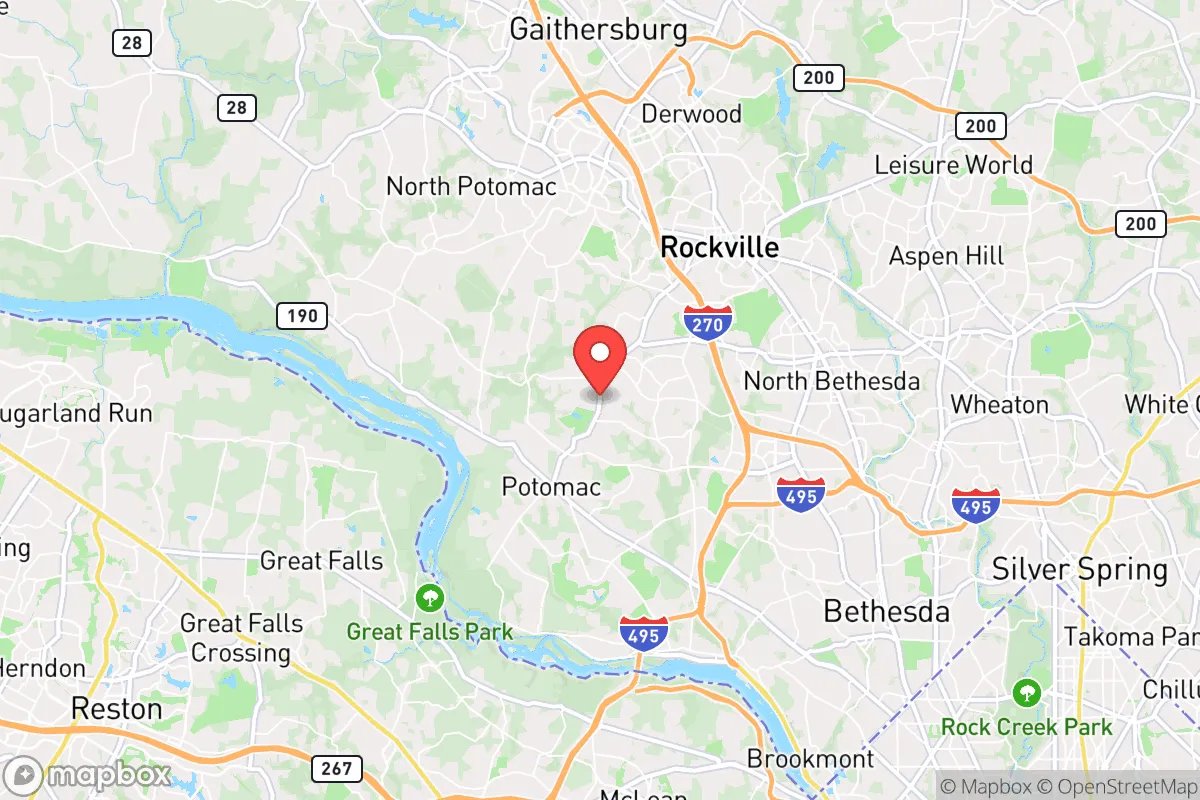
District shown is the primary district for this city’s centroid. Cities may span multiple districts.
Local Political AnalysisPolitical Analysis of Potomac, MD
Potomac, Maryland, is about as deep blue as it gets in the D.C. suburbs, with a Cook PVI of D+30. That means in a typical election, Democrats win by a 30-point margin over Republicans. It wasn't always this way — I remember when this area was a lot more mixed, with plenty of old-school fiscal conservatives and folks who just wanted to be left alone. But over the last two decades, the political center of gravity has shifted hard left, and it's not showing any signs of swinging back.
How it compares
To really understand Potomac, you have to look at the towns around it. Drive ten minutes north to Darnestown or Poolesville, and you'll find a more balanced political mix — still blue-leaning, but with a noticeable conservative presence, especially in the rural pockets. Head east into Bethesda or Chevy Chase, and you're in even deeper blue territory, where progressive activism is the norm. The contrast is stark: Potomac's wealth and proximity to D.C. government jobs have created a bubble where the prevailing view is that more government is the answer to everything. Meanwhile, just over the county line in Montgomery Village or Gaithersburg, you'll hear more people grumbling about taxes and regulations. The D+30 rating isn't just a number — it means that in local elections, the primary is often the only race that matters, and the Republican candidate is usually a long shot from the start.
What this means for residents
For someone who values personal freedom and limited government, living in Potomac means constantly swimming against the current. The county government in Montgomery County has a reputation for being aggressive with new regulations — from strict zoning laws that make it hard to build anything without endless permits, to energy mandates that force homeowners into expensive upgrades. Property taxes are high, and they keep climbing to fund programs that many residents didn't vote for. The school system, while top-rated, has become a battleground for ideological battles over curriculum and parental rights. If you're a conservative, you learn to keep your head down in social settings — it's not uncommon to feel like the odd one out at a neighborhood gathering. The long-term trend is concerning: as the D.C. federal workforce expands, the area attracts more people who see government as a solution, not a problem. I don't see that changing anytime soon.
Culturally, Potomac has a distinct feel. It's a place where people are polite but guarded, and political discussions are often avoided unless you know the room. There's a strong emphasis on environmentalism and social justice in local policy, which translates into things like plastic bag bans, strict recycling rules, and mandatory affordable housing set-asides in new developments. For a conservative, it can feel like you're living under a microscope, with the county constantly telling you how to live your life. The silver lining is that the community is safe, the schools are excellent, and the property values hold up well. But if you're looking for a place where your voice on limited government and personal responsibility is heard, Potomac is a tough sell. It's a beautiful area, but the political climate is something you have to be ready for — and it's only getting more one-sided.

State Political ClimatePolitical Climate in Maryland
State Political AnalysisPolitical Environment in the State
Maryland has long been a deep blue state, with Democrats holding a supermajority in the General Assembly and every statewide office for decades. The state’s partisan lean is driven overwhelmingly by the Washington, D.C., suburbs and Baltimore City, where progressive coalitions dominate. Over the last 10-20 years, the trajectory has been a steady march leftward on taxes, regulation, and cultural issues, making it one of the most challenging environments in the Mid-Atlantic for conservative-leaning individuals and families.
Urban vs. rural divide
The political map of Maryland is a tale of two starkly different worlds. The western counties—Garrett, Allegany, and Washington—are reliably red, with Trump winning them by double digits in 2020. The Eastern Shore, including Worcester and Queen Anne’s counties, also leans conservative, though the shore’s growth is bringing more purple voters. The real power lies in the D.C. suburbs: Montgomery County (population over 1 million) and Prince George’s County are among the most liberal jurisdictions in the nation, with Democratic margins exceeding 70-80%. Baltimore City is similarly deep blue, while Baltimore County and Howard County have shifted left as well, driven by professional-class transplants. The only real swing area is Anne Arundel County (home to Annapolis), which has trended blue in recent cycles but still has pockets of conservative resistance in places like Severna Park and Pasadena. The rural-urban divide is so extreme that a conservative voter in Oakland (Garrett County) has virtually no political common ground with a voter in Silver Spring (Montgomery County).
Policy environment
Maryland’s policy environment is aggressively progressive. The state has a graduated income tax with a top rate of 5.75%, plus county-level add-ons that can push effective rates over 9% in places like Montgomery County. Property taxes are high, and the state’s estate tax kicks in at $5 million, with no portability. On regulation, Maryland has some of the strictest environmental rules in the country, including a ban on hydraulic fracturing and a 2023 law requiring net-zero emissions by 2045. Education policy is dominated by the Blueprint for Maryland’s Future, a massive funding plan that funnels billions into public schools but has been criticized for expanding bureaucracy and limiting school choice. The state has universal mail-in voting, no voter ID requirement, and same-day registration—policies that conservatives argue erode election integrity. Healthcare is heavily regulated, with a state-based insurance exchange and a 2023 law expanding Medicaid coverage to undocumented immigrants. The regulatory climate is generally hostile to small business, with high licensing fees and complex labor laws, including a $15 minimum wage that is indexed to inflation.
Trajectory & freedom
Maryland is becoming less free by nearly any measure. On gun rights, the state passed the Firearm Safety Act of 2013, which banned assault weapons and limited magazine capacity to 10 rounds. In 2024, the legislature passed a law requiring a permit to purchase any firearm, effectively ending the state’s “shall-issue” carry system. Parental rights have been eroded by the Maryland Comprehensive Health Education Framework, which mandates LGBTQ+ inclusive sex education in public schools, with no opt-out for parents. Medical autonomy took a hit with the 2023 Trans Health Equity Act, which requires Medicaid to cover gender transition procedures for minors. Property rights are constrained by the state’s aggressive use of smart growth zoning, which limits development in rural areas and concentrates density in already-liberal suburbs. Taxation is a constant pressure: in 2024, the legislature considered a wealth tax on capital gains over $1 million, though it failed. The trend is clear: each legislative session brings new restrictions on personal liberty, with little pushback from the supermajority.
Civil unrest & political movements
Maryland has a history of civil unrest, most notably the 2015 Baltimore riots following the death of Freddie Gray, which led to a state of emergency and National Guard deployment. Since then, organized activist movements have been dominated by left-leaning groups like Maryland for Justice and Showing Up for Racial Justice, which push for defunding police and decriminalizing drugs. The state is a sanctuary jurisdiction, with the Maryland Trust Act (2019) limiting cooperation between local law enforcement and federal immigration authorities. This has created flashpoints in counties like Frederick and Harford, where local sheriffs have resisted. On the right, the Maryland Republican Party is weak and fractured, though grassroots groups like Moms for Liberty have gained traction in school board races in Carroll County and the Eastern Shore. Election integrity remains a hot-button issue: the 2020 election saw widespread use of mail-in ballots, and a 2024 audit found no fraud, but many conservatives remain skeptical of the state’s no-ID voting system. Secession rhetoric is rare but not absent—some residents of Western Maryland have floated the idea of joining West Virginia, though it’s mostly symbolic.
Projection
Over the next 5-10 years, Maryland will likely become more progressive, driven by demographic shifts. The D.C. suburbs are growing faster than the rural west, and in-migration from other blue states (New York, California) is accelerating the leftward trend. The state’s high cost of living and tax burden are pushing some conservatives to flee to Pennsylvania, Delaware, or West Virginia, further concentrating the blue vote. The 2024 election saw Maryland’s congressional delegation remain all-Democratic, and the state’s electoral votes are safely blue. However, there are countercurrents: the Eastern Shore is growing, and some exurban counties like Carroll and Harford are becoming more conservative as families seek affordable housing. A conservative moving in now should expect a decade of continued tax increases, gun restrictions, and progressive education mandates, with little chance of political change at the state level.
For a new resident, the bottom line is this: Maryland offers proximity to D.C. and a strong economy, but at the cost of high taxes, heavy regulation, and a political environment that is actively hostile to conservative values. If you value personal freedom, gun rights, and low taxes, you will find yourself swimming against the current. The best bet for a conservative is to settle in a red county like Garrett or Carroll, where local government offers some buffer, but state-level policies will still affect your daily life. It’s a beautiful state with great schools and natural scenery, but it’s not a place where conservative ideals are welcomed—or even tolerated—in the halls of power.
* Values derived from national, state, county, city and local statistics and may differ in a specific area. Last updated: 2026-04-27T14:55:29.000Z
Narrative content on this page is AI-generated and may contain mistakes. Verify any details that matter before acting on them.
ReloMaps may earn a commission from affiliate links at no extra cost to you.

