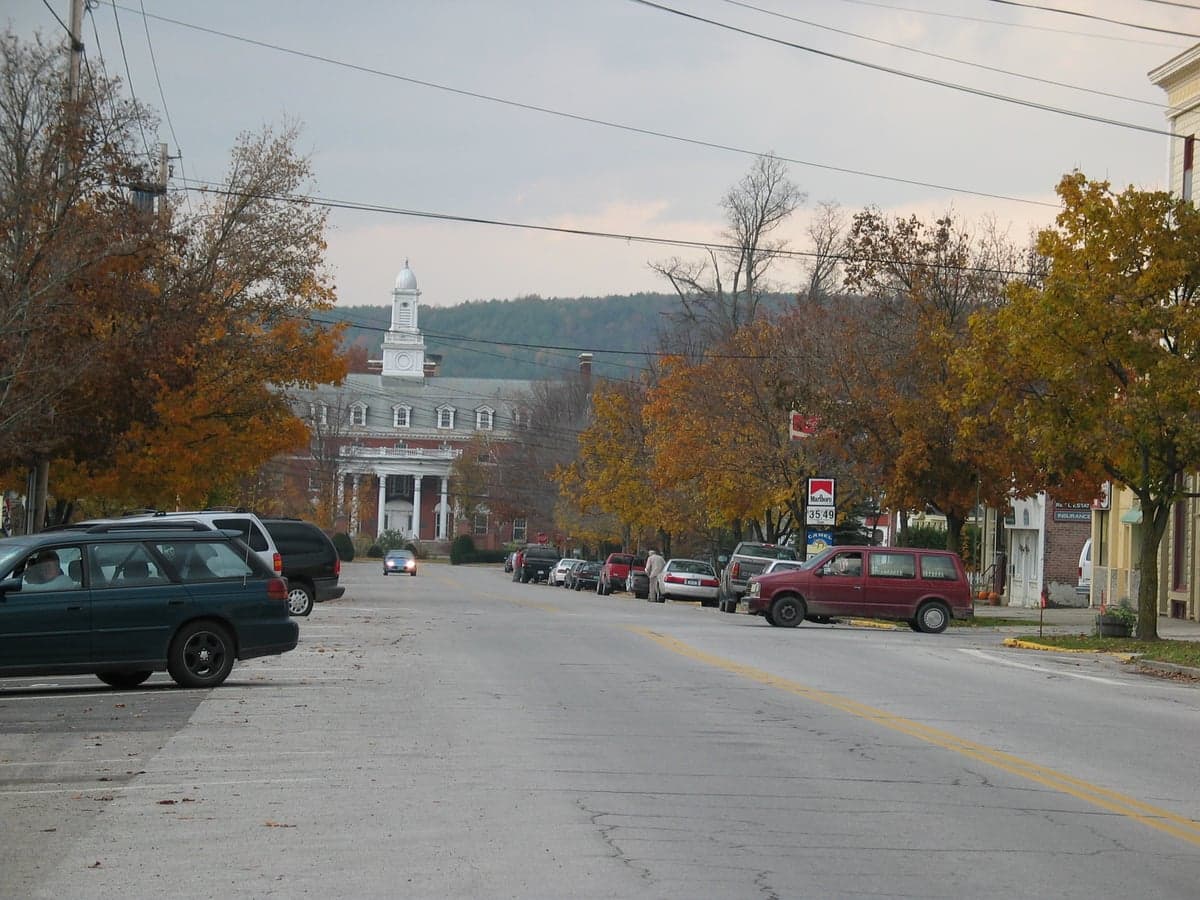
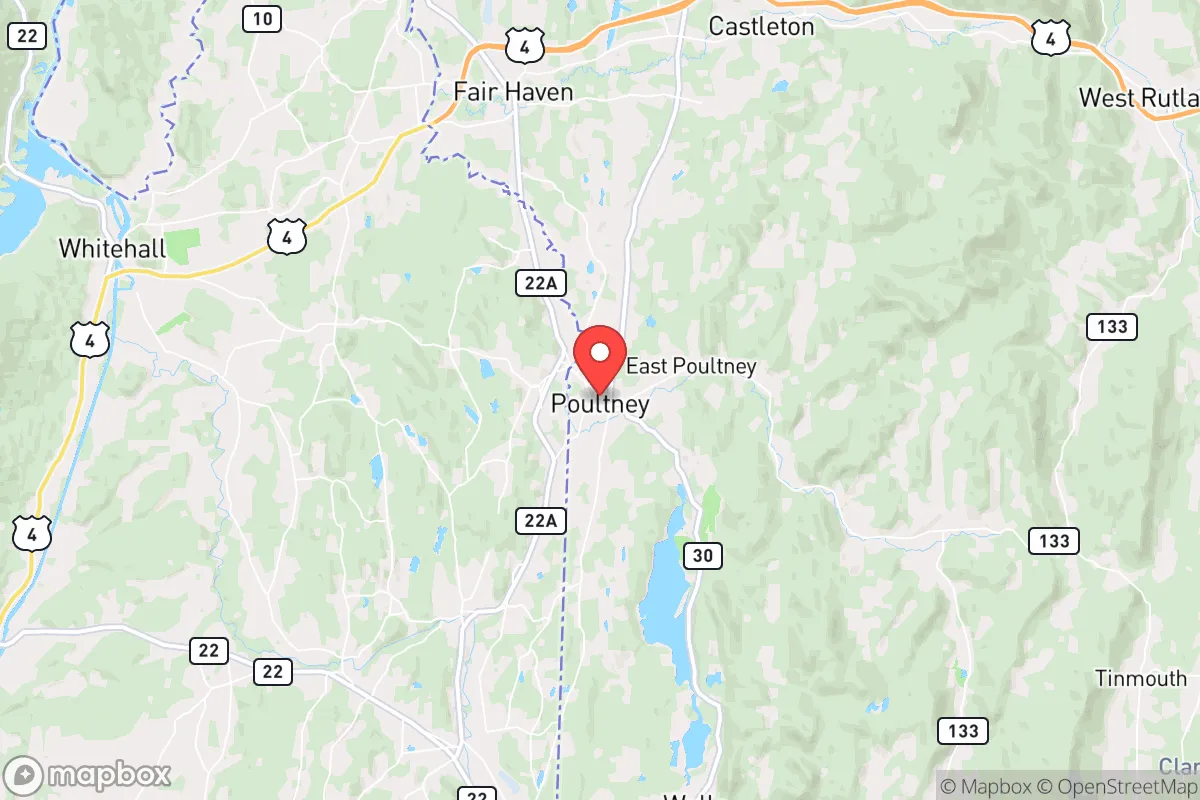
Photo: Wikipedia
Demographics of Poultney, VT
Affluence Level in Poultney, VT
A low-income area with significant economic hardship. Household wealth and educational attainment are well below national averages.
People of Poultney, VT
Today, Poultney, Vermont, is a small, predominantly white community of 1,105 residents, shaped by its industrial past and a recent influx of out-of-state retirees and remote workers drawn to its low taxes and rural character. The town’s population is notably older than the state median, with a high proportion of college-educated residents (38.5%) and a very low foreign-born share (0.0%), reflecting a largely homogeneous, native-born population. Its identity is rooted in slate quarrying and small-town New England traditions, with a distinctive mix of historic village density and scattered lakeside homes along Lake St. Catherine. For a conservative-leaning newcomer, Poultney offers a quiet, affordable, and politically moderate environment, though its demographic stability means limited ethnic or cultural diversity.
How the city was settled and grew
Poultney’s original population arrived in the late 18th century, primarily as Yankee settlers from Connecticut and Massachusetts, drawn by land grants from the New Hampshire Grants and the promise of fertile valley land along the Poultney River. The town was chartered in 1761 and quickly became a hub for the slate industry, which attracted a wave of Welsh and Irish immigrant quarry workers in the mid-19th century. These groups settled in distinct neighborhoods: the Welsh Hill area, near the slate quarries on the town’s western edge, became home to Welsh-speaking families who worked the quarries, while Irish Town, a cluster of modest homes along the river south of Main Street, housed Irish laborers and their descendants. The village center, around Main Street and the Poultney River, developed as a commercial and civic core, with Greek Revival and Federal-style homes built by Yankee merchants and mill owners. By 1900, the population peaked near 2,500, supported by slate, marble, and dairy farming, but the decline of the quarry industry after World War I triggered a steady out-migration that lasted through the mid-20th century.
Modern era (post-1965)
After the Hart-Cellar Act of 1965, Poultney saw virtually no new immigration—its foreign-born population remains 0.0% today—and the town’s demographic story since then has been one of domestic in-migration and gradual aging. The post-1965 period brought a modest wave of counterculture back-to-the-landers from New York and New England, who bought cheap farmland and old quarry houses in areas like East Poultney, a historic district of 18th-century homes and the town’s original settlement, and along Lake St. Catherine’s eastern shore, where seasonal cottages were converted to year-round residences. These newcomers were largely white, college-educated, and politically liberal, creating a subtle cultural divide with the older, more conservative quarry-and-farming families concentrated in West Poultney and the village center. The 1990s and 2000s saw a second wave: retirees and remote workers from southern New England and the Mid-Atlantic, attracted by Vermont’s low property taxes and Poultney’s affordable housing stock (median home value around $180,000). This group settled heavily in the Village Historic District and along Route 30 north of town, renovating Victorian homes and fueling a modest real estate market. The Hispanic population, now 5.9%, is a very recent phenomenon, largely composed of seasonal agricultural workers and a few families employed in local services, but they remain a small and dispersed group without a distinct neighborhood concentration.
The future
Poultney’s population is projected to remain stable or decline slightly over the next decade, as the aging cohort of retirees and long-time residents passes on and younger families continue to leave for larger job markets. The town’s 0.0% foreign-born share and minimal non-white population (87.9% white) suggest it will not become a destination for immigrant communities, and the small Hispanic and East/Southeast Asian (1.5%) groups are likely to plateau or assimilate into the broader white population. The main demographic shift will be a continued influx of out-of-state remote workers and retirees, who are drawn by Poultney’s low cost of living and proximity to outdoor recreation—this group is overwhelmingly white and college-educated, reinforcing the town’s existing character. The risk is a growing economic divide between these newcomers, who often have out-of-state incomes, and the local working-class population, who face limited job opportunities beyond education, healthcare, and seasonal tourism. Neighborhoods like East Poultney and the Lake St. Catherine area will likely see further gentrification, while the village center and West Poultney remain more affordable but struggle with aging infrastructure and population loss.
For a conservative-leaning individual or family considering a move, Poultney is becoming a quieter, older, and more economically stratified version of its industrial-era self—a place where the population is homogenizing in terms of race and ethnicity, but tribalizing along lines of income and length of residence. The town offers safety, low taxes, and a strong sense of local history, but newcomers should expect a community that is resistant to rapid change and where social networks are built slowly, often through church, volunteer fire departments, or town meeting. It is a good fit for those seeking a low-cost, rural New England lifestyle with minimal cultural diversity and a stable, if slowly shrinking, population base.

* Values derived from national, state, county, city and local statistics and may differ in a specific area. Last updated: 2026-04-30T05:04:35.000Z
Narrative content on this page is AI-generated and may contain mistakes. Verify any details that matter before acting on them.
ReloMaps may earn a commission from affiliate links at no extra cost to you.

