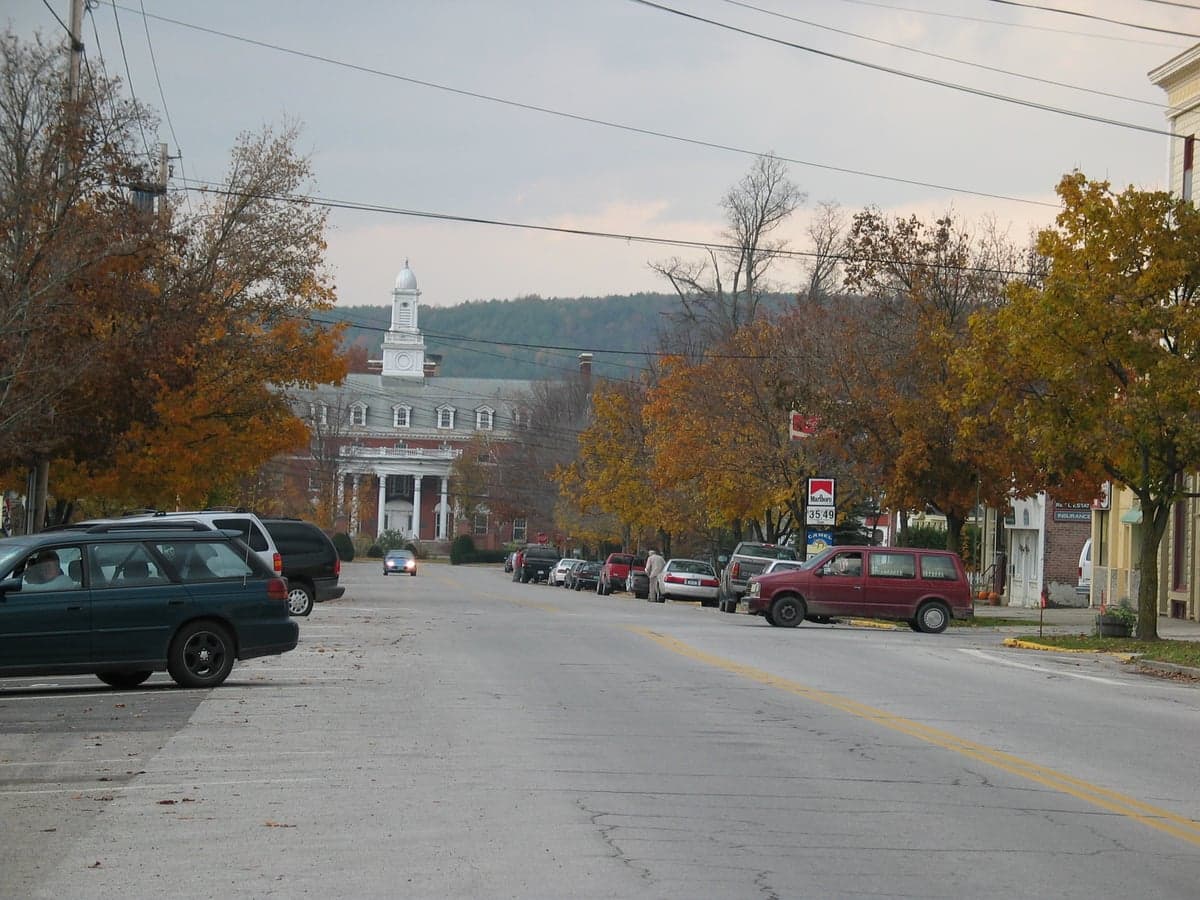
Photo: Wikipedia
Personal Sovereignty in Poultney, VT
Moderate friction. Expect trade-offs in some aspect of personal liberty and independence.
What does Personal Sovereignty tell us?
Personal Sovereignty measures your capacity for self-reliance and independence with minimal government friction. Higher scores mean fewer barriers between you and the way you want to live... but it assumes you have the space you need and good neighbors.
What does this tell us?
Personal Sovereignty measures your capacity for self-reliance and independence with minimal government friction. Higher scores mean fewer barriers between you and the way you want to live... but it assumes you have the space you need and good neighbors.
State Policy
Energy independence: Importer (15% of energy produced in-state)
Personal Liberty
Homesteading

Personal Liberty Analysis
Poultney, Vermont, offers a notably high degree of personal sovereignty relative to much of the Northeast, but it is not a libertarian free-for-all. The town's small population (roughly 1,800) and rural character create a low-pressure environment where government presence in daily life is minimal compared to urban centers. However, Vermont's state-level policies—particularly in taxation, gun control, and health mandates—impose real constraints that a conservative or survivalist-minded individual must weigh carefully. The key trade-off is between Poultney's hands-off local culture and Montpelier's progressive regulatory framework.
Tax burden and regulatory posture in Poultney
Vermont carries a heavy state-level tax burden, ranking among the highest in the nation for property taxes. In Poultney, the combined property tax rate (town and school) typically falls between 2.0% and 2.5% of assessed value, which is significant for a rural area. A $200,000 home would incur roughly $4,000–$5,000 annually in property taxes. State income tax is progressive, topping out at 8.75% for high earners, and sales tax is 6%. For a prepper or conservative, the upside is that local services are thin—there is no local income tax, and the town government is small, meaning less direct interference. Building permits are required for most structural work, but enforcement is lax compared to suburban jurisdictions; many residents add sheds, fences, or small outbuildings without formal approval. The state's Act 250 land-use law applies to larger developments (10+ acres of subdivision or commercial projects), but a single-family home on an existing lot is generally exempt. The regulatory posture is best described as "high state tax, low local enforcement"—a mixed bag for those seeking to minimize government footprint.
Self-defense and gun law specifics in Vermont
Vermont is a constitutional carry state, meaning no permit is required to carry a concealed firearm for anyone legally allowed to possess one. This is a strong point for personal sovereignty. There is no state-level firearm registry, no waiting period for purchases, and no magazine capacity limit. However, the landscape shifted significantly in 2023 with the passage of S.30, which raised the minimum age to purchase a firearm to 21 and banned the sale of "assault weapons" (defined broadly to include many semi-automatic rifles with certain features). Private sales between individuals still require a background check through a licensed dealer, a restriction that preppers and survivalists often view as an infringement. Magazine capacity is effectively limited to 10 rounds for long guns and 15 for handguns under the same law, though pre-ban magazines are grandfathered. Self-defense law in Vermont is generally favorable: there is no duty to retreat in one's home (castle doctrine), but outside the home, a duty to retreat applies if safe to do so. Poultney's rural setting means encounters with law enforcement are rare, and the local sheriff's office is generally respectful of gun rights. For a conservative, the bottom line is that Vermont's gun laws are more restrictive than New Hampshire's but far less so than New York's or Massachusetts's.
Self-reliance and homesteading viability in Poultney
Poultney's rural character makes it a viable location for homesteading and off-grid living, with important caveats. Minimum lot sizes in the town's rural zoning districts are typically 2 to 5 acres, which is sufficient for a substantial garden, small livestock (chickens, goats, a cow), and even a modest orchard. Many properties in the surrounding area are 10+ acres, offering genuine seclusion. Zoning allows for accessory dwelling units, workshops, and barns without excessive red tape. Off-grid feasibility is high: solar panels are common, and the state has net metering policies that allow homeowners to sell excess power back to the grid. However, Vermont requires that all dwellings have a permitted wastewater system (septic), which can cost $10,000–$20,000 to install, and well water must be tested. Burning trash is prohibited, and open burning of brush requires a permit from the town fire warden. For a prepper, the biggest regulatory hurdle is the state's Act 250 review for any new construction that disturbs more than 10 acres—so keeping a homestead under that threshold avoids a major layer of bureaucracy. Water rights are generally tied to the land (groundwater extraction is unregulated for household use), and hunting is legal with a license, providing a direct food source. Poultney's growing season is short (roughly 120 frost-free days), but cold-hardy crops and season extension techniques (hoop houses) are widely used.
Personal liberties in Poultney: parental rights, medical autonomy, speech, and property
Parental rights in Vermont are under pressure from state-level policies. The state mandates comprehensive sex education in public schools, and parents cannot opt their children out of specific lessons—only the entire curriculum. Vermont also has a "gender identity" nondiscrimination law that applies to schools, meaning students can use bathrooms and locker rooms matching their gender identity without parental notification. For conservative parents, this is a significant concern. Homeschooling is legal and relatively straightforward: parents must file an annual enrollment notice and provide a "narrative" of curriculum, but there is no standardized testing requirement. Medical autonomy is mixed: Vermont has a vaccine mandate for school attendance (including COVID-19 for a period, though that has been lifted), and the state's universal healthcare push raises concerns about government control over treatment decisions. However, Poultney's distance from major medical centers means that practical enforcement of medical mandates is weak—many residents simply avoid the system. Free speech is protected under the First Amendment, and Poultney's small-town culture generally tolerates dissenting views, though social pressure can be intense in a close-knit community. Property rights are strong in practice: the town does not have a rental registry or rent control, and short-term rentals (Airbnb) are allowed without special permits. Eminent domain is rarely used. The biggest property-rights issue is the state's Act 250, which can restrict land use based on "community character" and aesthetic standards, a subjective criterion that preppers view as overreach.
Overall, Poultney offers a solid foundation for personal sovereignty compared to most of the Northeast, but it is not a sanctuary from state-level overreach. The town's low population density, minimal local government, and constitutional carry status are genuine assets for a survivalist or conservative. The trade-offs are Vermont's high property taxes, the 2023 gun restrictions, and progressive mandates on education and health. For someone willing to navigate these state-level constraints—and who values a quiet, rural environment with good homesteading potential—Poultney ranks as a moderate-to-strong choice for personal autonomy, falling short of New Hampshire or upstate New York's more libertarian pockets but far exceeding the regulatory density of southern New England or the Mid-Atlantic. The key is to buy land under 10 acres, invest in solar and septic early, and be prepared to engage with the state's bureaucracy only when absolutely necessary.

* Values derived from national, state, county, city and local statistics and may differ in a specific area. Last updated: 2026-04-30T05:04:35.000Z
Narrative content on this page is AI-generated and may contain mistakes. Verify any details that matter before acting on them.
ReloMaps may earn a commission from affiliate links at no extra cost to you.

