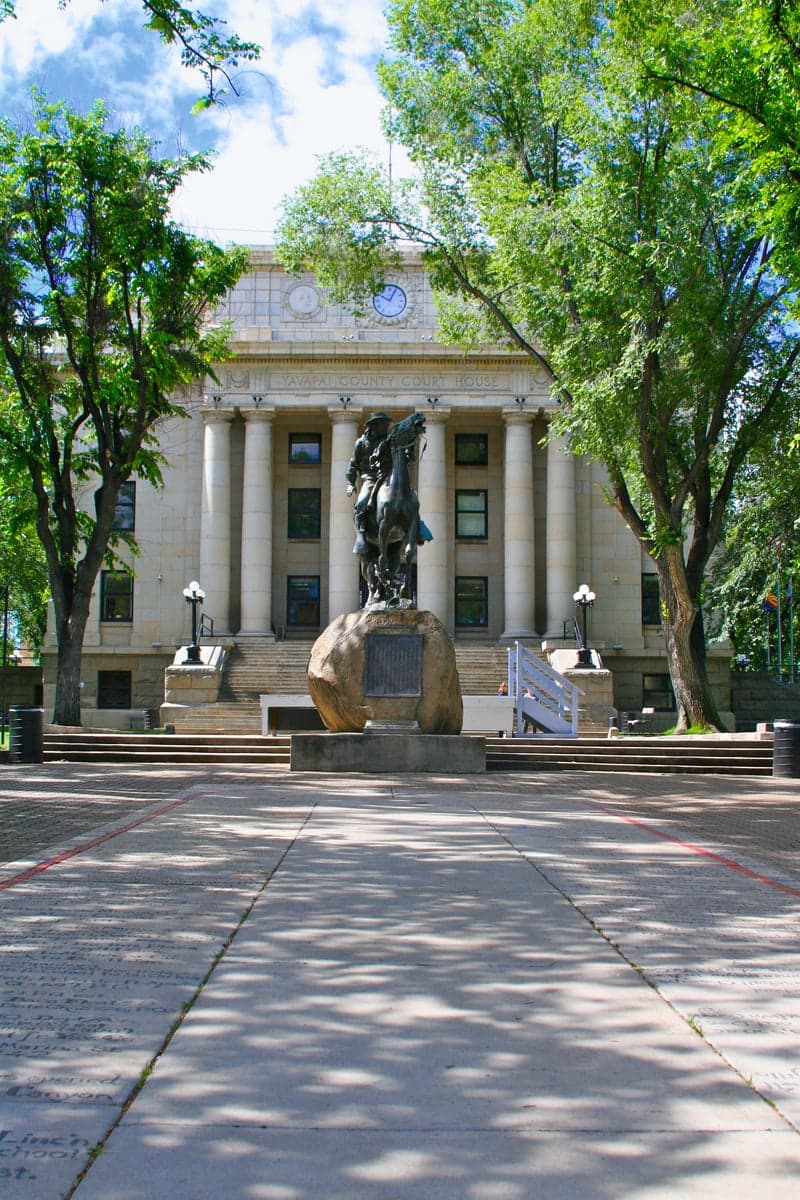
Photo: Wikipedia
Demographics of Prescott, AZ
Affluence Level in Prescott, AZ
A middle-class area roughly in line with national averages across income, home values, education, and employment.
People of Prescott, AZ
The people of Prescott, Arizona today form a predominantly white, politically conservative, and well-educated population of 46,744, with a notably low foreign-born share of just 1.5%. The city’s character is defined by a strong retiree and second-home presence, a growing remote-worker cohort, and a deep-rooted Western heritage culture centered on ranching, rodeo, and outdoor recreation. With 84.6% of residents identifying as white and 41.1% holding a college degree, Prescott stands as one of Arizona’s most demographically homogeneous cities, though its Hispanic population (9.2%) and small but visible East/Southeast Asian community (1.7%) add modest diversity. The city’s identity is distinctly different from the fast-growing, more diverse Phoenix metro area 90 miles south.
How the city was settled and grew
Prescott was founded in 1864 as the territorial capital of Arizona, deliberately sited in the pine-forested Bradshaw Mountains to attract settlers away from the hotter, more dangerous mining camps. The original population was overwhelmingly Anglo-American — miners, ranchers, and merchants from the U.S. South and Midwest — drawn by the 1863 discovery of gold in the nearby Hassayampa River and the promise of free-range cattle grazing. The city’s historic Coffee Pot Drive and Whiskey Row districts (the latter on Montezuma Street) were built by these early settlers, with saloons and mercantile stores serving the mining trade. A second wave arrived after the railroad reached Prescott in 1887, bringing a small number of Chinese laborers who worked on the tracks and later established laundries and restaurants in the South Prescott area near the depot. By 1900, the population was nearly all white, with a tiny Hispanic minority of ranchers and sheepherders living on the outskirts. The city’s growth remained modest through the mid-20th century, driven by the establishment of Prescott National Forest headquarters (1908) and the steady expansion of Yavapai College (founded 1966).
Modern era (post-1965)
After the 1965 Immigration and Nationality Act, Prescott saw almost no direct immigration from new source countries — its foreign-born population today is just 1.5%, one of the lowest rates among Arizona cities of comparable size. Instead, the modern era has been defined by domestic in-migration: retirees from California, the Midwest, and the Northeast seeking lower taxes, cooler summers, and a conservative political climate. This wave settled heavily in the Pioneer Park and Granite Dells neighborhoods, where master-planned 55+ communities and custom homes on large lots proliferated after 1990. A smaller but notable influx of remote workers and second-home buyers arrived after 2010, drawn by Prescott’s historic downtown and fiber-optic internet, concentrating in the Thumb Butte area and the Miller Valley district. The Hispanic population grew from roughly 5% in 1990 to 9.2% today, driven largely by service-sector workers in construction, hospitality, and landscaping — many of whom live in the South Prescott and Granite Creek corridors. The East/Southeast Asian community (1.7%) consists primarily of medical professionals and engineers employed at Yavapai Regional Medical Center and Embry-Riddle Aeronautical University, clustered near the university campus in the Airport Area. The Indian-subcontinent population (0.3%) is tiny and largely tied to tech and academic roles at Embry-Riddle.
The future
Prescott’s population is projected to grow modestly — perhaps 10-15% over the next decade — but its demographic composition is unlikely to shift dramatically. The city’s high housing costs (median home price above $600,000 as of 2025) and restrictive zoning in historic districts will continue to filter for affluent, white, and older newcomers. The Hispanic share may rise slowly as second-generation families age into homeownership, but Prescott lacks the entry-level job base and rental stock to attract large-scale immigrant settlement. The East/Southeast Asian and Indian communities are expected to remain small and professional, tied to the university and hospital. The most notable trend is the continued “California-ization” of the Pioneer Park and Granite Dells areas, where new arrivals from high-tax states are driving up prices and shifting local politics toward a more moderate conservatism — though the city remains solidly Republican. Prescott is not tribalizing into distinct ethnic enclaves; rather, it is homogenizing into an older, whiter, wealthier version of itself, with the main dividing line being between long-time locals and newcomers rather than race or ethnicity.
For a conservative-leaning individual or family moving to Prescott now, the city offers a stable, safe, and culturally familiar environment with little demographic turbulence. The population is aging (median age 52), well-educated, and politically engaged, with a strong volunteer and civic culture. The trade-off is limited racial and economic diversity, a tight housing market, and a social scene that revolves heavily around retirees and outdoor recreation rather than young families or nightlife. Prescott is becoming a more exclusive version of its historic self — not a melting pot, but a well-preserved enclave of Western tradition.

* Values derived from national, state, county, city and local statistics and may differ in a specific area. Last updated: 2026-05-01T07:46:15.000Z
Narrative content on this page is AI-generated and may contain mistakes. Verify any details that matter before acting on them.
ReloMaps may earn a commission from affiliate links at no extra cost to you.

