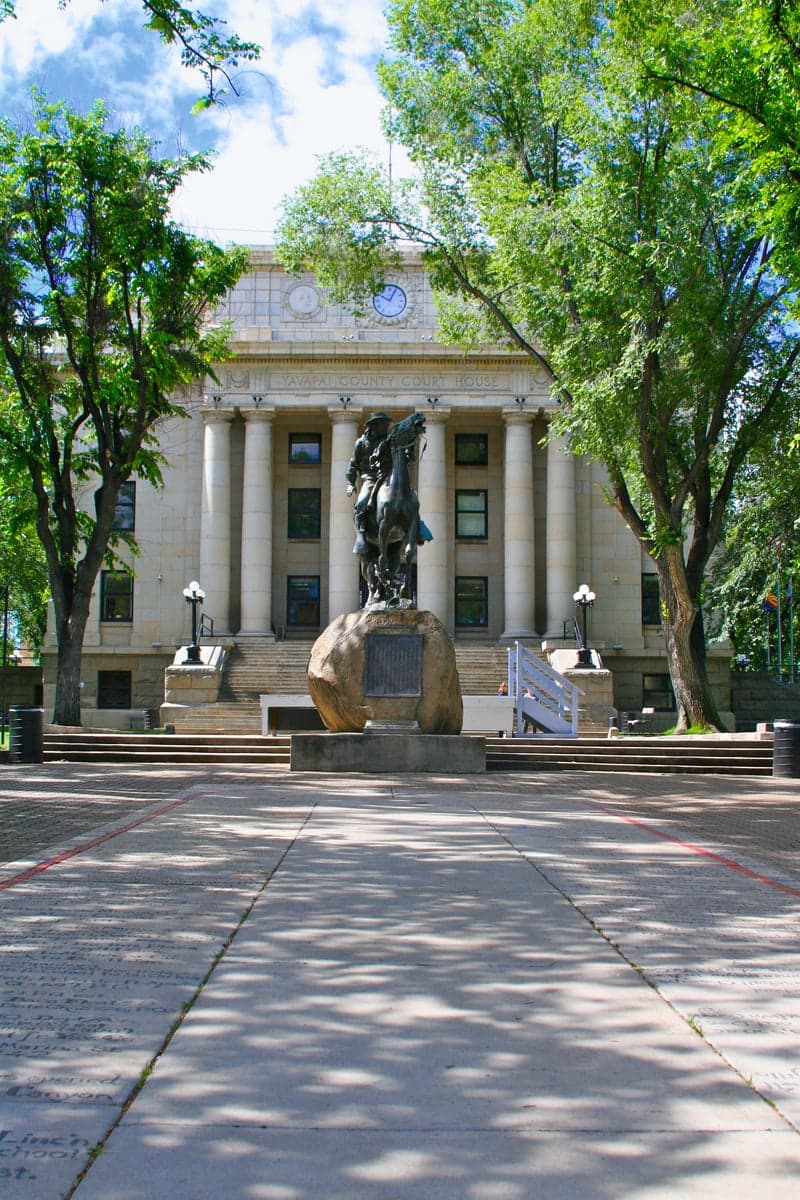
Photo: Wikipedia
Political ClimatePolitical Climate in Prescott, AZ
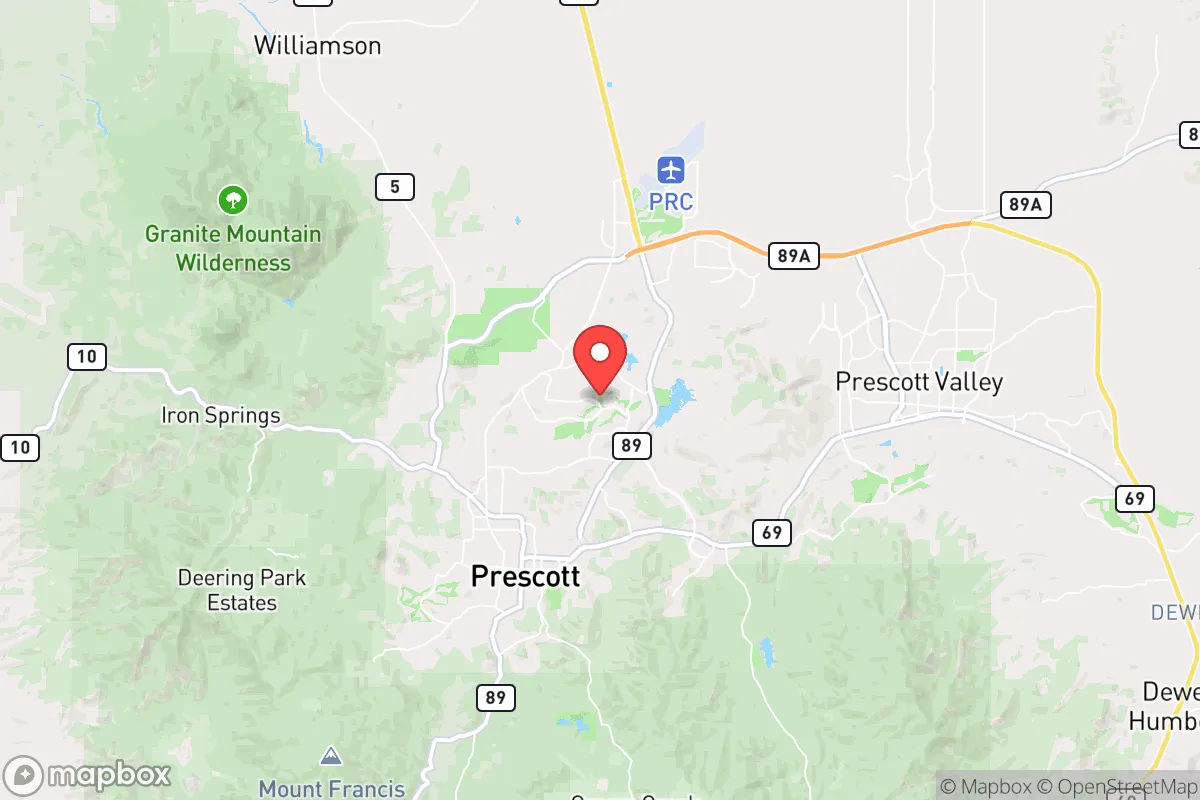
District shown is the primary district for this city’s centroid. Cities may span multiple districts.
Local Political AnalysisPolitical Analysis of Prescott, AZ
Prescott has long been a rock-ribbed conservative stronghold, and that hasn't changed much, though you can feel the winds shifting at the edges. The area's Cook PVI of R+7 tells you the baseline, but it doesn't capture the full picture. Yavapai County as a whole went +26 for Trump in 2024, and Prescott itself is reliably red in local races, but the city council and county supervisor seats have seen a few closer contests in recent cycles. The real story is the cultural tension between the old-guard ranchers, retirees, and small business owners who want to keep Prescott exactly as it is, and the influx of folks from California and Maricopa County who bring different ideas about land use, growth, and what "community" means.
How it compares
If you drive 30 minutes south to Prescott Valley, you'll find a similar conservative bent, but it's more working-class and less focused on historic preservation. Head 45 minutes west to Chino Valley, and you're in deep-red agricultural country where the politics are even more libertarian-leaning. The real contrast is Sedona, about 45 minutes north, which is a blue dot in a red sea—its art-and-tourism economy attracts a very different demographic. Even closer, Jerome is a tiny artist enclave that votes reliably progressive. So Prescott sits as the conservative anchor of the Quad Cities area, but it's not monolithic. The city's own wards show some variation: the more established neighborhoods near the courthouse square lean older and more traditional, while newer subdivisions on the outskirts attract families who are conservative but less tied to the old ways.
What this means for residents
For someone who values limited government and personal freedom, Prescott is still a good place to be, but you have to keep an eye on things. The city council has debated things like short-term rental regulations and water-use restrictions, which can feel like creeping overreach if you're not careful. The county sheriff's office is solidly pro-Second Amendment, and you won't get sideways looks for open carry. Property taxes are low compared to Phoenix or Flagstaff, and there's no state income tax on retirement income. But the growth pressure is real: more people means more demand for services, which inevitably leads to more rules. The school board has stayed mostly conservative, but there have been heated meetings over library books and curriculum, so that's something to watch if you have kids in the district.
The cultural vibe is still very much "live and let live" as long as you're not trying to change things too fast. You'll see Trump flags and Gadsden flags flying alongside American flags on the same streets. The local GOP is active and well-organized, but there's a growing libertarian streak that pushes back on any government expansion, even from Republican officials. If you're worried about progressive ideology creeping in, the biggest threat isn't from within Prescott itself—it's from state-level mandates out of Phoenix or federal overreach from D.C. that trickle down. The city's historic preservation rules and zoning codes can feel restrictive to some, but they're also what keeps Prescott from turning into just another sprawling suburb. For now, the balance holds, but the next few election cycles will tell you whether the old guard can hold the line or whether the newcomers shift things just enough to make you nervous.

State Political ClimatePolitical Climate in Arizona
State Political AnalysisPolitical Environment in the State
Arizona has transformed from a reliably Republican stronghold into a true battleground state over the past two decades, with a partisan lean that now sits roughly evenly split between red and blue. The state’s 11 electoral votes went for Joe Biden in 2020 by just 10,457 votes—a razor-thin margin that shocked many longtime residents—and the 2024 cycle saw Donald Trump narrowly reclaim the state by about 2 points, reflecting a deeply divided electorate. The dominant coalitions are a fast-growing suburban and exurban population, a heavily Democratic-leaning Maricopa County core (Phoenix metro), and a rural and small-town base that remains staunchly conservative. Over the last 10-20 years, the trajectory has been a steady leftward drift driven by massive in-migration from California and other blue states, though a recent conservative backlash—especially around education and border issues—has slowed that shift and even reversed it in some key races.
Urban vs. rural divide
The political map of Arizona is a textbook study in geographic polarization. Maricopa County, home to over 60% of the state’s population, is the epicenter of the battle: Phoenix, Tempe, and Scottsdale lean left, while the county’s eastern and western suburbs—places like Mesa, Gilbert, and Surprise—remain reliably conservative. Pima County (Tucson) is a Democratic stronghold, with the city itself voting blue by wide margins while the surrounding desert and mountain communities lean red. The rural counties—Yavapai (Prescott), Mohave (Kingman, Lake Havasu City), Gila (Globe), and Apache (St. Johns)—vote Republican by 20-40 points, driven by a mix of ranching, mining, and retirement communities. The Flagstaff area (Coconino County) is a blue island in the north, anchored by Northern Arizona University and a growing outdoor recreation economy. The divide isn’t just urban vs. rural; it’s also about growth patterns: the fast-growing exurbs like Maricopa (Pinal County) and Queen Creek are trending red, while the core Phoenix metro is slowly purpling. A new resident will notice that driving 30 minutes outside any major city can feel like crossing into a different state politically.
Policy environment
Arizona’s policy environment is a mixed bag that reflects its split personality. On the plus side for conservatives: the state has a flat income tax rate of 2.5% (down from 4.5% in 2019), no estate tax, and a right-to-work law that keeps unions weak. Property taxes are low, with an average effective rate around 0.62%. The regulatory posture is generally business-friendly, though local zoning battles in Phoenix and Tucson can be fierce. On education, Arizona was an early leader in school choice—the Empowerment Scholarship Account (ESA) program, expanded in 2022, gives every family access to public funds for private or homeschool expenses. That’s a huge win for parental rights. However, the state’s public school funding per pupil remains near the bottom nationally, and teacher unions have been vocal. Healthcare policy is a flashpoint: Arizona expanded Medicaid under Obamacare in 2013, and the program now covers about 1 in 5 residents. Election laws have been a rollercoaster—the state passed voter ID requirements and tightened mail-in ballot rules in 2022, but also has automatic voter registration at the DMV and no-excuse mail voting, which many conservatives view as a vulnerability. The state’s constitution also allows for citizen initiatives, which has led to progressive wins like the 2020 minimum wage hike and the 2024 abortion rights amendment (Proposition 139), overriding the legislature’s 15-week ban.
Trajectory & freedom
On personal freedom, Arizona is a state of contradictions that is becoming less free in some areas and more free in others. The good news: the 2022 expansion of the ESA program was a massive win for educational freedom, and the state has a strong castle doctrine and stand-your-ground law. Constitutional carry (permitless concealed carry) has been law since 2010, and the legislature passed a preemption law in 2023 that blocks local governments from enacting their own gun restrictions—a direct response to Tucson and Flagstaff trying to ban guns in city buildings. Property rights are generally strong, with no state-level rent control and a relatively straightforward permitting process for new construction. The bad news: the 2024 passage of Proposition 139 enshrined a “fundamental right” to abortion up to viability in the state constitution, overriding the legislature’s 15-week ban. This was a major blow to pro-life advocates. Additionally, the state’s energy regulatory commission has pushed a renewable energy mandate (50% by 2035), which critics say drives up electricity costs. On the border, Governor Katie Hobbs (D) has resisted cooperation with federal immigration enforcement, while the legislature passed a bill in 2024 requiring local police to cooperate with ICE—a fight that’s ongoing in court. The net trajectory: Arizona is pulling in two directions at once, with the legislature pushing conservative reforms and the ballot box delivering progressive mandates.
Civil unrest & political movements
Arizona has been a hotbed of political activism on both sides. The 2020 election aftermath saw massive protests in Phoenix, with both Trump supporters and Black Lives Matter demonstrators clashing outside the Maricopa County Recorder’s Office. The state was ground zero for the “Stop the Steal” movement, with the Arizona Senate’s “audit” of Maricopa County ballots in 2021 drawing national attention and deep partisan divisions. On the left, the #RedForEd teacher walkout in 2018 shut down schools for six days and led to a wave of progressive school board candidates. Immigration politics are ever-present: the 2010 SB 1070 law (the “show me your papers” law) made Arizona a national symbol of tough enforcement, but the state’s position has softened since then, with the 2024 border crisis pushing some Democrats to the right. There’s a growing secessionist sentiment in rural counties—several have passed resolutions calling for a “State of Arizona” separation from Maricopa County, though it’s mostly symbolic. Election integrity remains a live issue: the 2022 gubernatorial race saw Kari Lake (R) refuse to concede, and ongoing lawsuits over ballot drop boxes and signature verification keep the issue in the news. A new resident will notice that political yard signs, bumper stickers, and even flags are far more common here than in many other states—people wear their politics on their sleeves.
Projection
Over the next 5-10 years, Arizona is likely to remain a purple state with a slight rightward tilt, driven by demographic shifts. The in-migration from California has slowed as housing costs in Arizona have risen, and the newcomers are increasingly conservative-leaning—many are fleeing California’s high taxes and progressive policies. The Hispanic population, which makes up about 32% of the state, is not a monolith; while younger Hispanic voters lean left, older and more religious Hispanic voters are trending right, especially on social issues. The retirement communities in Sun City, Green Valley, and Lake Havasu City are reliably conservative, and the influx of remote workers from blue states is actually boosting the exurban and small-town economies, which reinforces the red vote. However, the urban cores of Phoenix and Tucson will continue to grow and diversify, keeping the state competitive. The wildcard is the border: if the federal government fails to secure it, expect Arizona to pass even stricter state-level enforcement, which could galvanize both sides. For someone moving in now, expect a decade of close elections, high political engagement, and a state that is slowly trending redder in the exurbs and bluer in the cities—but the overall balance will likely stay within a few points of 50-50.
Bottom line for a new resident: Arizona offers a relatively low-tax, business-friendly environment with strong school choice and gun rights, but you’ll be living in a state where every election is a knife fight and where progressive ballot initiatives can override the legislature. If you’re moving here for freedom, you’ll find plenty of it in the suburbs and rural areas, but you’ll also need to be politically engaged to protect it. The state is not a safe red haven—it’s a battlefield, and your vote will matter more here than almost anywhere else in the country.
* Values derived from national, state, county, city and local statistics and may differ in a specific area. Last updated: 2026-05-01T07:46:15.000Z
Narrative content on this page is AI-generated and may contain mistakes. Verify any details that matter before acting on them.
ReloMaps may earn a commission from affiliate links at no extra cost to you.

