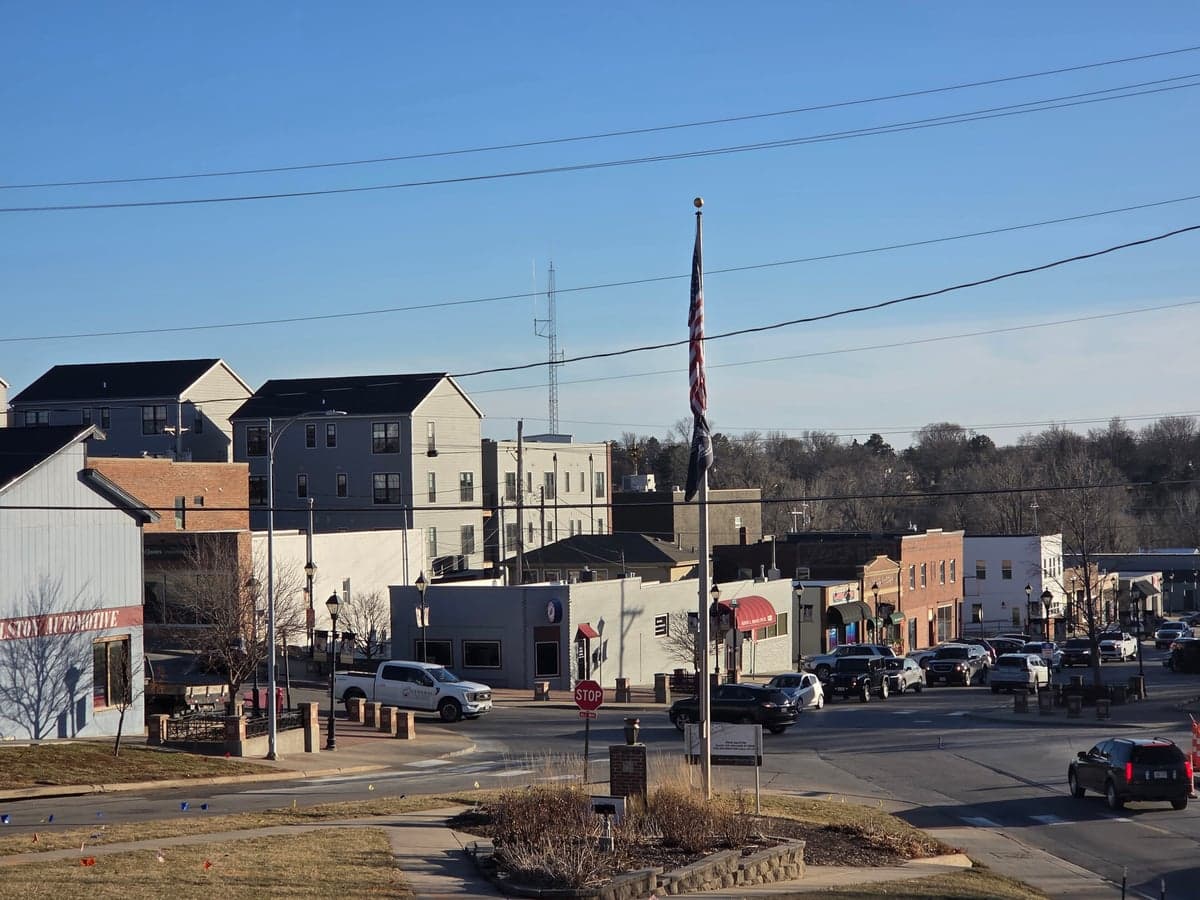
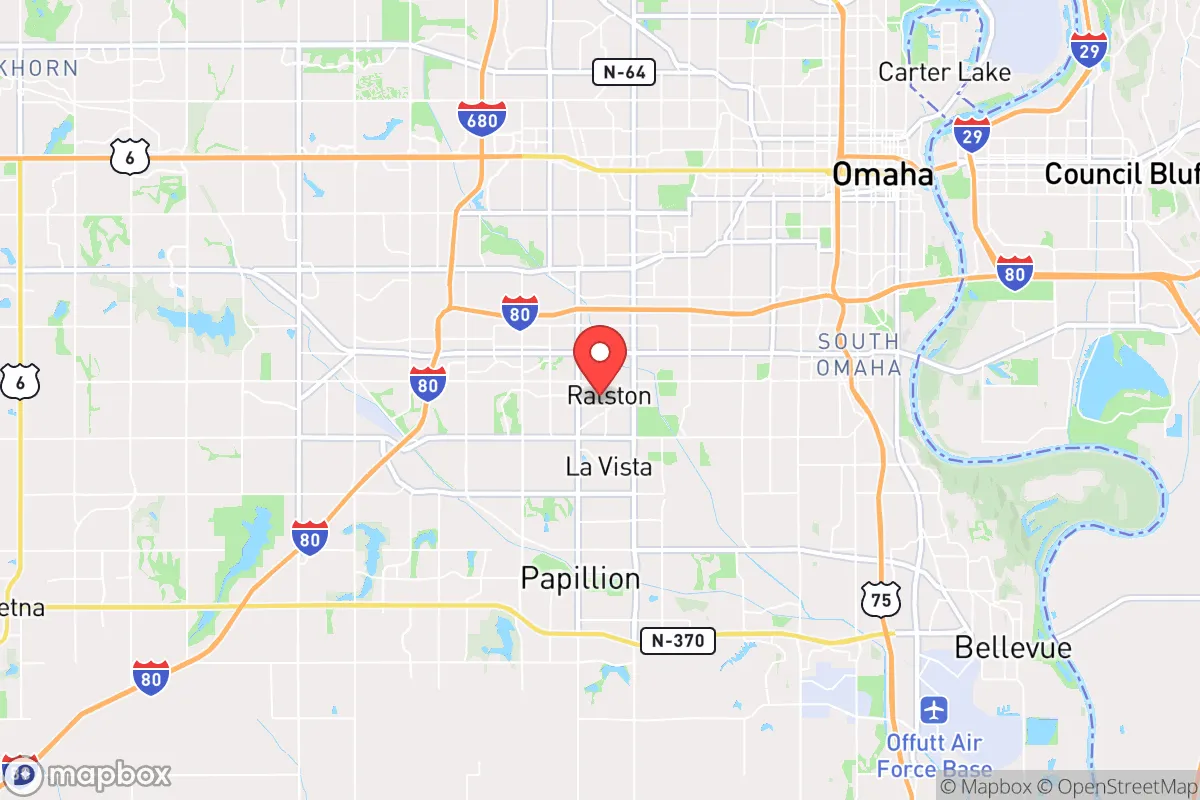
Photo: Wikipedia
Political ClimatePolitical Climate in Ralston, NE
District shown is the primary district for this city’s centroid. Cities may span multiple districts.
Local Political AnalysisPolitical Analysis of Ralston, NE
Ralston, Nebraska, sits in a bit of a political bubble compared to the rest of the state. While Douglas County as a whole has been trending blue, Ralston itself holds a Cook PVI of D+3, meaning it's a solidly Democratic-leaning area. That wasn't always the case, and if you've lived here for a while, you've seen the shift happen block by block, election by election. It's not a radical change overnight, but the trajectory is clear, and for those of us who value limited government and personal freedoms, it's something worth keeping an eye on.
How it compares
Drive ten minutes west to Millard or fifteen minutes southwest to Gretna, and you're in a completely different political world. Those areas lean heavily Republican, with voters who are much more skeptical of government expansion and more protective of Second Amendment rights and local control. Ralston, by contrast, has become a pocket where progressive policies find more traction. The contrast is stark: you can see it in local school board races, in the types of ordinances that get proposed, and in the general attitude toward things like zoning regulations and business licensing. While Omaha proper has long been the state's liberal hub, Ralston's D+3 rating shows it's now firmly in that camp, even if it still feels like a small town in some ways.
What this means for residents
For a resident who values personal autonomy and distrusts government overreach, the practical effects are real. You'll see more support for things like increased property taxes to fund social programs, stricter environmental regulations that can hit small businesses, and a general willingness to let the city council or county board make decisions that used to be left to neighborhoods and individuals. The school district, for example, has seen pushes for curriculum changes and diversity initiatives that some parents feel go beyond academics and into social engineering. If you're the kind of person who thinks the government should stay out of your wallet, your home, and your child's education, Ralston's current direction is a concern. The political climate here isn't hostile, but it's increasingly aligned with a philosophy that sees government as a solution rather than a necessary evil.
One cultural distinction that stands out is Ralston's identity as a "city within a city." It's a small, tight-knit community that prides itself on its own police force, its own parks, and its own sense of place. But that local pride is being tested as the political winds shift. The push for more regional cooperation with Omaha, for example, sounds good on paper but often means ceding local control to a larger, more progressive bureaucracy. Longtime residents remember when Ralston was a place where you could pretty much do what you wanted on your own property without a permit or a committee. That's changing. The next few years will tell whether Ralston can hold onto its independent character or if it becomes just another neighborhood of Omaha, with all the policy baggage that entails. If you're considering moving here, just know what you're walking into: a friendly town with a political direction that's worth watching closely.

State Political ClimatePolitical Climate in Nebraska
State Political AnalysisPolitical Environment in the State
Nebraska has been a reliably red state for decades, but it’s not the deep-red monolith many outsiders assume. The state’s overall partisan lean is solidly Republican — it hasn’t voted for a Democratic presidential candidate since 1964 — but the internal dynamics are shifting in ways that matter for anyone considering a move here. Over the last 10-20 years, the dominant coalition has been a mix of rural conservatives, agricultural interests, and a growing suburban base, but the Omaha metro area has become a persistent blue island, and Lincoln has trended leftward. The result is a state that feels politically stable on the surface but is quietly becoming more contested, especially as in-migration from places like California and Colorado accelerates.
Urban vs. rural divide
The political map of Nebraska is stark. The eastern third of the state, anchored by Omaha (Douglas County) and Lincoln (Lancaster County), drives the state’s Democratic vote. Omaha’s 2nd Congressional District — the “Blue Dot” — has flipped between parties in recent cycles, voting for Joe Biden in 2020 and splitting its tickets in 2024. Lincoln, home to the University of Nebraska, has become reliably blue at the state legislative level, with progressive city council majorities pushing policies like a local minimum wage hike and non-discrimination ordinances. Meanwhile, the rest of the state is deeply red. Grand Island, Kearney, and North Platte are conservative strongholds, with rural counties like Banner County and Arthur County routinely voting 85-90% Republican. The divide isn’t just urban vs. rural — it’s also suburban. Papillion and La Vista in Sarpy County are growing fast and remain reliably red, but they’re seeing an influx of younger families who are less culturally conservative than their parents. That’s a trend to watch.
Policy environment
Nebraska’s policy environment is broadly conservative, but with notable exceptions. The state has no income tax on Social Security benefits and a flat income tax rate that’s been cut in recent years — currently 5.84% and scheduled to drop to 3.99% by 2027. Property taxes are high, especially in rural areas, and that’s a perennial complaint. The state legislature is officially nonpartisan (unicameral), but in practice it’s dominated by Republicans. On education, Nebraska has a robust school choice movement — the state passed a school voucher program in 2023 (LB 753) that provides tax credits for private school scholarships, though it faced a referendum challenge. Healthcare is a mixed bag: the state expanded Medicaid under the Affordable Care Act in 2020 via ballot initiative, but the legislature has resisted further expansion. Election laws are moderately restrictive — voter ID was passed in 2023 (LB 514), and the state has no same-day registration. Gun laws are among the most permissive in the country: constitutional carry was enacted in 2023 (LB 77), allowing permitless concealed carry for anyone 21 or older. That’s a big plus for Second Amendment advocates.
Trajectory & freedom
On the freedom front, Nebraska has been moving in a positive direction for conservatives, but not without some worrying countercurrents. The 2023 passage of constitutional carry (LB 77) was a major win for gun rights, and the state’s preemption law prevents local governments from enacting their own firearm restrictions — a key safeguard against the kind of patchwork regulations seen in states like Colorado. Parental rights have been strengthened: the 2023 “Parents’ Bill of Rights” (LB 108) requires schools to notify parents about curriculum changes and medical services, and it prohibits instruction on sexual orientation or gender identity in grades K-3. That’s a direct response to the kind of overreach seen in blue states. However, the state’s tax burden remains a concern. While income taxes are being cut, property taxes are still among the highest in the region, and the state’s reliance on sales tax means low-income families bear a disproportionate share. Medical freedom is a mixed bag: Nebraska did not impose broad vaccine mandates during COVID, but the state’s health department retains significant emergency powers that could be used in future crises. The 2024 legislative session saw a push to limit those powers (LB 1072), but it stalled. On the whole, Nebraska is becoming more free in the areas that matter most to conservatives — guns, education, and parental control — but the tax and regulatory picture is less rosy.
Civil unrest & political movements
Nebraska has not seen the kind of large-scale civil unrest that has plagued coastal cities, but there have been flashpoints. The 2020 George Floyd protests in Omaha turned violent, with looting and fires in the Old Market district, and the city’s police response was criticized from both sides. Since then, Omaha has seen a rise in organized activist groups on the left, including the local chapter of Black Lives Matter and the Nebraska Democratic Socialists of America, which have pushed for police reform and defunding efforts — though those have largely failed at the state level. On the right, the Nebraska Republican Party has been energized by election integrity concerns, particularly after the 2020 election. The state’s “Nebraska Accountability and Disclosure Commission” has been a target of conservative activists who argue it’s too cozy with the establishment. There’s also a growing “Second Amendment sanctuary” movement in rural counties like Boyd County and Cherry County, where local officials have passed resolutions vowing not to enforce any future federal gun bans. Immigration politics are relatively quiet compared to border states, but the issue flared up in 2023 when the legislature debated a bill (LB 535) that would have required local law enforcement to cooperate with ICE — it passed, but only after a contentious fight. The most visible political flashpoint for a new resident would likely be the ongoing battle over abortion: Nebraska passed a 12-week abortion ban in 2023 (LB 574), and the issue remains a major mobilizing force for both sides.
Projection
Over the next 5-10 years, Nebraska is likely to become more politically competitive, but not necessarily more liberal. The key demographic shift is in-migration: people from high-tax, high-regulation states like California, Illinois, and Colorado are moving to Nebraska for lower housing costs and a more traditional lifestyle. Many of these newcomers are conservative-leaning, but they bring with them a different set of priorities — they’re often more focused on economic freedom than cultural issues, and they may be less comfortable with the state’s deeply rural social conservatism. The Omaha metro area will continue to grow, and the 2nd Congressional District could become a permanent swing seat. Meanwhile, rural counties will continue to shrink, which could dilute their political power over time. The state’s nonpartisan legislature means that party discipline is weaker than in other states, which can lead to unpredictable outcomes — a moderate Republican governor like Jim Pillen has been able to work with Democrats on some issues, but the next governor could be more hardline. The biggest wildcard is property tax reform: if the state can’t get that under control, it could drive out the very people who are moving in. For a conservative relocating here, the projection is cautiously optimistic: Nebraska is trending in the right direction on guns, education, and parental rights, but the tax burden and the growing influence of Omaha’s progressive wing are real concerns.
For a new resident, the bottom line is this: Nebraska offers a high degree of personal freedom, especially if you value gun rights, school choice, and local control. The state is not perfect — property taxes are a headache, and the Omaha metro area is a blue island that can feel culturally distant from the rest of the state — but the overall trajectory is more positive than negative. If you’re moving here, expect a place where your vote actually matters in state-level races, where your kids can go to school without being subjected to radical gender ideology, and where the government is generally more interested in staying out of your life than in managing it. Just be prepared to pay for that freedom with some of the highest property taxes in the region — and to keep an eye on Omaha, because that’s where the political future of the state will be decided.
* Values derived from national, state, county, city and local statistics and may differ in a specific area. Last updated: 2026-05-01T04:29:59.000Z
Narrative content on this page is AI-generated and may contain mistakes. Verify any details that matter before acting on them.
ReloMaps may earn a commission from affiliate links at no extra cost to you.

