 Popular
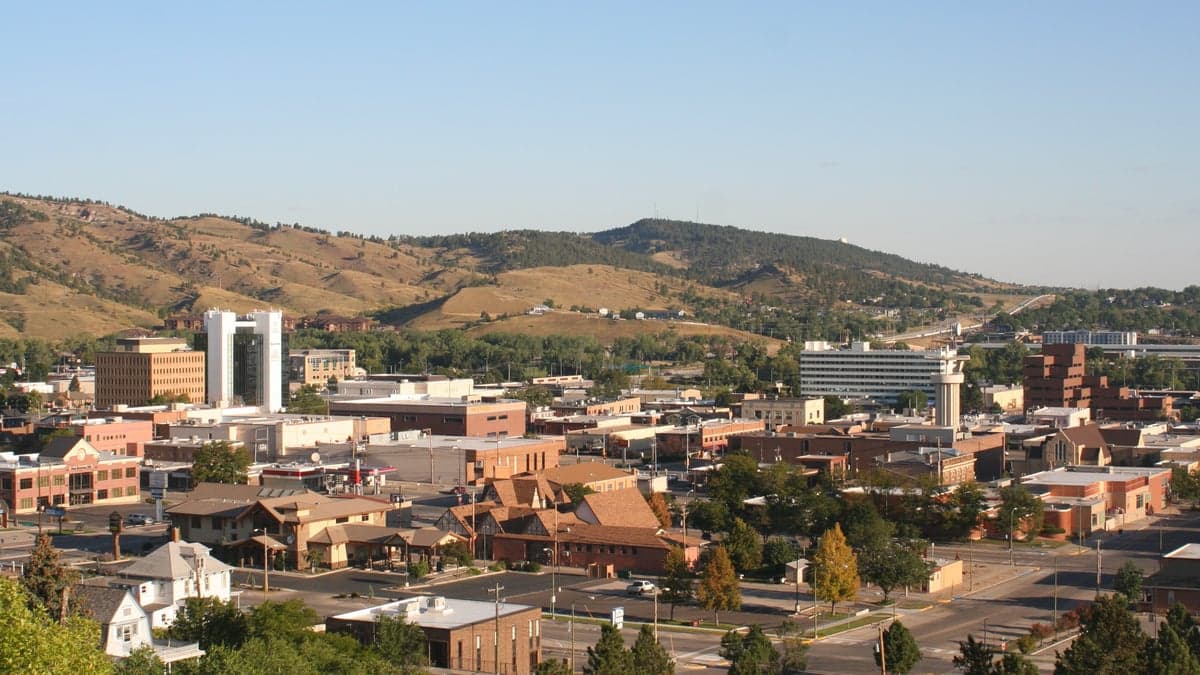
Photo: Wikipedia
Demographics of Rapid City, SD
Affluence Level in Rapid City, SD
A middle-class area roughly in line with national averages across income, home values, education, and employment.
People of Rapid City, SD
Rapid City's population of 76,836 is overwhelmingly native-born and white (76.8%), with a foreign-born share of just 0.8% that ranks among the lowest for any U.S. city of its size. The city's character is shaped by its role as a regional trade and medical hub for western South Dakota, drawing residents from surrounding ranching communities and the nearby Pine Ridge and Rosebud reservations. Distinctive markers include a strong military presence from Ellsworth Air Force Base, a growing number of remote workers attracted to Black Hills recreation, and a population that is notably older and more family-oriented than the national median.
How the city was settled and grew
Rapid City was founded in 1876 as a railroad and supply town for the Black Hills gold rush, with the first permanent settlers being white prospectors, merchants, and homesteaders drawn by the 1874 Custer Expedition's gold discovery. The city's original core developed around the Downtown Historic District along St. Joseph Street, where early merchants built wood-frame storefronts to serve miners heading to the northern hills. The arrival of the Chicago and North Western Railway in 1886 transformed Rapid City into a regional shipping point for cattle and timber, attracting Scandinavian and German immigrants who settled in the West Boulevard neighborhood, where many of their descendants still live in early-1900s Craftsman homes. The Homestake Mine in Lead, though 40 miles away, drew a steady stream of Cornish, Irish, and Italian miners who commuted or eventually moved their families to Rapid City's South Side near the railroad yards. By 1930, the city's population had reached 10,000, and the establishment of Ellsworth Air Force Base in 1942 brought a wave of military personnel and civilian contractors, many of whom settled in the North Rapid area near the base, creating a distinct blue-collar, transient community that remains today.
Modern era (post-1965)
After the 1965 Immigration and Nationality Act, Rapid City saw virtually none of the large-scale immigration that reshaped coastal cities. The foreign-born population peaked at just 1.2% in 1990 and has since declined to 0.8%. The city's Hispanic population grew modestly from 1.1% in 1990 to 5.6% today, concentrated in the Meadowbrook and West Rapid neighborhoods, where Mexican-American families work in construction, hospitality, and meatpacking. The East/Southeast Asian population (1.1%) is primarily Hmong and Vietnamese families who arrived as secondary migrants from larger Midwest cities in the 1980s and 1990s, settling in the East Rapid area near the Rushmore Mall corridor. The Indian-subcontinent population (0.2%) is almost entirely physicians and engineers recruited by Regional Health and Black Hills State University, living in newer subdivisions like Sky Ranch in the southwest hills. The Black population (1.5%) includes both military families from Ellsworth and a small number of Lakota Sioux who identify as Black on census forms due to mixed ancestry; most live in North Rapid near the base or in public housing along East Boulevard. Suburbanization after 1980 pushed white families into the Black Hawk and Piedmont areas outside city limits, leaving Rapid City proper with a slightly older, more diverse core than its surrounding county.
The future
Rapid City's population is projected to grow to roughly 85,000 by 2035, driven by domestic in-migration from California, Colorado, and the Upper Midwest rather than international immigration. The Hispanic share is expected to rise to 8-10% as second-generation families age into childbearing years, while the white share will decline slowly from natural decrease (more deaths than births among older white residents). The East/Southeast Asian and Indian communities will likely remain small and professional, concentrated in medical and tech roles. The city is not tribalizing into distinct ethnic enclaves; rather, it is slowly homogenizing as newer subdivisions in the Southwest Hills and Valley View areas attract a mix of white, Hispanic, and Asian families who share similar income brackets. The most significant demographic pressure is the continued growth of the Native American population (estimated at 8-10% of the city, though not captured in standard census categories), as Lakota families move from reservations for jobs and services, settling in North Rapid and the Lakota Homes neighborhood near the civic center.
For a conservative-leaning mover, Rapid City is becoming a more diverse but still culturally homogeneous place — a regional hub where the dominant identity remains rooted in western ranching, military service, and outdoor recreation, with immigrant communities too small to reshape local politics or daily life. The city's low crime rate, strong schools in the western neighborhoods, and lack of urban congestion make it attractive for families seeking stability, though the limited ethnic diversity and very low foreign-born share mean less cultural variety than comparably sized cities in the Midwest or Mountain West.

* Values derived from national, state, county, city and local statistics and may differ in a specific area. Last updated: 2026-04-19T04:24:41.000Z
Narrative content on this page is AI-generated and may contain mistakes. Verify any details that matter before acting on them.
ReloMaps may earn a commission from affiliate links at no extra cost to you.

