Photo: Wikipedia
Demographics of Raton, NM
Affluence Level in Raton, NM
A middle-class area roughly in line with national averages across income, home values, education, and employment.
People of Raton, NM
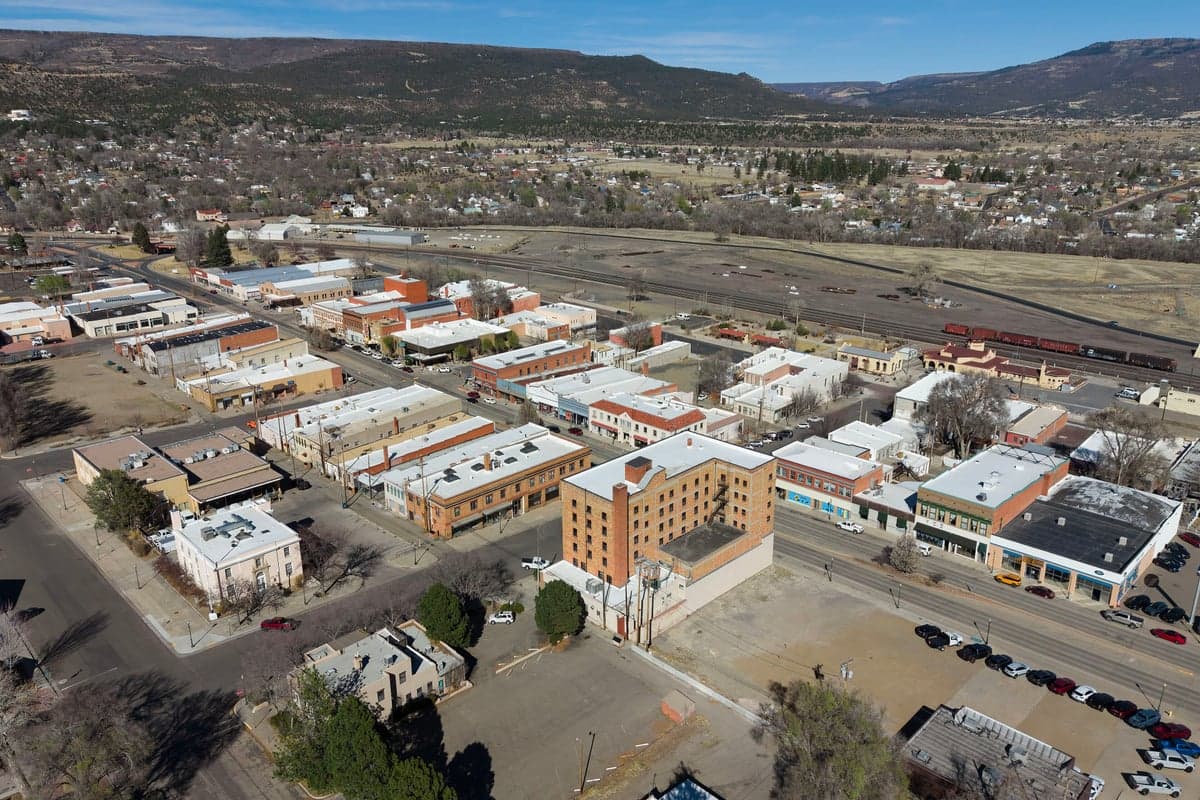
The people of Raton, New Mexico, today form a small, predominantly Hispanic and White community of 6,013 residents, shaped by a century of railroad, mining, and ranching history. With a foreign-born population of just 1.5%, the city is overwhelmingly native-born, and its identity is rooted in a working-class, culturally Catholic, and politically moderate-to-conservative character. Distinct neighborhoods like the historic South Raton barrio and the North Raton railroad district still reflect the settlement patterns of the early 20th century, while newer subdivisions like Mountain View Estates and Sunset Hills house the city’s small but stable middle class.
How the city was settled and grew
Raton’s population history begins not with Spanish colonization but with the arrival of the Atchison, Topeka and Santa Fe Railway in 1879. The railroad chose the Raton Pass route over the competing Maxwell Land Grant, and the town was platted in 1880 as a division point for locomotive servicing and coal refueling. The first wave of settlers were Anglo railroad workers, engineers, and managers, who built homes in the North Raton district near the rail yards and along Second Street. Simultaneously, Mexican and Mexican-American laborers—many from southern Colorado and northern New Mexico—arrived to work the coal mines in the surrounding canyons and the railroad’s maintenance shops. They established the South Raton neighborhood, a tight-knit barrio centered around South Second Street and the Our Lady of Guadalupe Church, which remains the heart of the Hispanic community today. By 1910, the population had surged to over 8,000, fueled by coal mining in nearby Van Houten and Koehler (now ghost towns) and the railroad’s demand for labor. A small number of Italian and Slavic immigrant miners also settled in the East Raton area near the old coke ovens, though their numbers never rivaled the Hispanic majority. The city’s growth plateaued after the 1920s as coal declined and the railroad automated, but the ethnic geography—Anglo north, Hispanic south—persisted through the mid-20th century.
Modern era (post-1965)
After the 1965 Hart-Cellar Act, Raton saw virtually no new international immigration. The foreign-born share dropped from roughly 5% in 1960 to 1.5% today, and the city’s demographic story since the 1970s is one of domestic out-migration and ethnic consolidation. The railroad’s continued downsizing—the Santa Fe Railway’s Raton yard closed its major repair shops in 1982—triggered a steady population decline from a peak of 8,226 in 1960 to 6,013 in 2024. Anglo families, particularly those in North Raton and the newer Mountain View Estates subdivision, left for job centers in Denver, Albuquerque, and Texas. Meanwhile, the Hispanic population, which was already a majority by 1970, grew through higher birth rates and relative stability among families rooted in South Raton and the West Side (the area west of the railroad tracks). Today, the city is 55.0% Hispanic and 40.7% White non-Hispanic, with negligible Black (0.3%), East/Southeast Asian (0.0%), and Indian-subcontinent (0.4%) populations. The college-educated share is just 18.8%, reflecting the city’s blue-collar base and limited white-collar job growth. The Sunset Hills neighborhood, developed in the 1990s on the city’s western edge, attracted a mix of middle-class Hispanic and Anglo families, but it remains small—fewer than 200 homes. No significant ethnic enclaves have formed for any group other than Hispanic and Anglo, as the city lacks the economic draw for new immigrant communities.
The future
Raton’s population is likely to continue a slow decline or stagnation, with the Hispanic share gradually increasing through natural growth and the Anglo share shrinking through out-migration and an aging demographic. The city is not tribalizing into distinct new enclaves; rather, it is homogenizing into a predominantly Hispanic, working-class community with a small Anglo minority concentrated in North Raton and Mountain View Estates. The foreign-born population will remain negligible—Raton offers few entry-level jobs in manufacturing or agriculture that attract immigrants, and its remote location in the Sangre de Cristo Mountains discourages new arrivals. The 0.4% Indian-subcontinent population, likely tied to the local hospital or the state prison in nearby Springer, is too small to form a community. Over the next 10–20 years, the city’s character will likely become more uniformly Hispanic and Catholic, with a declining tax base and an aging housing stock in South Raton. The only potential for stabilization lies in tourism (the Raton Pass and Sugarite Canyon State Park) and remote work, which could attract a small number of younger Anglo and Hispanic families to Sunset Hills or the East Raton area if broadband improves.
For someone moving in now, Raton is a quiet, affordable, and culturally homogeneous town where Hispanic heritage is the dominant social fabric and Anglo residents are a shrinking but still present minority. The city offers low crime, a slower pace, and strong community ties, but limited economic opportunity and little ethnic diversity beyond the Hispanic-Anglo binary. New arrivals should expect to integrate into a community where Spanish is commonly heard in South Raton and English dominates in North Raton, and where the next decade will likely see a continued consolidation of the Hispanic majority.

* Values derived from national, state, county, city and local statistics and may differ in a specific area. Last updated: 2026-05-01T02:59:03.000Z
Narrative content on this page is AI-generated and may contain mistakes. Verify any details that matter before acting on them.
ReloMaps may earn a commission from affiliate links at no extra cost to you.

