Photo: Wikipedia
Demographics of Ravenswood, WV
Affluence Level in Ravenswood, WV
A below-average socioeconomic profile. Incomes, home values, and educational attainment trail the U.S., with higher poverty and unemployment.
People of Ravenswood, WV
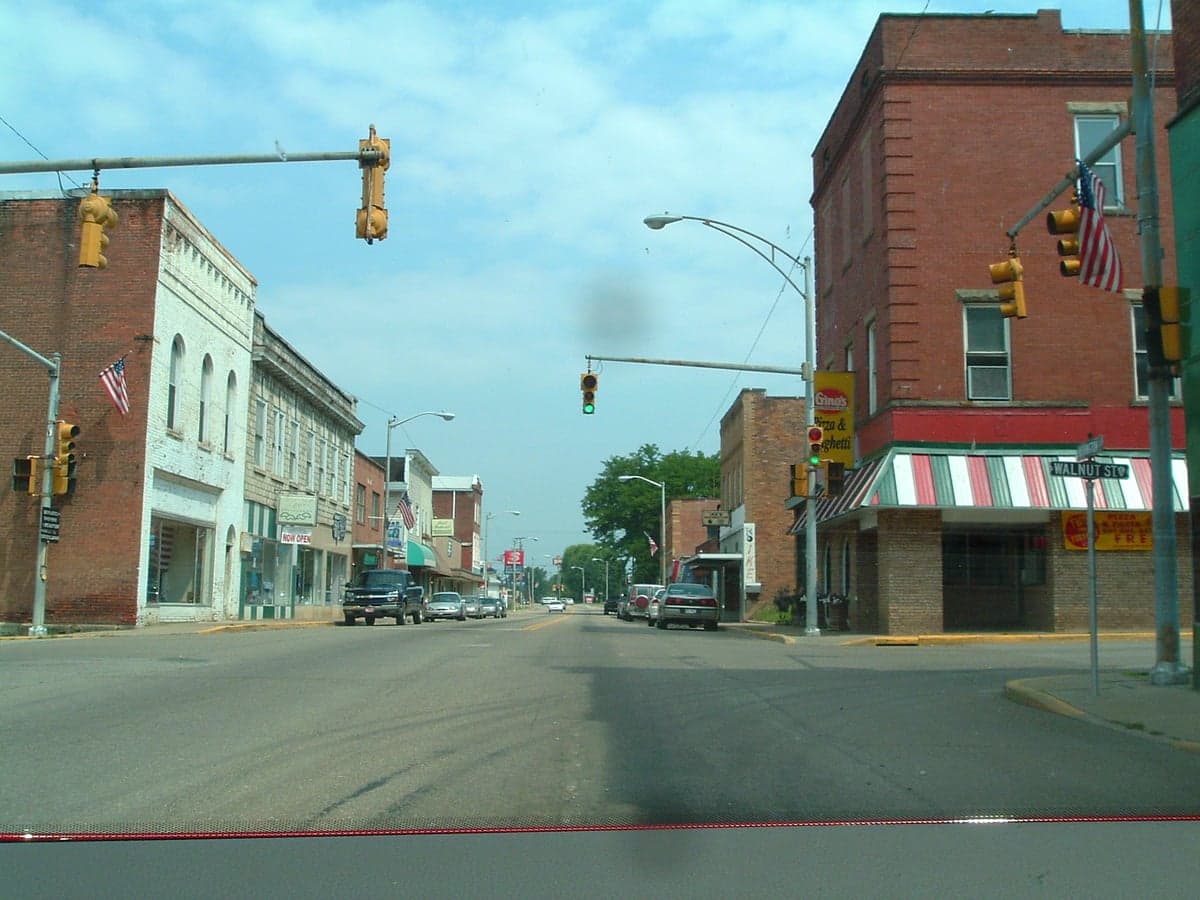
Ravenswood, West Virginia, is a small, tightly-knit Ohio River town of 3,846 residents that remains overwhelmingly white (93.9%) and native-born, with a foreign-born population of just 0.2%. The city’s identity is rooted in its industrial working-class heritage, shaped by generations of families who arrived for factory and river jobs, and today it retains a quiet, family-oriented character with a median age around 45. College attainment is low at 20.0%, reflecting a community where skilled trades and manufacturing have long been the economic backbone rather than white-collar professions. For those moving in, Ravenswood offers a stable, culturally homogeneous environment where neighborly ties run deep and change comes slowly.
How the city was settled and grew
Ravenswood’s population history begins with European-American settlers drawn by land grants along the Ohio River in the early 19th century. The town was formally platted in 1835 by John G. Jackson, a Virginia congressman, and its early growth was fueled by river trade and agriculture. The arrival of the Baltimore and Ohio Railroad in the 1850s connected Ravenswood to broader markets, but the real population surge came with industrialization. The Ravenswood Aluminum Company (RACO) plant, opened in 1957, transformed the town, drawing thousands of workers from across Appalachia and the Midwest. These workers settled in neighborhoods like Ravenswood Heights, a hillside district of modest postwar homes built for plant employees, and Washington District, the older core near the river where original settler families lived. The plant’s peak employment of over 2,000 in the 1970s made Ravenswood a classic company town, with a population that swelled to nearly 5,000 by 1980. The workforce was almost entirely white, native-born, and male, with women largely in support roles or homemaking—a pattern that defined the community’s social fabric for decades.
Modern era (post-1965)
After the 1965 Hart-Cellar Act, Ravenswood saw virtually no immigration-driven diversification. The foreign-born share has never exceeded 0.5%, and the 2020 Census recorded just 0.2%. Instead, the post-1965 story is one of domestic out-migration and aging. The RACO plant’s decline—it was sold, restructured, and eventually closed in 2015—triggered a steady population drop from 4,800 in 1990 to 3,846 today. Younger families left for jobs in Charleston, Huntington, or out of state, hollowing out neighborhoods like Ravenswood Manor, a 1960s subdivision near the plant that now has a higher share of retirees. The small Hispanic population (1.4%) and East/Southeast Asian population (0.4%) are concentrated in Riverside Drive and Main Street rental units, often tied to temporary contract work at the remaining industrial sites like the Constellation Energy hydroelectric plant. The Black population (0.3%) is scattered, with no distinct enclave. The Indian-subcontinent population is zero. Racially, the city has homogenized further since 2000, as the few non-white families who arrived during the plant’s boom years have largely aged out or moved away.
The future
Ravenswood’s population is projected to continue a slow decline, with the 2030 Census likely showing around 3,500–3,600 residents. The city is not tribalizing into distinct ethnic enclaves—it is too small and homogeneous for that—but it is aging in place, with the 65+ cohort growing from 22% in 2020 to an estimated 28% by 2030. The few immigrant families (mostly Hispanic and East/Southeast Asian) are assimilating rapidly, often through marriage or church networks, and their children are likely to leave for college or urban jobs. No new industrial anchor is on the horizon; the former RACO site is being redeveloped as a light industrial park, but it will not replicate the workforce of the past. The Ravenswood Historic District, a cluster of 19th-century homes near the river, is seeing some in-migration of remote workers from Washington, D.C., and Pittsburgh, drawn by low home prices—but this is a trickle, not a wave.
For someone moving in now, Ravenswood is becoming a quieter, older, and more insular place—a town where the population is shrinking but the community is stable. The lack of diversity and low college attainment mean limited social friction but also limited economic dynamism. New residents will find a place where everyone knows your name, but where the next generation is likely to leave. It is a good fit for those seeking a low-cost, low-crime, family-oriented setting with deep roots, but not for those expecting growth or demographic change.

* Values derived from national, state, county, city and local statistics and may differ in a specific area. Last updated: 2026-05-02T00:54:50.000Z
Narrative content on this page is AI-generated and may contain mistakes. Verify any details that matter before acting on them.
ReloMaps may earn a commission from affiliate links at no extra cost to you.

