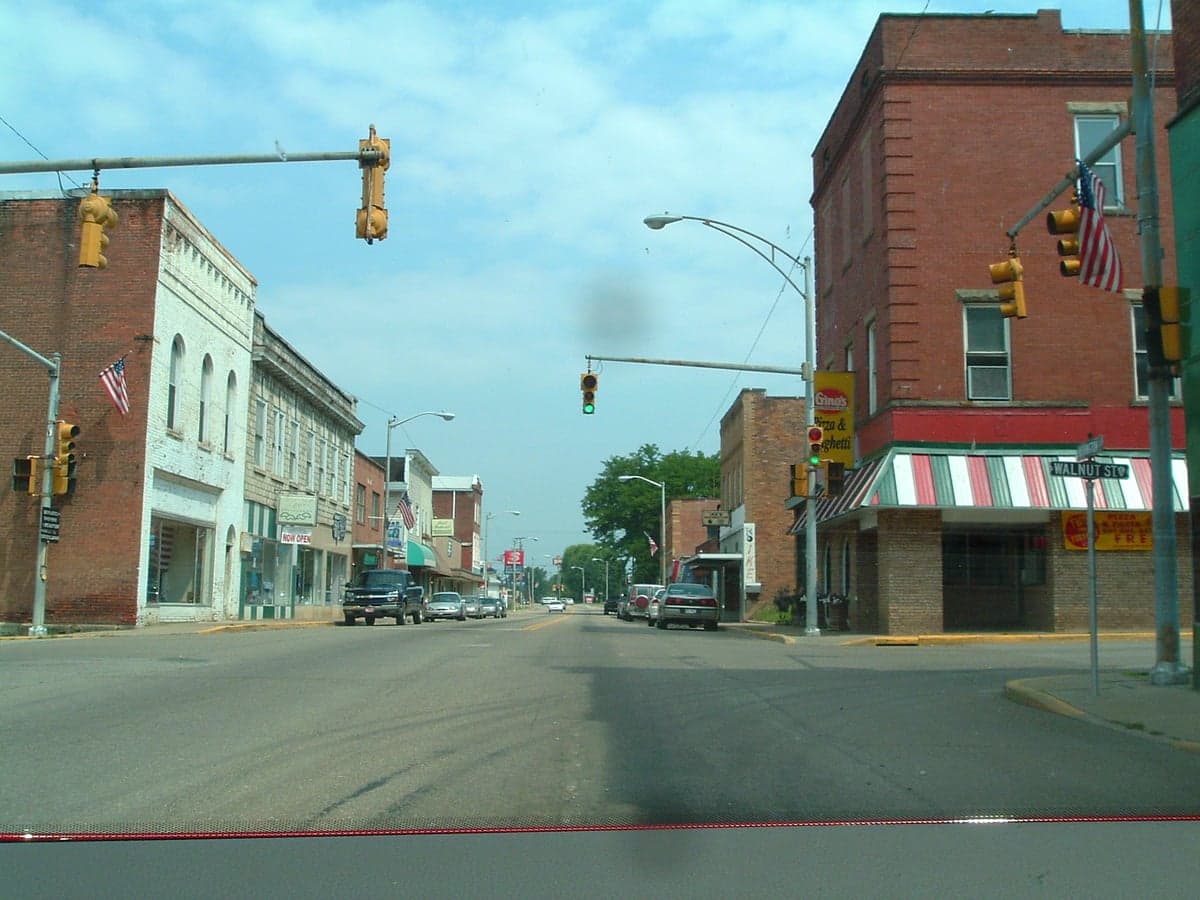
Photo: Wikipedia
Political ClimatePolitical Climate in Ravenswood, WV
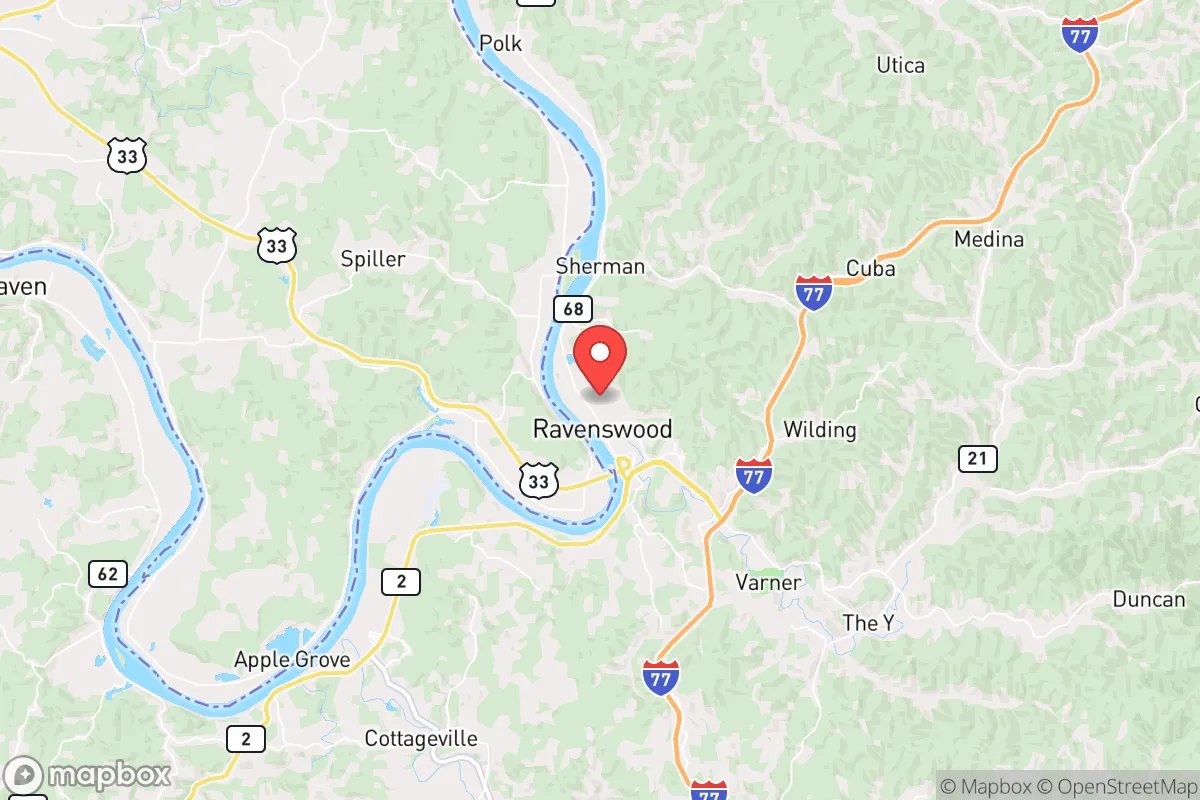
District shown is the primary district for this city’s centroid. Cities may span multiple districts.
Local Political AnalysisPolitical Analysis of Ravenswood, WV
Ravenswood, West Virginia, is about as solidly conservative as small-town America gets, with a Cook PVI of R+22 that puts it deep in the red column. This isn't a recent swing—it's a long-standing cultural and political identity that's held steady for decades, rooted in the area's working-class values, family traditions, and a deep skepticism of government overreach. While some neighboring towns like Parkersburg (about 20 miles north) have seen a slight uptick in progressive activism, especially around the college scene at West Virginia University at Parkersburg, Ravenswood has remained remarkably stable. The local sentiment is clear: folks here want to be left alone to live their lives, run their businesses, and raise their kids without the heavy hand of state or federal bureaucracy telling them how to do it.
How it compares
Compared to other parts of Jackson County, Ravenswood is actually a bit more conservative than the county average, which itself leans heavily Republican. The county seat, Ripley, is about 15 miles east and shares a similar political vibe, but Ravenswood's smaller, more insular community means the conservative voice is louder and more unified. Contrast that with Charleston, about 45 miles southeast, where you see a more mixed political landscape—some progressive pockets near the state capitol and the university. Even Huntington, 50 miles southwest, has a noticeable liberal streak in its downtown and college areas. Ravenswood, though, feels like a different world. The local elections here are rarely competitive for Democrats; the real debates happen within the Republican primary, where the question is how conservative is conservative enough. That R+22 rating isn't just a number—it's a reflection of a community that votes its conscience and its values, and those values are deeply rooted in personal liberty and limited government.
What this means for residents
For someone moving to Ravenswood, the political climate means you can expect a government that stays out of your way. The local city council and county commission are generally pro-business, pro-gun, and pro-traditional family structures. You won't see the kind of progressive policy experiments you might find in larger cities—no talk of defunding police, no heavy-handed zoning regulations, and no push for radical social programs. The downside, if you can call it that, is that the community can be slow to change, and there's a strong resistance to anything that feels like outside interference. For example, when the state pushed for more stringent COVID-19 mandates a few years back, Ravenswood's local leaders were among the most vocal in pushing back, arguing that personal choice and local control should trump state directives. That kind of independence is a double-edged sword: it protects individual freedoms, but it can also mean less investment in public infrastructure or social services that some residents might want. Overall, though, the political climate here is a breath of fresh air for anyone tired of being told how to live their life by distant bureaucrats.
Cultural and policy distinctions
One thing that sets Ravenswood apart is its strong Second Amendment culture. You'll see "Come and Take It" flags flying alongside American flags, and the local gun shows are well-attended. The town also has a notable resistance to any form of carbon tax or environmental regulation that could impact the local energy industry—natural gas and coal are still part of the economic backbone here, even if the industry has shrunk. There's also a quiet but firm opposition to any kind of "woke" curriculum in the local schools; the Jackson County Board of Education has consistently rejected diversity, equity, and inclusion initiatives, and parents are very involved in what their kids are taught. In the long term, Ravenswood is likely to stay conservative, but there's a growing concern among locals about the influx of remote workers from more liberal states. Some worry that these newcomers might bring their politics with them, but so far, the community's culture has proven resilient. If you value personal freedom, local control, and a government that respects your rights, Ravenswood is a place where you can breathe easy—just don't expect it to change for anyone.

State Political ClimatePolitical Climate in West Virginia
State Political AnalysisPolitical Environment in the State
West Virginia is one of the most reliably Republican states in the nation, with a deep-red partisan lean that has only intensified over the past 20 years. The state voted for Donald Trump by nearly 39 points in 2020 and by a similar margin in 2024, making it the most pro-Trump state in the country by vote share. This wasn't always the case—West Virginia was a Democratic stronghold for most of the 20th century, but the cultural and economic shift away from the national Democratic Party began in earnest around 2000, accelerated by the coal wars and the Obama-era "War on Coal." Today, the dominant coalition is a mix of rural conservatives, working-class voters who feel abandoned by coastal elites, and a growing number of out-of-state transplants seeking lower taxes and fewer regulations. The trajectory is clear: West Virginia is getting redder, not bluer, and that trend shows no signs of reversing.
Urban vs. rural divide
The political map of West Virginia is starkly divided between its few small cities and its vast rural expanse. Charleston, the capital and largest city, is the only real blue dot in the state, with Kanawha County voting narrowly Democratic in recent presidential elections thanks to unionized government workers and a small but vocal progressive cohort. Morgantown, home to West Virginia University, leans left as well, driven by faculty, students, and younger professionals—Monongalia County went for Joe Biden in 2020 by about 5 points. Huntington and Wheeling are more purple, with Huntington's Cabell County flipping between parties depending on the cycle. But once you leave these urban islands, the landscape turns deep red. Mingo County, Logan County, and McDowell County in the southern coalfields routinely deliver 75-80% of their votes to Republicans. The rural-urban divide here isn't about suburbs versus cities—it's about small towns and hollows versus a handful of college towns and state government hubs. If you're moving to Berkeley Springs or Lewisburg, you're in solidly conservative territory; if you're looking at Shepherdstown near the Maryland border, expect a more mixed, college-town vibe.
Policy environment
West Virginia's policy environment is aggressively conservative by national standards, though it still lags behind states like Texas or Florida in some areas. The state has no personal income tax on Social Security benefits and has been phasing down its personal income tax rate—it's currently at 3.99% and dropping toward elimination under a 2023 law that triggers further cuts when revenue targets are met. Property taxes are among the lowest in the nation, capped by the state constitution at 1% of assessed value for most residential property. The regulatory posture is business-friendly, with right-to-work laws on the books since 2016 and a tort reform system that has capped non-economic damages in medical malpractice cases. Education policy is a battleground: the state passed a broad school choice law in 2021, creating the Hope Scholarship program that lets parents use state education funding for private school tuition, homeschooling, or other alternatives. That program survived a court challenge in 2024 and is expanding. Healthcare is a mixed bag—West Virginia expanded Medicaid under Obamacare, which many conservatives oppose, but the state also has some of the loosest vaccine mandates in the country. Election laws are solid: voter ID is required, early voting is available but limited to 10 days, and there's no same-day registration. The state also purged roughly 40,000 inactive voters from its rolls in 2023, a move election integrity advocates praised.
Trajectory & freedom
West Virginia is becoming more free in several key areas, particularly on gun rights, parental rights, and taxation. In 2023, the legislature passed constitutional carry, allowing any adult who can legally possess a firearm to carry it openly or concealed without a permit. That same year, the state enacted the "Parental Bill of Rights," which requires schools to notify parents of any medical or mental health services offered to their children and prohibits instruction on sexual orientation or gender identity in K-3 classrooms. On medical autonomy, West Virginia banned nearly all abortions in 2022 after the Dobbs decision, with exceptions only for rape, incest, and medical emergencies—one of the strictest laws in the country. Property rights got a boost with the 2024 passage of a law limiting the use of eminent domain for private economic development projects. On the downside, the state still has a sales tax on groceries (though at a reduced 3% rate), and the personal income tax, while falling, hasn't been eliminated yet. The biggest freedom concern for conservatives is the state's heavy reliance on federal funding—roughly 40% of the state budget comes from Washington, which creates a long-term vulnerability if federal priorities shift. But on the whole, the trajectory is toward less government intrusion in daily life, not more.
Civil unrest & political movements
West Virginia has a history of labor militancy and populist anger, but in recent years, the flashpoints have shifted. The 2018 teachers' strike shut down schools across the state for nine days and was a rare moment of cross-party unity—rural conservatives and union Democrats stood together against a Republican governor and legislature over pay and benefits. That strike was a precursor to similar walkouts in other states, but it didn't translate into lasting progressive power; the same voters who struck for higher wages also voted overwhelmingly for Trump. More recently, the political energy has been on the right. The "Mountain State" chapter of Moms for Liberty is active in several counties, pushing for book bans and curriculum transparency. Anti-vaccine mandate protests drew thousands to the state capitol in 2021 and 2022, and the state legislature responded by passing one of the strongest vaccine exemption laws in the country. There's no significant secession or nullification movement, though some rural counties have floated the idea of joining neighboring states—Mineral County residents have occasionally discussed merging with Maryland's more conservative panhandle. Immigration politics are largely theoretical here, as West Virginia has one of the smallest foreign-born populations in the nation (about 1.5%), but the state passed a law in 2024 requiring all law enforcement to cooperate with federal immigration authorities. Election integrity controversies have been minimal; the state uses paper ballots and has a strong chain-of-custody process, and there were no major disputes in 2020 or 2024.
Projection
Over the next 5-10 years, West Virginia will likely become even more conservative, driven by two forces: out-migration of younger, more liberal residents and in-migration of conservatives from high-tax states like New York, New Jersey, and California. The state's population has been shrinking for decades, but the people leaving tend to be college graduates and younger workers, while the people arriving are often retirees or remote workers seeking lower costs and fewer regulations. The Eastern Panhandle, particularly Jefferson County and Berkeley County, is seeing the fastest growth, and these new residents are overwhelmingly conservative—many are fleeing the D.C. suburbs for a more rural, lower-tax lifestyle. The coal industry will continue to decline, but the state is pivoting to natural gas, timber, and tourism, which don't carry the same union-heavy political baggage. The biggest wildcard is the state's health and drug crisis—opioid addiction has devastated communities and strained public services, and if the state can't turn that around, it could accelerate out-migration. But politically, the trend is clear: West Virginia will remain one of the most reliably red states in the country, with no serious threat of flipping at the presidential or Senate level for the foreseeable future.
For a conservative moving to West Virginia, the bottom line is this: you'll find a state that largely governs the way you'd want, with low taxes, strong gun rights, parental control over education, and a culture that values self-reliance. The trade-offs are real—limited job opportunities outside of healthcare and energy, a struggling healthcare system in rural areas, and a population that's aging and shrinking. But if you're looking for a place where the government stays out of your business and your neighbors share your values, West Virginia delivers. Just know that the "free" part of "free state" comes with fewer amenities and longer drives to everything. Pick your town carefully—Bridgeport and Morgantown offer the best balance of conservative politics and decent infrastructure, while the southern coalfields are cheaper but more isolated. Either way, you'll be in good company.
* Values derived from national, state, county, city and local statistics and may differ in a specific area. Last updated: 2026-05-02T00:54:50.000Z
Narrative content on this page is AI-generated and may contain mistakes. Verify any details that matter before acting on them.
ReloMaps may earn a commission from affiliate links at no extra cost to you.

