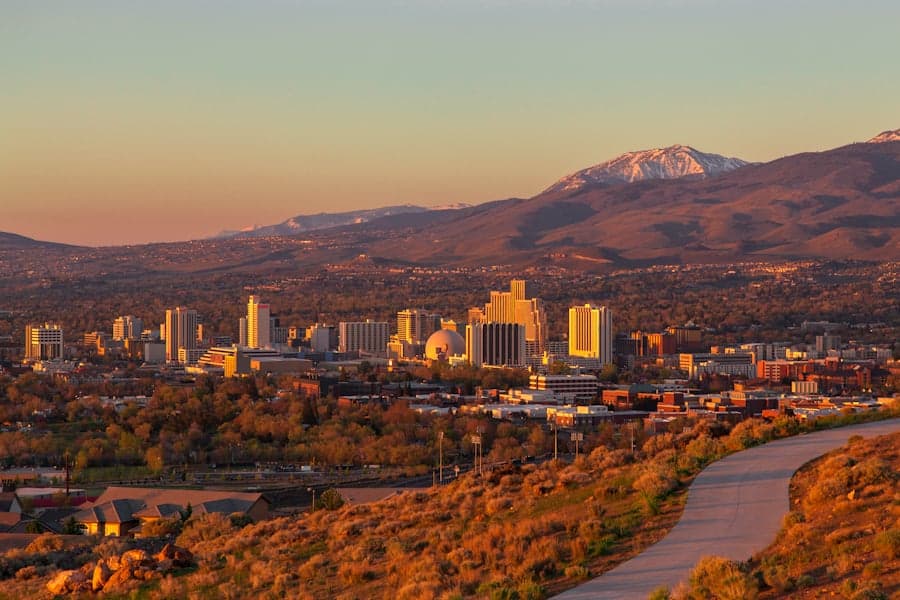
Photo: Wikipedia
Demographics of Reno, NV
Affluence Level in Reno, NV
A middle-class area roughly in line with national averages across income, home values, education, and employment.
People of Reno, NV
The people of Reno, Nevada today number 268,959, forming a moderately dense urban core in a high-desert basin. The city’s character is defined by a 58.3% white, non-Hispanic majority alongside a substantial 24.6% Hispanic population, with smaller but notable East/Southeast Asian (5.1%), Black (3.1%), and Indian-subcontinent (1.7%) communities. A 35.7% college-educated rate and an 8.5% foreign-born share mark Reno as a growing, diversifying western hub that retains a distinctly working-class, libertarian-leaning identity rooted in its gaming and logistics past.
How the city was settled and grew
Reno was founded in 1868 as a railroad town on the Transcontinental Railroad, named after Union General Jesse Reno. The original population was overwhelmingly white, drawn by railroad construction jobs and the promise of land along the Truckee River. The city’s first major growth wave came with the Comstock Lode silver boom in Virginia City (1859–1880s), which made Reno a supply and entertainment hub. The historic Downtown and Wells Avenue districts were built by these early settlers, with Wells Avenue later becoming a gateway for immigrant groups. A second wave arrived in the early 20th century with the legalization of gambling (1931) and easy divorce laws, attracting service workers and entrepreneurs. The Midtown neighborhood, originally a streetcar suburb, housed many of these new arrivals. By 1950, Reno’s population was nearly 90% white, with a small Chinese community concentrated near the railroad yards—a remnant of the original transcontinental workforce.
Modern era (post-1965)
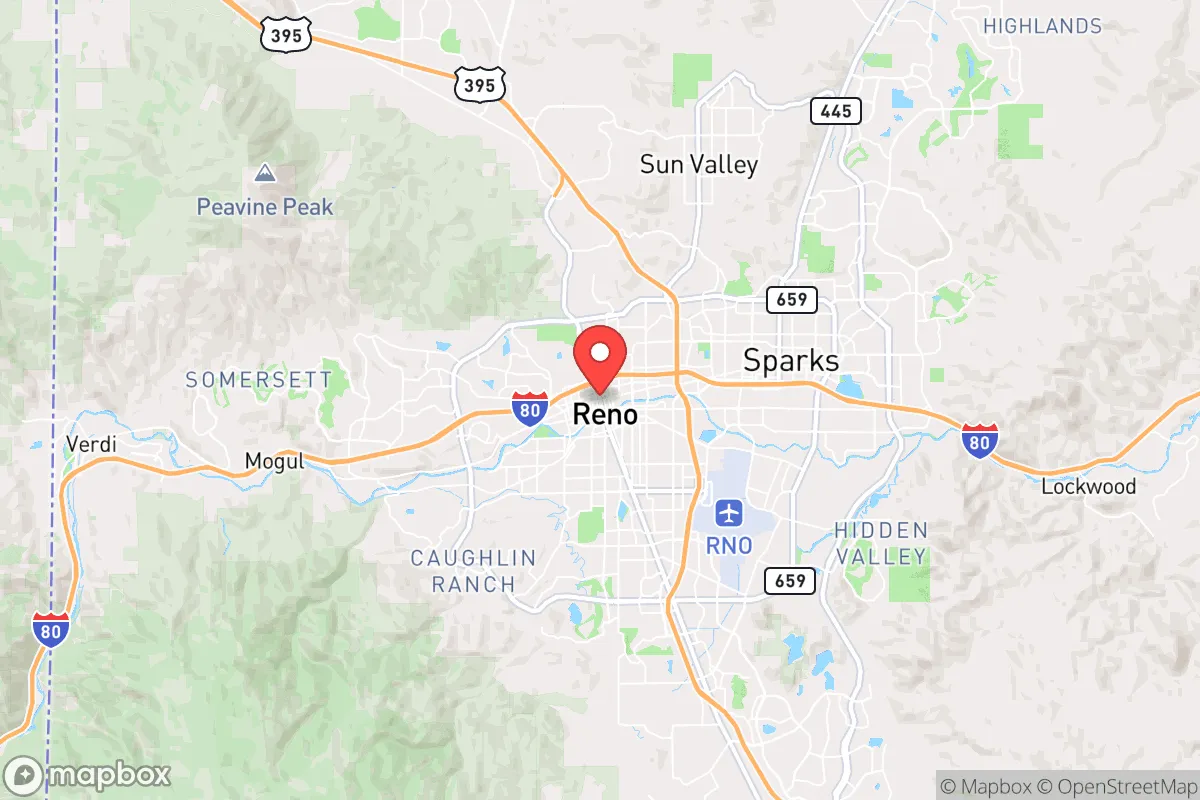
The 1965 Hart-Cellar Act reshaped Reno’s demographics, though the city’s foreign-born share remains modest at 8.5% compared to national averages. The most significant post-1965 shift has been Hispanic in-migration, driven by agricultural work in the surrounding valleys and later by construction and hospitality jobs during the 1990s–2000s boom. Today, Hispanic residents are concentrated in Sun Valley (an unincorporated suburb north of Reno) and the Neil Road corridor, where Mexican and Central American families have established churches, markets, and community centers. The East/Southeast Asian population (5.1%) grew primarily through professional migration tied to the University of Nevada, Reno (UNR) and the tech sector, with many settling in the Caughlin Ranch and Southwest Reno neighborhoods. The Indian-subcontinent community (1.7%) is newer, largely post-2000, drawn by engineering and healthcare jobs; they cluster near UNR and in the Plumb Lane area. The Black population (3.1%) remains small and dispersed, with no single dominant enclave, though the Whitaker Park area has a historic presence. Domestic in-migration from California—particularly the Bay Area—has been the largest driver of population growth since 2010, bringing white and Asian professionals seeking lower taxes and housing costs. This has accelerated suburbanization in South Meadows and Damonte Ranch, where new subdivisions are overwhelmingly white and Asian.
The future
Reno’s population is heading toward greater ethnic diversity, but the trajectory is one of enclave formation rather than full assimilation. The Hispanic share (24.6%) is projected to rise to 30–32% by 2040, driven by higher birth rates and continued migration from California and Latin America. Sun Valley and Neil Road will likely become more solidly Hispanic, while the white population (58.3%) is aging and declining in share. The East/Southeast Asian and Indian communities are growing slowly but steadily, primarily through professional recruitment; they are unlikely to form large ethnic neighborhoods, instead integrating into white-majority suburbs like Caughlin Ranch. The Black population is expected to remain below 5%, as Reno lacks the industrial base or historical pull factors that attract larger Black migration. The foreign-born share (8.5%) may edge toward 12% by 2040, but Reno will remain a predominantly native-born city. The biggest wildcard is continued California out-migration: if housing affordability worsens, Reno could see a surge of white and Asian professionals, accelerating gentrification in Midtown and the downtown core while pushing lower-income Hispanic families further into Sun Valley or neighboring Sparks.
For someone moving to Reno now, the city is becoming a moderately diverse, increasingly stratified western metro. The white professional class is expanding in the southwest suburbs, Hispanic families are consolidating in the north and east, and smaller Asian and Indian communities are carving out niches near the university and tech corridors. The city’s libertarian, low-regulation ethos remains intact, but demographic pressures—especially from California transplants—are slowly shifting its political and cultural center of gravity. New arrivals should expect a place where neighborhood identity matters more than ever, and where the old “Biggest Little City” slogan now describes a patchwork of distinct, growing communities.

* Values derived from national, state, county, city and local statistics and may differ in a specific area. Last updated: 2026-04-15T23:43:43.000Z
Narrative content on this page is AI-generated and may contain mistakes. Verify any details that matter before acting on them.
ReloMaps may earn a commission from affiliate links at no extra cost to you.

