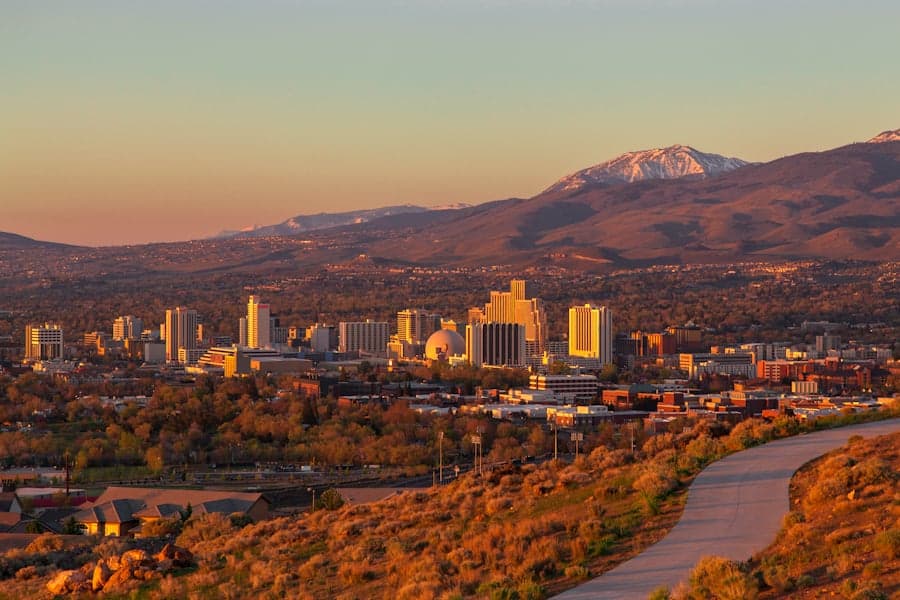
Photo: Wikipedia
Personal Sovereignty in Reno, NV
Viable for self-reliance. Generally workable, though some barriers may limit total independence.
What does Personal Sovereignty tell us?
Personal Sovereignty measures your capacity for self-reliance and independence with minimal government friction. Higher scores mean fewer barriers between you and the way you want to live... but it assumes you have the space you need and good neighbors.
What does this tell us?
Personal Sovereignty measures your capacity for self-reliance and independence with minimal government friction. Higher scores mean fewer barriers between you and the way you want to live... but it assumes you have the space you need and good neighbors.
State Policy
Energy independence: Importer (15% of energy produced in-state)
Personal Liberty
Homesteading

Personal Liberty Analysis
Reno, Nevada offers a notably high degree of personal sovereignty compared to much of the West Coast and even parts of the interior West, largely due to the state's constitutional framework and a political culture that still values individual autonomy over collective mandates. While not a libertarian paradise—Clark County (Las Vegas) exerts significant influence on state policy—Washoe County, home to Reno, maintains a more independent, live-and-let-live ethos that appeals to those seeking to minimize government overreach. The city’s position as a mid-sized urban hub with a surrounding rural hinterland creates a unique balance: you get the economic opportunities of a growing metro area without the suffocating regulatory environment found in places like Portland or Denver. For the survivalist-minded individual or family, Reno represents a pragmatic choice—a place where you can still own your life, your property, and your decisions, provided you’re willing to navigate the occasional tension between state-level mandates and local enforcement.
Tax burden and regulatory posture: How Nevada’s fiscal structure protects your income and property
Nevada’s tax structure is one of the strongest draws for anyone seeking to keep more of what they earn. There is no state income tax, which means every dollar you make stays in your pocket—a critical advantage for self-employed individuals, remote workers, or those building a homestead business. Property taxes are also low by national standards, with an effective rate around 0.55% of assessed value, and Nevada’s tax cap law (AB 489) limits annual increases to 3% for owner-occupied homes, protecting you from the kind of tax-driven displacement seen in California or Colorado. Sales tax in Reno runs about 8.265%, which is moderate, but the absence of an income tax more than compensates. From a regulatory standpoint, Nevada is a right-to-work state with minimal business licensing hurdles—you can start a small farm, a trade business, or a home-based manufacturing operation without drowning in red tape. The state’s minimal corporate and personal property tax burdens further reduce government’s ability to siphon your resources. For the prepper, this fiscal autonomy means more capital for land, supplies, and self-sufficiency investments, rather than funding an ever-expanding state apparatus.
Self-defense and gun law specifics: What the Second Sanctuary status means for your rights
Reno sits in Washoe County, which has declared itself a Second Amendment Sanctuary—a formal resolution that local law enforcement will not enforce unconstitutional federal firearm restrictions. Nevada state law is generally pro-gun: you can carry a concealed firearm with a permit (shall-issue, no discretionary denial), and open carry is legal without a permit. The state does have a background check requirement for private sales (enacted via ballot initiative in 2016), which is a point of contention, but enforcement is lax in rural and suburban areas, and private transfers among family or close associates are effectively unmonitored. No magazine capacity bans, no assault weapon bans, and no waiting periods exist at the state level, though Reno’s city council has occasionally flirted with local restrictions—none have passed. Stand-your-ground laws are in effect, and Nevada’s castle doctrine protects you from civil liability if you use force to defend your home or vehicle. For the survivalist, the practical reality is that you can own, carry, and store firearms with minimal government interference, and the sanctuary resolution provides a political buffer against future federal overreach. The local gun culture is strong, with multiple ranges, training facilities, and a thriving community of like-minded individuals.
Self-reliance and homesteading viability: Lot sizes, zoning, and off-grid feasibility in Washoe County
Reno itself is a compact city, but the surrounding unincorporated areas of Washoe County—places like Spanish Springs, Cold Springs, and the Virginia City Highlands—offer large lots (1 to 40+ acres) with minimal zoning restrictions. County zoning allows for agricultural use, including livestock, on parcels as small as 2.5 acres in many areas, and there are no county-wide bans on rainwater collection or composting toilets. Off-grid living is feasible but requires navigating Nevada’s water rights laws: you need a permitted well or hauled water, and solar panels are unrestricted (net metering is available but increasingly less favorable). No state-level building codes apply to unincorporated areas for owner-built structures, though you must comply with septic and electrical safety standards. The biggest hurdle is the Reno-Sparks area’s strict fire code in wildland-urban interface zones, which mandates defensible space and may limit certain construction materials. For the serious homesteader, the best strategy is to buy land in the county’s rural pockets—where you can raise chickens, goats, or even a few head of cattle—while maintaining a small residence in town for work and supplies. The growing local food movement and presence of the University of Nevada’s Cooperative Extension provide resources for learning self-sufficiency skills.
Personal liberties: Parental rights, medical autonomy, speech, and property protections
Nevada’s legal framework generally respects parental rights, though it is not as robust as some red states. No statewide mask or vaccine mandates for children are currently in effect, and the state’s 2023 law (SB 327) prohibits schools from requiring COVID-19 vaccines for attendance. However, Nevada does have a mandatory vaccination schedule for school entry (MMR, DTaP, polio, etc.), with only medical and religious exemptions—no philosophical exemption. Homeschooling is legal with minimal regulation: you file a notice of intent annually and provide a basic educational plan, but there are no standardized testing requirements or curriculum approvals. Medical autonomy is a mixed bag: Nevada has legalized recreational marijuana (which some conservatives view as a liberty issue, others as a vice), but it also has a broad emergency powers statute that gave the governor significant authority during the pandemic—a concern for those wary of future overreach. Free speech is strongly protected under the Nevada Constitution, and there are no hate speech laws that criminalize political expression. Property rights are solid: no statewide rent control, no forced inclusionary zoning, and eminent domain is rarely abused. For the conservative-leaning individual, the key takeaway is that Reno offers a high degree of personal autonomy in daily life—you can raise your children as you see fit, speak your mind without fear, and use your property largely as you wish—but you must remain vigilant against potential state-level encroachment, particularly from the Las Vegas-dominated legislature.
In the broader landscape of American personal sovereignty, Reno stands as a strong contender for those seeking a balance between urban opportunity and individual freedom. It lacks the extreme libertarian ethos of rural Idaho or Montana, but it also avoids the isolation and limited economic options of those areas. Compared to the West Coast, Reno is a sanctuary of fiscal and personal liberty; compared to the Deep South, it offers more cultural tolerance for diverse lifestyles while maintaining conservative values on self-defense and property. The primary risks are the potential for future state-level overreach (especially on health mandates and water rights) and the creeping influence of California transplants who may bring more statist attitudes. For the survivalist or prepper who wants a base with good infrastructure, a supportive gun culture, and genuine homesteading potential, Reno is a top-tier choice—provided you buy your land in the county, keep your legal affairs in order, and stay engaged in local politics to protect what you’ve built.

* Values derived from national, state, county, city and local statistics and may differ in a specific area. Last updated: 2026-04-15T23:43:43.000Z
Narrative content on this page is AI-generated and may contain mistakes. Verify any details that matter before acting on them.
ReloMaps may earn a commission from affiliate links at no extra cost to you.

