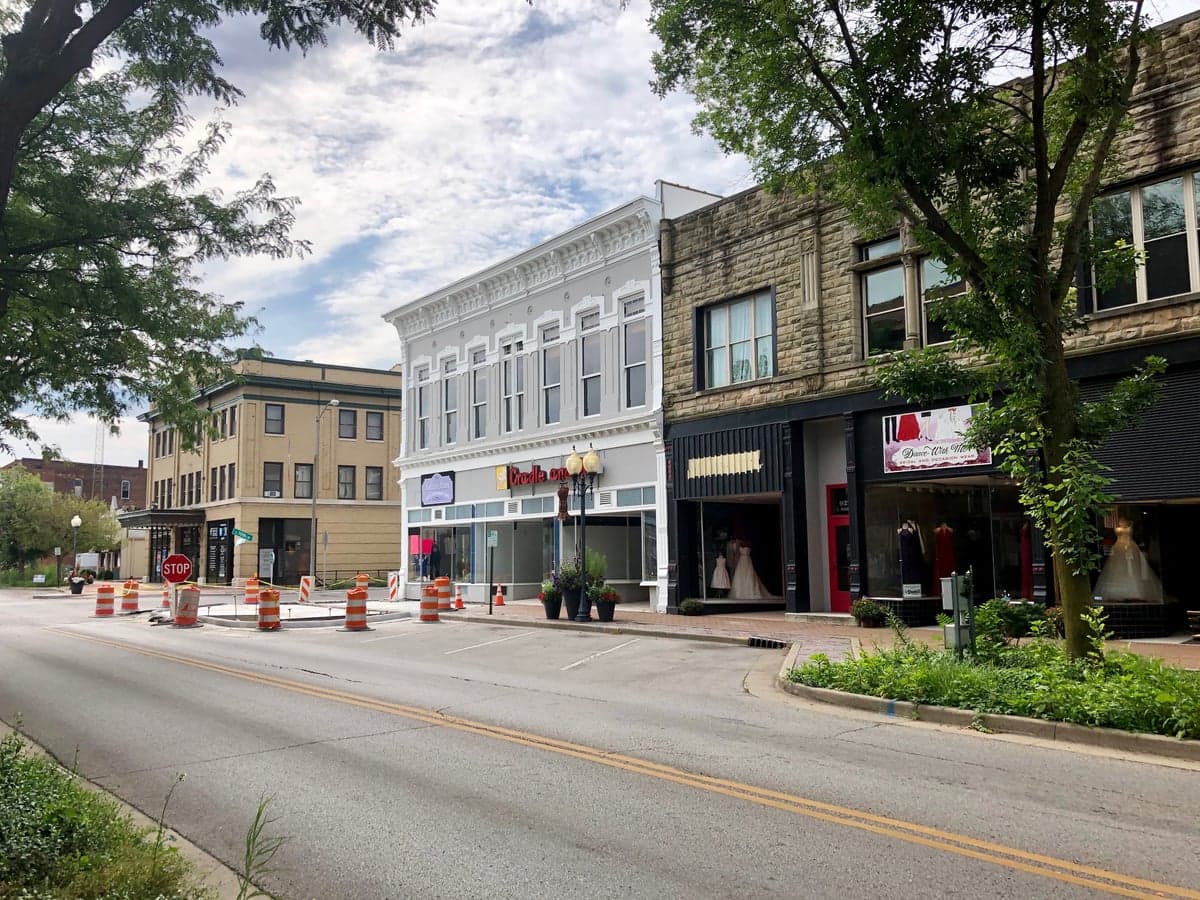
Photo: Wikipedia
Demographics of Richmond, IN
Affluence Level in Richmond, IN
A low-income area with significant economic hardship. Household wealth and educational attainment are well below national averages.
People of Richmond, IN
The people of Richmond, Indiana, today number 35,551, forming a predominantly White (79.3%) and native-born community with a modest but growing Hispanic presence (5.2%) and a stable Black population (6.6%). The city’s character is shaped by its industrial past and small-town Midwestern identity, with a lower-than-average college attainment rate (20.6%) and a foreign-born share of just 3.4% that reflects limited recent immigration. Distinctive markers include a strong manufacturing heritage, a tight-knit network of historic neighborhoods, and a population that is older and more rooted than the national average.
How the city was settled and grew
Richmond was founded in 1806 by Quaker settlers from North Carolina and Pennsylvania, drawn by the fertile land of the Whitewater River Valley and the promise of religious freedom. These early families, largely of English and Scots-Irish descent, established the town as a center for agriculture and milling. The arrival of the National Road in the 1830s and later the railroad transformed Richmond into a manufacturing hub, attracting German and Irish immigrants in the mid-19th century who settled in working-class districts like the Old Town neighborhood and the North Side. By the early 1900s, the city’s industrial base—led by the Richmond Carriage Company, the Starr Piano Company, and later the Wayne Knitting Mills—drew a wave of Appalachian migrants from Kentucky and Tennessee, who concentrated in the South Side and the Glen Miller Park area. These groups built the city’s distinctive brick homes and established the civic institutions—churches, union halls, and social clubs—that defined Richmond through the mid-20th century.
Modern era (post-1965)
After the 1965 Hart-Cellar Act, Richmond saw only a modest increase in foreign-born residents, with the 3.4% share today remaining well below the national average. The most notable post-1965 shift has been domestic: the decline of manufacturing after the 1970s led to population loss (from a peak of roughly 45,000 in 1970 to 35,551 today), and many younger residents left for larger cities. The Hispanic population grew from near zero to 5.2%, with families settling primarily in the West Side and the area around Chester Boulevard, drawn by jobs in warehousing and food processing. The Black population, historically small and concentrated in the South Side near the former industrial corridor, has remained stable at 6.6%. East/Southeast Asian communities (1.5%) are a small but visible presence, with families often connected to the local medical sector and concentrated in the Northwest neighborhoods near Reid Health. The Indian-subcontinent population (0.2%) is negligible, largely tied to professional roles at the university or hospital. Suburbanization within Wayne County has pulled some middle-class residents to outlying areas like the Abington Pike corridor, but Richmond’s core neighborhoods remain predominantly White and working-class.
The future
Richmond’s population is projected to continue a slow decline, with the city’s older age structure and limited job growth in high-skilled sectors reducing in-migration. The Hispanic share is likely to grow gradually, potentially reaching 8-10% by 2040, as families expand and new arrivals fill labor gaps in logistics and manufacturing. The Black and East/Southeast Asian populations are expected to remain stable, with no major new immigrant waves on the horizon. The city is not tribalizing into distinct ethnic enclaves; rather, it is slowly homogenizing as younger, more diverse residents leave for larger metros and the remaining population ages in place. The Old Town neighborhood and the North Side are seeing modest reinvestment from local nonprofits, but overall, Richmond is becoming a quieter, older, and more uniformly White community.
For someone moving in now, Richmond offers a stable, affordable, and historically grounded community where the population is slowly shrinking and aging. The city’s future is one of gradual demographic continuity rather than rapid change, making it a predictable choice for those seeking a low-cost, low-drama Midwestern setting with a strong sense of local identity.

* Values derived from national, state, county, city and local statistics and may differ in a specific area. Last updated: 2026-04-22T10:25:28.000Z
Narrative content on this page is AI-generated and may contain mistakes. Verify any details that matter before acting on them.
ReloMaps may earn a commission from affiliate links at no extra cost to you.

