
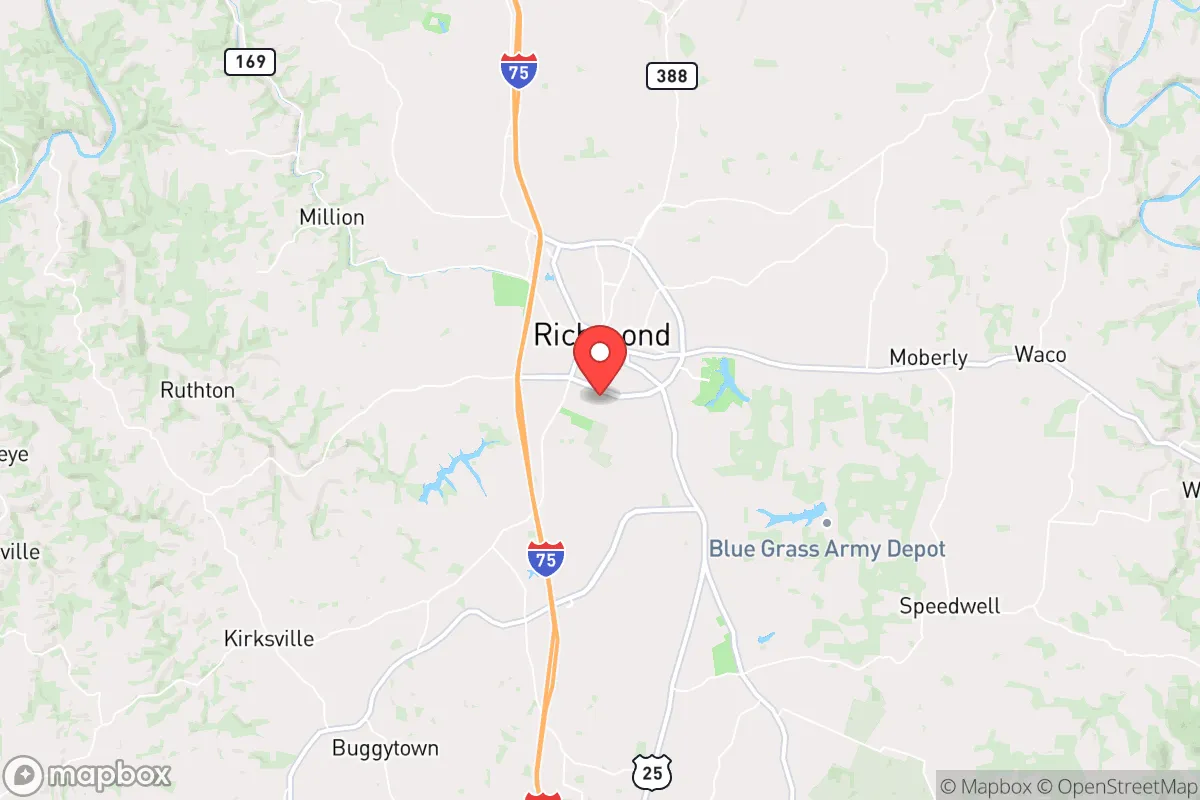
Photo: Wikipedia
Personal Sovereignty in Richmond, KY
Viable for self-reliance. Generally workable, though some barriers may limit total independence.
What does Personal Sovereignty tell us?
Personal Sovereignty measures your capacity for self-reliance and independence with minimal government friction. Higher scores mean fewer barriers between you and the way you want to live... but it assumes you have the space you need and good neighbors.
What does this tell us?
Personal Sovereignty measures your capacity for self-reliance and independence with minimal government friction. Higher scores mean fewer barriers between you and the way you want to live... but it assumes you have the space you need and good neighbors.
State Policy
Energy independence: Importer (60% of energy produced in-state)
Personal Liberty
Homesteading

Personal Liberty Analysis
Richmond, Kentucky offers a notably high degree of personal sovereignty compared to many parts of the country, particularly for those who prioritize minimal government interference in daily life. Nestled in the Bluegrass region, this city of roughly 36,000 operates within a state that has consistently pushed back against federal overreach, maintaining strong protections for gun rights, parental authority, and property freedom. For the survivalist or prepper-minded individual, Richmond represents a strategic balance—close enough to Lexington for resources, yet far enough to avoid the regulatory creep that chokes personal autonomy in larger metro areas.
Tax burden and regulatory posture: How Kentucky compares to high-tax states
Kentucky’s tax structure is a clear advantage for those seeking to keep more of their earnings and reduce dependency on government services. The state imposes a flat individual income tax rate of 4.0% as of 2026, down from 4.5% in 2024, with a scheduled path toward elimination. Property taxes are among the lowest in the nation, with an effective rate around 0.85% of assessed home value—roughly half the national average. Richmond itself does not levy a city income tax, unlike many Kentucky municipalities, meaning residents only pay state and county taxes. Sales tax is a flat 6% on most goods, with groceries and prescription drugs exempt. From a regulatory standpoint, Kentucky is a right-to-work state and has preempted local governments from enacting stricter business or firearm ordinances than state law. This means Richmond cannot, for example, impose its own gun bans or rental inspection regimes that exceed state standards. For the prepper, this regulatory uniformity reduces the risk of sudden local crackdowns on stockpiling, construction, or home-based enterprises.
Self-defense and gun law specifics: Constitutional carry and castle doctrine
Kentucky is one of the strongest Second Amendment states in the union, and Richmond residents benefit directly from that posture. The state enacted constitutional carry in 2019, meaning no permit is required to carry a concealed firearm for anyone legally allowed to possess one. There is no state-level waiting period, no firearm registration, and no magazine capacity restrictions. The castle doctrine is fully codified in Kentucky law (KRS 503.055), establishing a legal presumption that a homeowner who uses deadly force against an intruder acted in reasonable self-defense. This extends to vehicles and occupied structures. Additionally, Kentucky has a Stand Your Ground law (KRS 503.080), removing any duty to retreat before using force in any place where a person has a legal right to be. For the survivalist, this legal framework means Richmond is a jurisdiction where defensive preparation is not only tolerated but legally protected. Local law enforcement in Madison County generally respects these rights, and there are no county-level gun registries or additional permitting schemes. The nearest major city, Lexington, has attempted local gun ordinances in the past, but state preemption has consistently nullified them—a critical protection for Richmond residents who travel or work there.
Self-reliance and homesteading viability: Lot sizes, zoning, and off-grid feasibility
Richmond’s zoning and land-use policies are generally favorable for those pursuing self-reliance, though the degree depends on whether you are inside city limits or in the surrounding Madison County. Within the city, standard residential lots range from 0.25 to 0.5 acres, and zoning allows for vegetable gardens, small livestock like chickens (with permit limits on roosters), and rainwater collection. However, city code restricts larger livestock and imposes some building permit requirements for sheds and workshops. The real opportunity lies just outside city limits in the county’s unincorporated areas, where lot sizes of 1 to 10 acres are common and zoning is minimal. Madison County has no county-wide zoning ordinance for agricultural or rural residential parcels, meaning you can build a pole barn, install solar panels, drill a well, or set up a composting toilet without extensive bureaucratic approval. Off-grid living is legally feasible: Kentucky has no state law prohibiting rainwater harvesting, and solar installations are protected by the state’s net metering policy (though utilities can cap participation). Septic systems require a permit from the Madison County Health Department, but the process is straightforward for standard gravity-fed systems. For the prepper, the key takeaway is that Richmond’s rural fringe offers some of the most permissive homesteading conditions in the eastern U.S., with no county-level bans on food forests, root cellars, or alternative energy.
Personal liberties: Parental rights, medical autonomy, speech, and property
Kentucky has become a battleground for parental rights, and Richmond reflects that trend. The state passed the Parental Bill of Rights (HB 563) in 2022, which requires schools to notify parents of any medical or mental health services provided to their child and prohibits instruction on sexual orientation or gender identity in grades K-5. Madison County Schools have implemented these policies, meaning parents retain significant authority over their children’s education and healthcare decisions. Medical autonomy is mixed: Kentucky has strict abortion laws (a near-total ban with limited exceptions), which aligns with the conservative audience’s values, but also maintains vaccine mandates for school attendance (though religious exemptions are available). Speech protections are robust under the Kentucky Constitution, which explicitly protects “the right to speak, write, or print freely on any subject.” There are no state-level hate speech laws that criminalize political or religious expression. Property rights are strongly protected by Kentucky’s eminent domain laws, which require a public purpose and just compensation, and the state has no statewide rent control or landlord licensing schemes that could infringe on property use. For the survivalist, this means Richmond offers a legal environment where you can speak your mind, raise your children according to your values, and use your land largely as you see fit—without fear of local ordinances targeting political speech or property modifications.
Overall, Richmond, Kentucky provides a level of personal sovereignty that is increasingly rare in the United States. The combination of constitutional carry, low taxes, permissive rural zoning, and strong parental rights creates a legal framework where self-reliance is not just possible but actively protected. Compared to states like California, New York, or Illinois—where gun laws are restrictive, taxes are high, and local governments can override state protections—Richmond offers a refuge for those who view government overreach as the primary threat to liberty. For the strategic relocation-minded individual, this city represents a solid base of operations in a region that still respects the individual’s right to prepare, defend, and live independently.

* Values derived from national, state, county, city and local statistics and may differ in a specific area. Last updated: 2026-04-21T09:14:41.000Z
Narrative content on this page is AI-generated and may contain mistakes. Verify any details that matter before acting on them.
ReloMaps may earn a commission from affiliate links at no extra cost to you.

