

Photo: Wikipedia
Political ClimatePolitical Climate in Richmond, KY
District shown is the primary district for this city’s centroid. Cities may span multiple districts.
Local Political AnalysisPolitical Analysis of Richmond, KY
Richmond, Kentucky, has long been a reliably conservative community, and the numbers back that up with a Cook PVI of R+7. For decades, this was a place where folks pretty much agreed on the basics: limited government, personal responsibility, and a general distrust of anyone in Frankfort or Washington telling us how to live our lives. That's still the dominant feeling, but like a lot of places, you can feel the ground shifting under your feet. The old, quiet consensus is being challenged by a steady influx of people from more progressive areas, particularly those moving down from Lexington or out from the more liberal enclaves of Louisville, and it's creating a real tension beneath the surface.
How it compares
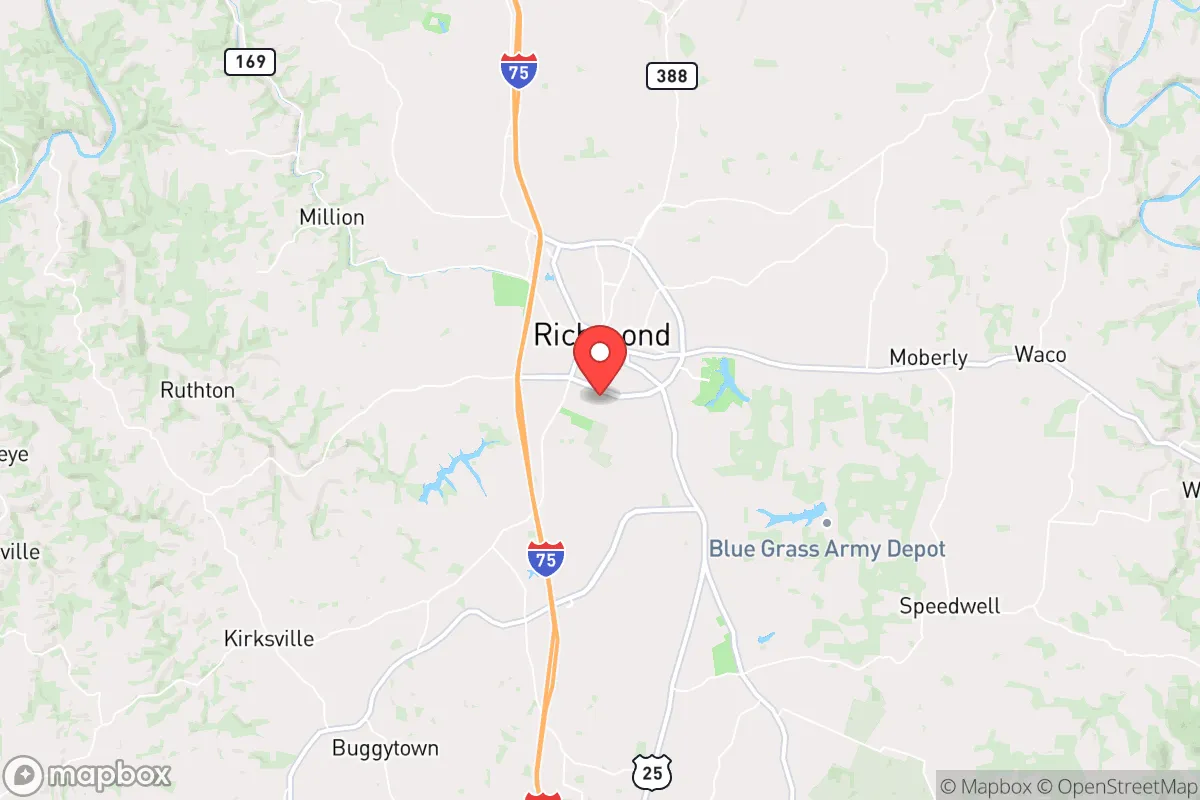
To really get the picture, you have to look at the map. Drive 20 miles north up I-75, and you hit Lexington, which is a whole different world—a blue island in a red sea. Richmond used to be a clear, bright red contrast to that, but now it's more of a contested purple in some precincts, especially around Eastern Kentucky University. Compare us to Berea, just a few miles south, which has its own quirky, artsy, and decidedly more liberal vibe. Or head west to places like Stanford or Liberty—those towns are still rock-ribbed conservative, no question. Richmond is becoming the front line, the place where the old Kentucky values of self-reliance and local control are bumping up against a newer, more collectivist way of thinking. It's not that we've flipped, but the margin for error is getting thinner.
What this means for residents
For a long-time resident, the biggest change isn't in who wins elections—Republicans still carry the county comfortably—but in the conversation. It used to be that local government was about fixing potholes and keeping the sewer running. Now, you see more and more energy going into debates that feel imported from national cable news: critical race theory in the schools, mask mandates, and zoning fights that feel like they're about "equity" rather than property rights. The real concern for folks who value their freedoms is the slow creep of government overreach. It starts with a "well-intentioned" ordinance here, a new county regulation there, and before you know it, you're asking for permission to put up a fence on your own land. The shift towards progressive ideology, even in small doses, is a red flag because it always seems to come with more rules, more oversight, and less trust in the individual to make their own choices.
One of the more telling cultural distinctions is the fight over the local school board. It used to be a sleepy, uncontested affair. Now, it's ground zero for the culture war, with parents pushing back hard against curriculum they see as undermining traditional values and pushing a political agenda. That's where the rubber meets the road. The long-term trajectory depends on whether the new arrivals assimilate into the local culture of live-and-let-live, or whether they succeed in changing the rules to fit their own worldview. For now, Richmond is still a good place to raise a family if you want to be left alone, but you have to stay vigilant. The fight for the soul of this town is real, and it's not over yet.

State Political ClimatePolitical Climate in Kentucky
State Political AnalysisPolitical Environment in the State
Kentucky has long been a reliably Republican state at the federal level, but its political climate is far more nuanced than a simple red-state label suggests. The state has voted for the GOP presidential candidate in every election since 2000, often by double-digit margins—Donald Trump carried it by 26 points in 2020 and by over 30 in 2016. However, the state’s political soul is a tug-of-war between a deeply conservative, rural base and a few urban centers that lean increasingly leftward. Over the last 10-20 years, the dominant trend has been a steady rightward shift in most of the state, driven by cultural and economic anxieties, even as Louisville and Lexington have become more progressive. For a conservative considering relocation, Kentucky offers a solidly red foundation, but the devil is in the details of local governance and emerging political fault lines.
Urban vs. rural divide
The political map of Kentucky is a textbook case of the urban-rural split that defines American politics. The two major metros—Louisville (Jefferson County) and Lexington (Fayette County)—are the state’s blue islands. Louisville, home to about 620,000 people, has voted Democratic in every presidential election since 2008, and its city council is firmly controlled by progressives. Lexington, with its university-driven economy, is similarly left-leaning, though slightly less so. These two counties alone account for roughly 20% of the state’s population, but they are surrounded by a sea of red. The rest of the state is overwhelmingly Republican, with rural counties in eastern Kentucky (like Pike, Floyd, and Letcher) voting GOP by 70-80% margins, a dramatic shift from their Democratic roots just 20 years ago. The Northern Kentucky suburbs of Cincinnati—places like Boone, Kenton, and Campbell counties—are reliably red but more moderate, often serving as a bellwether for statewide races. Meanwhile, the Bowling Green area (Warren County) has become a conservative stronghold, driven by a growing manufacturing base and a strong military presence at Fort Knox nearby. The Paducah region in the west is similarly solid red, though with a stronger libertarian streak on economic issues. The key takeaway: if you want a conservative environment, you’ll find it in most of the state, but you’ll need to avoid the urban cores of Louisville and Lexington.
Policy environment
Kentucky’s state-level policy environment is broadly conservative, but with some notable wrinkles. The state has a flat income tax that is being phased down—currently at 4.5% as of 2025, with a goal of reaching 0% by 2030 under legislation passed in 2022 (HB 8). This is a major win for fiscal conservatives. Property taxes are low, and there is no state tax on Social Security benefits. The regulatory posture is generally business-friendly, with right-to-work laws in place since 2017 (though a 2023 court ruling briefly threw that into question, it was quickly reaffirmed). On education, the state has a robust school choice movement: the Education Opportunity Account Act (SB 48, 2022) created a tax-credit scholarship program for private school tuition, though it’s been tied up in court challenges. The state also passed a parental rights bill (HB 9, 2022) that requires schools to notify parents of any changes in a child’s mental, emotional, or physical health—a clear win for family autonomy. Healthcare is a mixed bag: Kentucky expanded Medicaid under the Affordable Care Act in 2014, a move that many conservatives opposed, but the state has since implemented work requirements (though they’re currently blocked by courts). Election laws are solidly conservative: voter ID is required, and the state has purged inactive voters from rolls. Overall, the policy environment leans heavily toward personal freedom and limited government, with the notable exception of the Medicaid expansion, which remains a point of contention.
Trajectory & freedom
Kentucky is moving in a decidedly more freedom-oriented direction, especially on gun rights and parental authority. In 2019, the state passed constitutional carry (SB 150), allowing permitless carry of concealed firearms—a major expansion of Second Amendment rights. In 2021, the legislature overrode Governor Andy Beshear’s veto to pass a stand-your-ground law (SB 9), removing the duty to retreat before using deadly force. On medical autonomy, the state passed a ban on COVID-19 vaccine mandates for state employees and contractors (HB 5, 2023), and a law prohibiting mask mandates in schools (SB 1, 2023). Property rights have been strengthened by a 2022 law limiting local government’s ability to impose rent control (HB 373). However, there are concerning trends: the state’s medical marijuana program (SB 47, 2023) is heavily regulated and won’t be operational until 2025, and recreational cannabis remains illegal. The biggest red flag for freedom advocates is the state’s emergency powers—Governor Beshear used broad executive authority during COVID-19 to shut down businesses and churches, leading to a 2021 law (SB 1) that now limits a governor’s emergency orders to 30 days without legislative approval. That was a necessary check on executive overreach. Overall, the trajectory is positive for conservatives, but vigilance is needed to ensure the state doesn’t backslide on medical freedom or local control.
Civil unrest & political movements
Kentucky has seen its share of political flashpoints, most notably the Breonna Taylor protests in Louisville in 2020, which resulted in widespread property damage, two deaths, and a lasting sense of unease among residents. The city’s Democratic leadership was criticized for a slow response, and the unrest accelerated white flight to suburban counties like Oldham and Shelby. On the right, the Kentucky Freedom Coalition and local Moms for Liberty chapters have been highly active, particularly in school board races and library board battles over “inappropriate” books. Immigration politics are relatively quiet, as Kentucky has a small foreign-born population (about 4%), but there have been localized tensions in Louisville’s Shelby Park neighborhood over a growing immigrant community. Election integrity became a hot topic after the 2020 election, with the state’s Republican-led legislature passing a law (SB 2, 2021) that tightened absentee ballot rules and limited drop boxes—a move that reassured conservatives but drew criticism from progressives. There is no serious secession or nullification movement in Kentucky, though some rural counties have passed symbolic “Second Amendment sanctuary” resolutions. The most visible political movement is the ongoing battle over school curriculum, with parents in places like Bowling Green and Richmond successfully pushing for more transparency and parental opt-out rights. A new resident would notice that political signs and flags are common in rural areas, but open political conflict is rare outside of Louisville and Lexington.
Projection
Over the next 5-10 years, Kentucky is likely to become more conservative, not less, driven by two key factors: in-migration from blue states and the continued exodus of progressives from rural areas to the cities. The state is seeing a steady influx of new residents from California, Illinois, and Ohio, many of whom are drawn by lower taxes and a more traditional culture. These newcomers tend to be conservative-leaning, especially those settling in the Lake Cumberland region and the Lexington suburbs like Georgetown and Nicholasville. The urban cores of Louisville and Lexington will likely become more progressive, but their political influence will be diluted by population growth in red areas. The state’s flat tax phase-out will continue, making Kentucky even more attractive to businesses and retirees. However, there are risks: the state’s pension crisis (underfunded by over $40 billion) could force future tax hikes, and the opioid epidemic continues to devastate eastern Kentucky, creating a drag on economic growth. The biggest wildcard is the 2027 gubernatorial election—if a Republican wins the governor’s mansion (currently held by Democrat Andy Beshear), expect a wave of conservative legislation on school choice, medical freedom, and further tax cuts. If Beshear wins again, expect more veto battles and executive overreach. For a new resident, the next decade looks promising for conservative values, but the pension liability and urban crime trends in Louisville are worth watching closely.
For a conservative individual or family considering a move to Kentucky, the bottom line is this: you’ll find a state that broadly respects your freedoms, from gun rights to parental control over education, and a tax system that’s trending in the right direction. Avoid the urban cores of Louisville and Lexington if you want to live in a truly conservative environment, and instead look at the suburbs of Bowling Green, Richmond, or the Northern Kentucky counties. Be aware that the state’s pension debt and the lingering effects of the opioid crisis are real concerns, but the cultural and economic trajectory is positive. You’ll have to stay engaged locally—especially in school board and county commission races—to ensure the state doesn’t drift toward the progressive policies that plague neighboring states. Kentucky is a solid choice for those seeking a red state with a strong sense of community and a government that, for now, mostly stays out of your way.
* Values derived from national, state, county, city and local statistics and may differ in a specific area. Last updated: 2026-04-21T09:14:41.000Z
Narrative content on this page is AI-generated and may contain mistakes. Verify any details that matter before acting on them.
ReloMaps may earn a commission from affiliate links at no extra cost to you.

