Photo: Wikipedia
Demographics of Richmond, KY
Affluence Level in Richmond, KY
A below-average socioeconomic profile. Incomes, home values, and educational attainment trail the U.S., with higher poverty and unemployment.
People of Richmond, KY
The people of Richmond, Kentucky, today number roughly 35,500, forming a predominantly white (83.9%) and college-educated (34.3%) community centered on Eastern Kentucky University and regional healthcare employment. The city’s identity is shaped by a blend of long-standing Appalachian-rooted families, a significant student population, and a small but growing Hispanic (4.3%) and Black (5.1%) presence. With a foreign-born rate of just 2.7%, Richmond remains less diverse than the national average, but its character is shifting as suburban-style development draws new residents from Lexington and beyond.
How the city was settled and grew
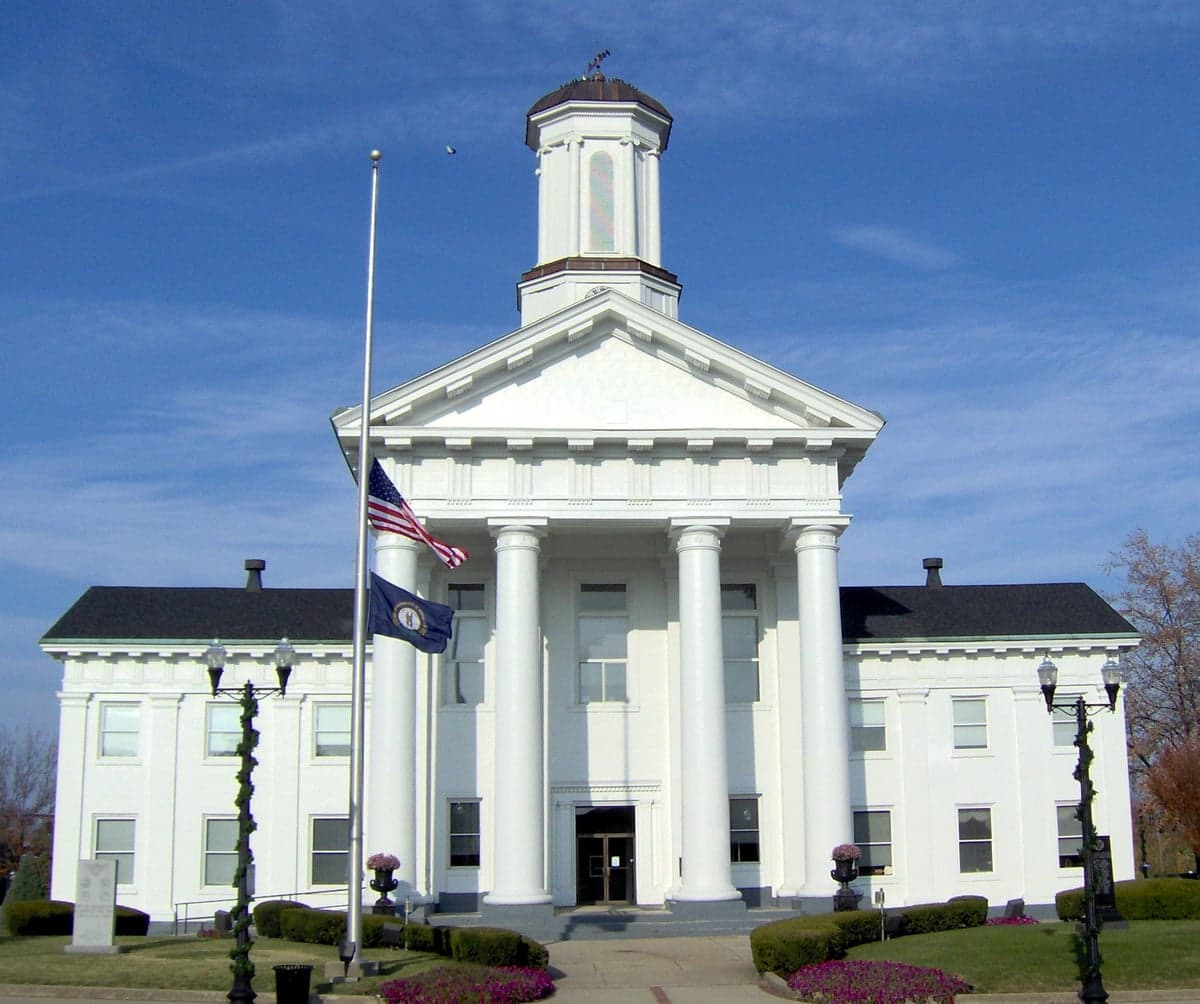
Richmond was founded in 1798 on land granted to Colonel John Miller for service in the Revolutionary War, with the first wave of settlers being Scots-Irish and English farmers moving through the Cumberland Gap. These early families established the Downtown Historic District around the Madison County Courthouse, building brick Federal-style homes and churches that still anchor the city core. The arrival of the Louisville & Nashville Railroad in the 1860s spurred a second wave, bringing German and Irish laborers who settled in the Lancaster Avenue corridor and the Old Irvinton neighborhood, where modest shotgun houses and worker cottages remain. By 1900, Richmond’s population had reached roughly 5,000, with a small Black community concentrated in the Berea Street area near the railroad tracks, a pattern common across Kentucky’s post-Reconstruction towns. Eastern Kentucky State Normal School (now EKU) opened in 1906, drawing faculty and students from across the state and creating the University Hill neighborhood of early 20th-century bungalows and boarding houses.
Modern era (post-1965)
The post-1965 period brought gradual demographic change. The 1965 Hart-Cellar Act had limited local impact—Richmond’s foreign-born population remains low—but domestic in-migration accelerated after Interstate 75 reached the city in the 1970s. Suburbanization pushed development south and east, creating the Lake Reba area with its 1980s-era subdivisions and big-box retail, and the Barnes Mill corridor, where newer single-family homes attracted Lexington commuters and EKU faculty. The Black population, which had been 6.8% in 1970, declined slightly to 5.1% by 2020, as younger Black families moved to larger metros. The Hispanic share grew from under 1% in 1990 to 4.3% today, driven by construction and agricultural work; these families have concentrated in the East Main Street area and in mobile home parks along the US-25 corridor. East/Southeast Asian residents (1.1%) are mostly EKU-affiliated professionals living near campus, while the Indian-subcontinent population (0.1%) remains negligible. The Shannon Run neighborhood, built in the 2000s, exemplifies the newer pattern: large single-family homes occupied by white professionals and empty-nesters, with few minority households.
The future
Richmond’s population is projected to grow modestly, reaching roughly 40,000 by 2040, driven by Lexington’s outward expansion and EKU’s stable enrollment. The city is not homogenizing into a single identity but rather tribalizing into distinct enclaves: the historic downtown and University Hill retain a walkable, older-stock character; Lake Reba and Barnes Mill are solidly middle-class white suburbs; and East Main Street is becoming a Hispanic commercial and residential node. The Black population is likely to remain flat or decline slightly, as younger Black adults continue to leave for Louisville or Nashville. The Hispanic share could reach 7-8% by 2040, driven by family reunification and service-sector jobs, but the foreign-born rate will stay well below the national average. The Indian and East/Southeast Asian populations will remain small and tied to EKU, with no signs of a broader ethnic enclave forming.
For someone moving to Richmond now, the city offers a stable, family-oriented environment with a conservative-leaning culture, good schools, and low crime relative to larger metros. The population is becoming slightly more diverse but remains overwhelmingly white and native-born, with clear geographic divisions by income and ethnicity. New arrivals will find a community that values tradition and local institutions, but one that is slowly adapting to the demographic currents reshaping the broader Bluegrass region.

* Values derived from national, state, county, city and local statistics and may differ in a specific area. Last updated: 2026-04-21T09:14:41.000Z
Narrative content on this page is AI-generated and may contain mistakes. Verify any details that matter before acting on them.
ReloMaps may earn a commission from affiliate links at no extra cost to you.

