
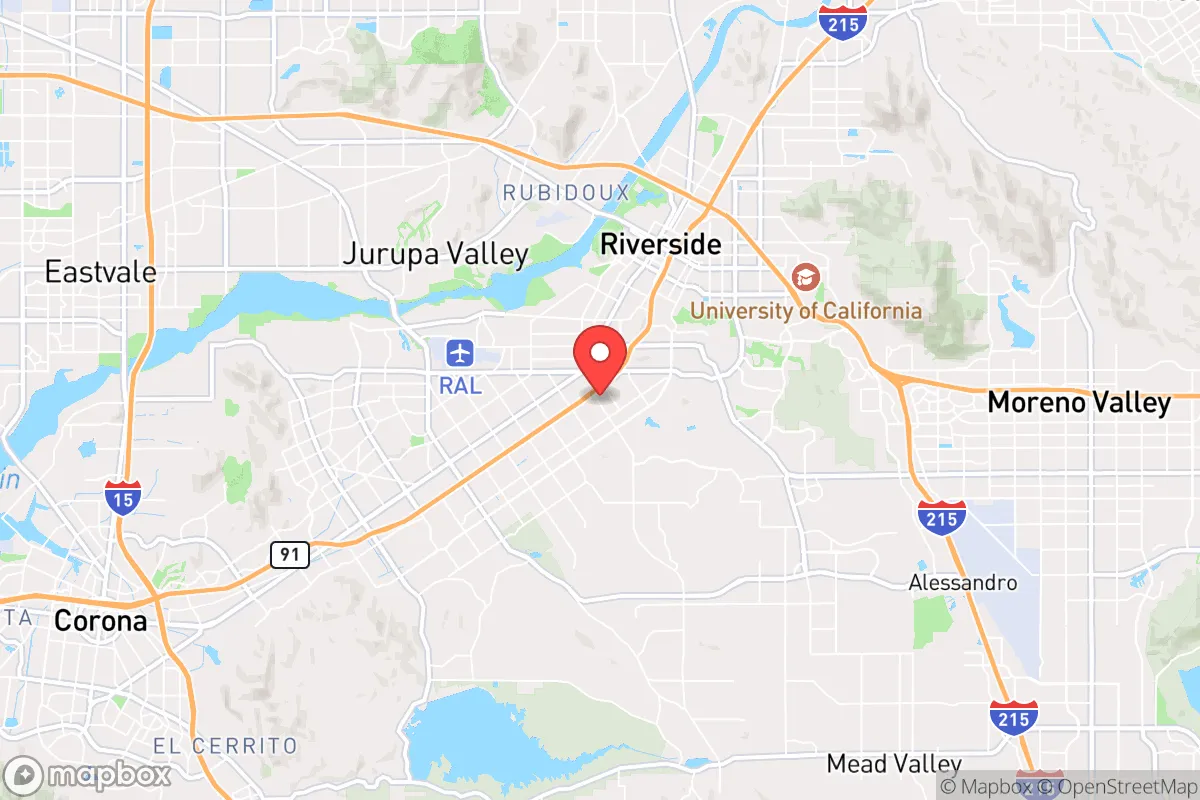
Photo: Wikipedia
Personal Sovereignty in Riverside, CA
Moderate friction. Expect trade-offs in some aspect of personal liberty and independence.
What does Personal Sovereignty tell us?
Personal Sovereignty measures your capacity for self-reliance and independence with minimal government friction. Higher scores mean fewer barriers between you and the way you want to live... but it assumes you have the space you need and good neighbors.
What does this tell us?
Personal Sovereignty measures your capacity for self-reliance and independence with minimal government friction. Higher scores mean fewer barriers between you and the way you want to live... but it assumes you have the space you need and good neighbors.
State Policy
Energy independence: Importer (33% of energy produced in-state)
Personal Liberty
Homesteading

Personal Liberty Analysis
For the individualist or prepper evaluating Riverside, California, personal sovereignty is a mixed bag defined by a constant tension between the state's heavy regulatory hand and the city's own geographic and cultural pockets of self-reliance. While California as a whole ranks near the bottom nationally for personal freedom indices—due to high taxes, strict gun laws, and expansive government mandates—Riverside offers some breathing room that other coastal metros do not. The city's inland location, lower population density relative to Los Angeles, and a growing community of like-minded homesteaders and survivalists create niches where autonomy can be exercised, but only within a framework that demands constant vigilance against state overreach.
Tax burden and regulatory posture: what it costs to live free in Riverside
California's tax regime is the first and most persistent assault on personal sovereignty in Riverside. The state's top marginal income tax rate of 13.3% applies to earnings over roughly $1 million, but even middle-income earners face a combined state and local burden that ranks among the highest in the nation. Property taxes, capped at 1% of assessed value under Proposition 13, are a relative bright spot—but only if you buy and hold long-term. New buyers face assessments based on purchase price, which in Riverside's current market (median home price around $580,000 as of early 2026) means a yearly property tax bill of roughly $5,800 before any local bond measures or Mello-Roos districts are added. Sales tax in Riverside County is 8.75%, and the state's gas tax—among the highest in the country—hits anyone who needs to move supplies or bug out. Regulatory posture is equally aggressive: California's California Environmental Quality Act (CEQA) can be weaponized to delay or kill any construction project, including personal off-grid improvements like rainwater catchment systems or solar arrays that exceed certain thresholds. The state's building codes are among the most restrictive in the nation, meaning any attempt to build a self-sufficient structure on your property will require permits, inspections, and likely a fight with local planning boards. For the prepper, this means every square foot of autonomy comes with a tax or a permit attached.
Self-defense and gun law specifics: what you can and cannot keep in Riverside
California's gun laws are a direct limitation on the right to keep and bear arms, and Riverside residents must navigate a dense thicket of restrictions. The state's Roster of Handguns Certified for Sale limits which new handguns can be purchased, effectively banning many modern models. Magazine capacity is capped at 10 rounds, and any magazine manufactured after 2000 that holds more than that is illegal to possess—even if you owned it before the ban. The state's "assault weapon" laws are among the most restrictive in the country, banning rifles by name and feature, including the AR-15 platform in most configurations. A 10-day waiting period applies to all firearm purchases, and a Firearm Safety Certificate is required. Carry permits (CCW) in Riverside County have become more accessible since the Supreme Court's Bruen decision in 2022, but the process still requires a training course, a background check, and a showing of "good cause" that is interpreted more liberally than in coastal counties. Open carry is illegal in California, and carrying a loaded firearm in a vehicle is generally prohibited without a CCW. For the survivalist, this means your home defense options are limited to what the state allows, and any plan that involves a rifle for perimeter security or a high-capacity sidearm for bug-out scenarios is legally risky. Ammunition purchases are also tracked through a state database, and background checks are required for every box of rounds. The net effect is a legal environment that treats gun ownership as a heavily regulated privilege, not a right.
Self-reliance and homesteading viability: lot sizes, zoning, and off-grid feasibility
Riverside's zoning and land-use policies create a split reality for the would-be homesteader. Within the city limits, most residential lots are standard suburban parcels of 6,000 to 10,000 square feet, which is enough for a substantial garden, a few fruit trees, and a chicken coop—but not for larger livestock or significant off-grid infrastructure. The city's municipal code restricts the keeping of goats, pigs, and other farm animals in most residential zones, and any structure over 120 square feet requires a building permit. Rainwater harvesting is legal but regulated: the state allows it, but you must comply with local health department rules if the water is used for anything beyond irrigation. Solar panels are widely permitted, but net metering policies have been scaled back, reducing the financial incentive for going fully off-grid. The real opportunity for self-reliance lies in the unincorporated areas of Riverside County, just outside the city limits. There, parcels of 1 to 5 acres are still available in places like the Badlands or near Lake Mathews, where zoning is more permissive and the county's building department is less aggressive. However, even in these areas, California's fire codes require defensible space and access roads that can add significant cost. Off-grid living—meaning no connection to the electrical grid or municipal water—is technically possible but practically difficult. The state's building code requires a permanent foundation and connection to an approved wastewater system (septic or sewer) for any habitable structure, and the California Energy Commission mandates that new homes meet strict energy efficiency standards that can be hard to achieve without grid power. For the serious prepper, Riverside offers a foothold for self-reliance, but it requires buying outside the city limits and fighting through layers of regulation.
Personal liberties: parental rights, medical autonomy, speech, and property
California's progressive governance directly impacts several areas of personal liberty that matter to conservative-leaning individuals. Parental rights have been a flashpoint: the state's Education Code prohibits schools from notifying parents when a child requests to change their gender identity or pronouns at school, a policy that has led to lawsuits and ongoing legislative battles. Riverside Unified School District, like all California districts, follows this state mandate, meaning parents cannot assume they will be informed about their child's activities at school. Medical autonomy is similarly constrained: California has some of the strictest vaccine mandates in the country, including requirements for school attendance that leave little room for religious or philosophical exemptions. The state's public health orders during the COVID-19 pandemic were among the longest-lasting and most restrictive, and the legal framework that enabled them remains in place. Free speech is protected under the First Amendment, but California's "hate speech" laws and workplace harassment statutes can create liability for speech that is protected in other states. Property rights are perhaps the most compromised: California's rent control laws (the Costa-Hawkins Rental Housing Act was partially repealed by the Tenant Protection Act of 2019) limit what landlords can charge, and the state's "builder's remedy" and housing element laws can force cities to approve high-density developments that override local zoning. For the property owner, this means your land use is subject to state-level override, and your ability to control who lives on your property is limited by tenant-friendly eviction laws. The cumulative effect is a state that treats individual autonomy as subordinate to collective policy goals, with Riverside offering only marginal relief from the broader California framework.
In the final analysis, Riverside's personal sovereignty is a compromise: you get a lower cost of living and more space than coastal California, but you are still operating within a state that actively limits gun rights, taxes income heavily, regulates land use intrusively, and prioritizes state authority over parental and medical autonomy. For the survivalist or prepper, Riverside is a viable base only if you are willing to work within the system—buying property in unincorporated areas, navigating the permit process, and accepting that your off-grid dreams will be constrained by state law. Compared to states like Texas, Arizona, or Idaho, where property taxes are lower, gun laws are more permissive, and zoning is less restrictive, Riverside offers a fraction of the sovereignty. It is a place to hunker down and build a life, but not a place to truly live free from government overreach. If your priority is maximum personal autonomy, look elsewhere. If you are tied to California for family or work, Riverside is one of the better inland options—but it is still California.

* Values derived from national, state, county, city and local statistics and may differ in a specific area. Last updated: 2026-04-29T21:30:54.000Z
Narrative content on this page is AI-generated and may contain mistakes. Verify any details that matter before acting on them.
ReloMaps may earn a commission from affiliate links at no extra cost to you.

