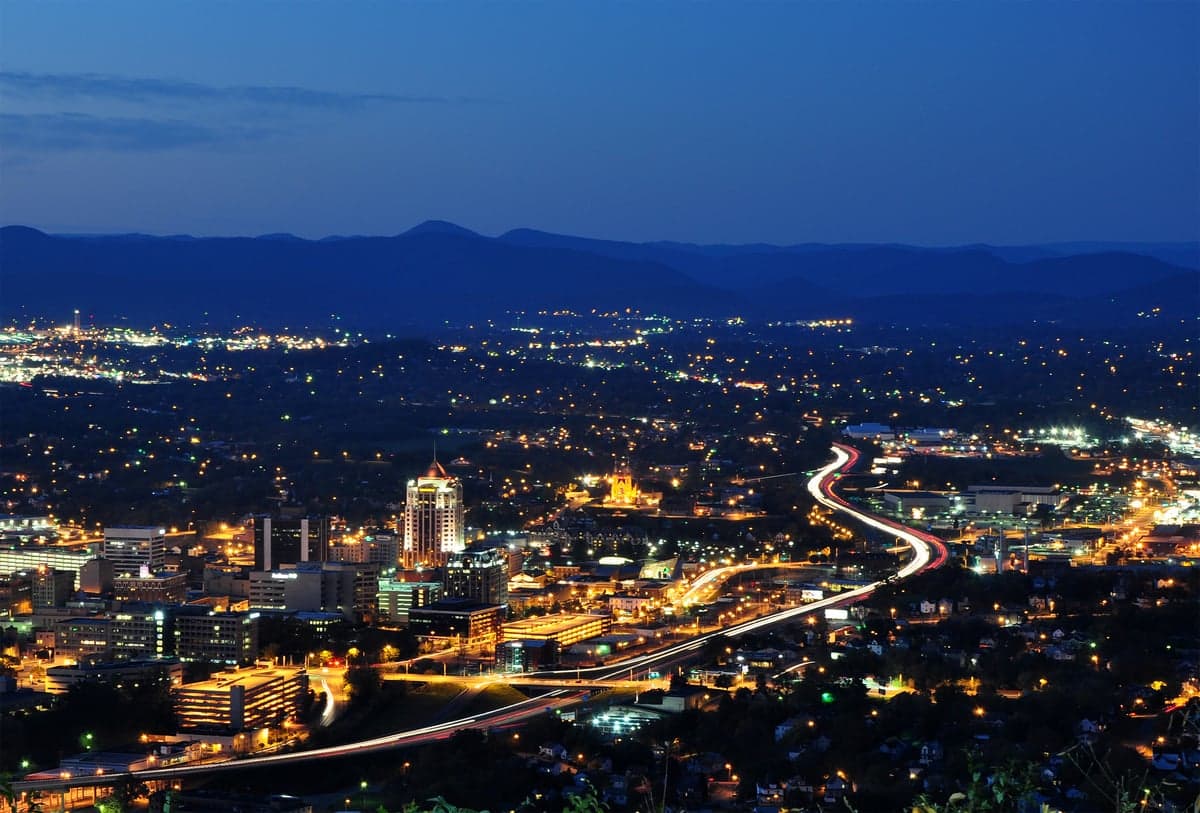
Photo: Wikipedia
Personal Sovereignty in Roanoke, VA
Viable for self-reliance. Generally workable, though some barriers may limit total independence.
What does Personal Sovereignty tell us?
Personal Sovereignty measures your capacity for self-reliance and independence with minimal government friction. Higher scores mean fewer barriers between you and the way you want to live... but it assumes you have the space you need and good neighbors.
What does this tell us?
Personal Sovereignty measures your capacity for self-reliance and independence with minimal government friction. Higher scores mean fewer barriers between you and the way you want to live... but it assumes you have the space you need and good neighbors.
State Policy
Energy independence: Importer (20% of energy produced in-state)
Personal Liberty
Homesteading

Personal Liberty Analysis
Roanoke, Virginia, offers a notably strong environment for personal sovereignty compared to many mid-sized cities in the Mid-Atlantic, largely due to Virginia's status as a Dillon's Rule state with a mixed record on individual liberties. While the city itself leans left politically, the surrounding Roanoke Valley and the broader state framework provide a buffer against the most aggressive forms of government overreach. For a single individual or parent operating from a survivalist or prepper mindset, Roanoke presents a strategic compromise: you get access to urban infrastructure and employment without the suffocating regulatory climate of Northern Virginia or the Commonwealth's more progressive enclaves. The key is understanding where the city's ordinances end and where state-level protections—and the region's cultural ethos of self-reliance—begin.
Tax burden and regulatory posture in Roanoke
Virginia's tax structure is generally moderate, but Roanoke's local add-ons require careful attention. The state income tax is a flat 5.75%, which is neither the lowest nor the highest nationally, but it's predictable. Property taxes in Roanoke City are around $1.20 per $100 of assessed value, which is reasonable for an urban area, though the city's assessment practices have been known to creep upward. The real burden for a sovereignty-minded individual is the personal property tax on vehicles—Virginia is one of the few states that taxes cars annually, and Roanoke City's rate is roughly $4.50 per $100 of assessed value. This is a hidden cost that eats into disposable income and feels like a direct tax on mobility. On the regulatory front, Roanoke is less aggressive than Northern Virginia but still imposes typical city-level codes: business licenses are required for home-based operations, and zoning can be restrictive. The city's stormwater utility fee and other environmental surcharges add a layer of bureaucratic friction. For a prepper, the key takeaway is that the tax burden is manageable but not negligible—you'll want to budget for the vehicle tax and keep an eye on property reassessments. The regulatory posture is best described as "annoying but not oppressive," especially if you live just outside city limits in Roanoke County, where taxes are lower and enforcement is looser.
Self-defense and gun law specifics in Virginia
Virginia's gun laws have shifted leftward in recent years, but Roanoke remains a relatively firearm-friendly environment compared to the state's northern suburbs. The Commonwealth requires a background check for all firearm sales, including private transfers, and has a one-handgun-per-month limit. However, Roanoke City and the surrounding counties are constitutional carry jurisdictions in practice—while Virginia technically requires a permit for concealed carry, the permitting process is shall-issue and relatively straightforward. The real concern for a prepper is the state's red flag law, which allows for temporary firearm seizure based on a court order. This law is enforced in Roanoke, though not as aggressively as in more liberal areas. Stand-your-ground laws do not exist in Virginia; there is a duty to retreat in public spaces before using deadly force, though the castle doctrine applies inside your home. For a parent, this means you need to be aware of the legal nuances: defending your family on your property is generally protected, but a confrontation on the street carries more legal risk. The local gun culture is strong—there are multiple ranges and gun shops in the valley, and the Roanoke Valley Gun Show is a regular event. If self-defense is a priority, Roanoke offers a workable legal environment, but you must stay informed on state-level changes and consider training that emphasizes de-escalation and legal boundaries.
Self-reliance and homesteading viability in the Roanoke Valley
Roanoke's geography is a major asset for self-reliance. The city sits in a valley surrounded by the Blue Ridge Mountains, meaning you can be in rural farmland within 15 minutes of downtown. Lot sizes in the city proper are typically small—quarter-acre or less—but Roanoke County and nearby Botetourt County offer acreage parcels starting at 1-5 acres for reasonable prices. Zoning in the county is generally permissive for small-scale agriculture: chickens, goats, and even a single cow are allowed on parcels of sufficient size, though you'll need to check specific subdivision covenants. Off-grid feasibility is mixed. The region gets about 40 inches of rain annually, so rainwater collection is viable, but Virginia law restricts it for potable use without treatment. Solar is a strong option—the valley gets decent sun, and net metering is available, though the utility company (Appalachian Power) has been known to complicate interconnection. The real challenge is septic and well regulations: if you buy land outside city limits, you'll need to navigate the Virginia Department of Health's permitting process, which can be costly and time-consuming. For a prepper, the ideal setup is a property in Botetourt or Franklin County with existing well and septic, on at least 5 acres, with southern exposure for solar. The growing season is about 180 days, suitable for most vegetables, and deer hunting is excellent in the national forest land that surrounds the valley.
Personal liberties: parental rights, medical autonomy, and property
Virginia's legal framework for personal liberties is a mixed bag that requires vigilance. Parental rights are generally respected in the Roanoke Valley, with school boards that have resisted some of the more controversial curriculum mandates seen in Northern Virginia. The state's compulsory attendance law is strict, but homeschooling is legal and relatively straightforward—you need to file a notice of intent and provide evidence of progress, but there is no state-level curriculum mandate. Medical autonomy is a growing concern. Virginia has a vaccine mandate for school attendance (with religious and medical exemptions), and the state's emergency powers during the pandemic were used to impose restrictions that many conservatives viewed as overreach. The Roanoke City Health Department is generally less aggressive than its northern counterparts, but the legal framework remains in place for future use. Property rights are protected by Virginia's right-to-farm law, which shields agricultural operations from nuisance lawsuits, but the state also has a conservation easement program that can permanently restrict land use—something to watch out for when buying property. Speech is protected under the First Amendment, but Roanoke's city council has shown a willingness to regulate public gatherings and demonstrations, particularly around the municipal building. For a parent or individual, the key is to understand that Virginia's laws are not as hostile to personal sovereignty as states like California or New York, but they are not as protective as states like Texas or Idaho. You have room to operate, but you must stay engaged with local politics and be prepared to push back against encroachments.
Overall, Roanoke offers a solid B-tier ranking for personal sovereignty among mid-sized American cities. It lacks the outright protections of a true red state, but it also avoids the worst excesses of deep-blue jurisdictions. The tax burden is moderate but includes the annoying vehicle tax. Gun laws are workable but require a permit and awareness of red flag statutes. Homesteading is viable if you choose the right county and navigate the regulatory hurdles. Personal liberties are generally respected, but the legal framework leaves room for future government overreach. For a survivalist or prepper, Roanoke is a strategic location: close to resources, surrounded by natural barriers, and with a population that still values self-reliance. The key is to live just outside city limits, stay informed on state legislation, and build a network of like-minded individuals in the valley. It's not a libertarian paradise, but it's a place where a determined individual can carve out a life of genuine autonomy.

* Values derived from national, state, county, city and local statistics and may differ in a specific area. Last updated: 2026-05-02T05:03:55.000Z
Narrative content on this page is AI-generated and may contain mistakes. Verify any details that matter before acting on them.
ReloMaps may earn a commission from affiliate links at no extra cost to you.

